


















Lesson 4 of 45 · Getting Started
The Four Converter Families
Sort every power converter into four families: rectifier, DC-DC converter, inverter and AC-AC converter, with examples, waveforms and a runnable harmonic demo.
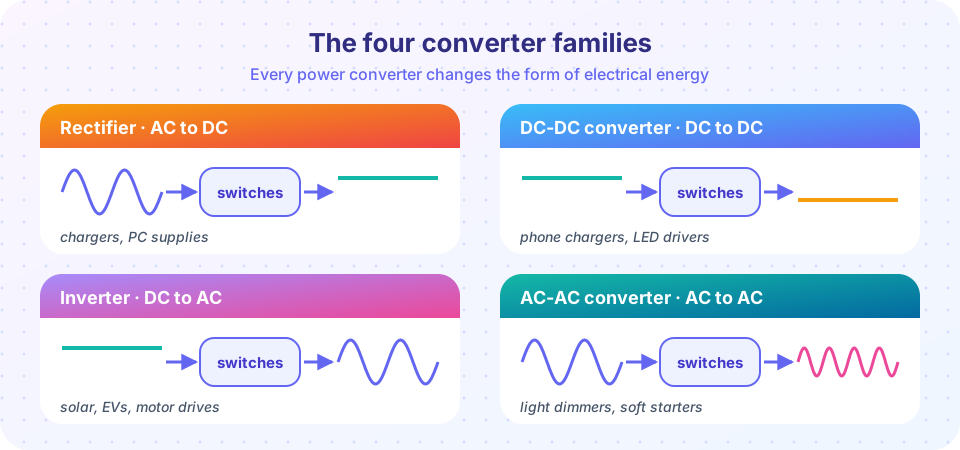
Power electronics looks bewildering at first because there seem to be hundreds of circuits with strange names. The good news is that nearly all of them fall into four families, named after what goes in and what comes out. Once you can place a circuit in the right family, you already know its purpose, and its main design questions follow.
What you will learn
- The four converter families and the waveform each takes in and delivers.
- Real products that contain each family.
- What "unidirectional" and "bidirectional" mean for converters.
- How rectified waveforms contain harmonics, with a runnable spectrum.
Key terms
- Rectifier: converts AC to DC.
- DC-DC converter: converts one DC level to another.
- Inverter: converts DC to AC.
- AC-AC converter: converts AC to AC with a different amplitude or frequency.
- Harmonic: a sine component at a whole-number multiple of a base frequency.
Family 1: Rectifiers (AC to DC)
A rectifier takes the alternating voltage from the mains or a generator and produces direct voltage. The simplest version uses diodes; a controlled version uses thyristors or transistors so that the DC level can be adjusted. You find rectifiers in every phone charger, laptop adapter, TV, battery charger and in the front end of almost every motor drive. Chapter 3 is entirely about them.
Family 2: DC-DC converters (DC to DC)
A DC-DC converter changes a DC voltage level, up or down, and often regulates it against changes in load. The buck converter steps down, the boost steps up, and the buck-boost does either. They sit inside phone chargers, USB-C adapters, LED drivers, computer motherboards (which produce 1 V for the processor from 12 V), and electric vehicles. Chapter 4 explains the three basic circuits.
Family 3: Inverters (DC to AC)
An inverter makes AC from DC. The AC may be a mains-frequency sine wave to feed the grid, as in a solar inverter, or a variable-frequency three-phase waveform to drive a motor, as in an electric car or an air-conditioner compressor. Inverters are the heart of chapter 5.
Family 4: AC-AC converters
These change the amplitude, frequency or phase of an AC waveform without an intermediate DC stage (a cycloconverter or matrix converter), or they adjust AC power with a thyristor, as in a light dimmer or a soft-starter for a motor. In practice, many AC-AC systems are built from a rectifier followed by an inverter with a DC link in the middle, which we call an AC-DC-AC converter. Both approaches belong in the same family.
Direction of power flow
Some converters only move power one way, like a diode rectifier in a phone charger. Others are bidirectional: an electric car's inverter drives the motor when accelerating and sends energy back to the battery when braking. Bidirectional converters need switches that can conduct and block in both directions of current, which affects the choice of devices in chapter 2.
Building blocks shared by all families
All four families use the same ingredients:
- Switches (diodes, MOSFETs, IGBTs, thyristors) that steer current.
- Passive energy storage (inductors and capacitors) that smooth and buffer.
- A controller that decides when to switch.
- Protection and sensing (fuses, current and voltage sensors).
When you learn a new converter, ask four questions: what is the input type, what is the output type, which switches are used and which part stores energy. That short checklist identifies almost any topology.
Harmonics: why a rectified wave is not pure DC
A rectified sine wave is a DC level with a ripple on top. Mathematically that ripple is a sum of sine waves at multiples of the ripple frequency, called harmonics. Knowing which harmonics exist tells you how large the filter must be. A full-wave rectified 50 Hz sine has ripple at 100 Hz, 200 Hz, 300 Hz and so on, with the 100 Hz component the largest.
Common misconceptions
- "An inverter is just a rectifier running backward." They share ideas, but an inverter must create a clean alternating waveform and keep it synchronized to a load or the grid, which needs a lot more control.
- "A DC-DC converter and a transformer do the same thing." A transformer only works with AC. A DC-DC converter chops the DC into pulses, which makes it behave like AC internally; some DC-DC converters even contain a high-frequency transformer.
Try it
The first demo is a numerical Fourier analysis of the waveforms in the families picture. It shows the average (DC) value of a half-wave and full-wave rectified sine, and the biggest ripple harmonic. It is a simulation of ideal diodes, with no voltage drop.
Press Run (or Ctrl + Enter) to see the result here.
Program input · what you'd type while the program runs
Type the answers before you press Run, one per line. Each time the program reads a line (with input()), it gets the next line from this box.
Press Run (or Ctrl + Enter) to see the console output here.
No output.
You can run the classifier and add your own devices. A product with two stages (a phone charger has a rectifier and then a DC-DC stage) simply contains two families in series.
Check your understanding
Quick check · 4 questions
of 4 answered You scored / 4 · perfect!
-
1. A circuit takes mains AC and produces a regulated 12 V DC. Which family is it?
AC in and DC out is the rectifier family; regulation is usually done by a DC-DC stage after it. -
2. Which family does the inverter in an electric car's motor drive belong to?
The battery gives DC and the motor needs three-phase AC. -
3. What does it mean that a converter is bidirectional?
Bidirectional converters can transfer power in both directions, such as motoring and regenerative braking. -
4. The ideal average of a full-wave rectified sine of peak 1 is about:
The average of |sin| is 2/π ≈ 0.637 of the peak.
Summary
- The four families are rectifier (AC-DC), DC-DC converter, inverter (DC-AC) and AC-AC converter.
- All share switches, energy storage, a controller and protection.
- Many real products chain two families, such as AC-DC-AC for a motor drive.
- A rectified wave is DC plus harmonics; the first ripple harmonic is at the rectified frequency.
Track your progress
Create a free account to tick off lessons and pick up where you left off on any device.
of Power Electronics lessons completed