


















Lesson 40 of 45 · Applications: Solar, EVs and Power Supplies
Chapter 8 review: solar, EVs and power supplies
Review solar I-V curves and MPPT, EV drivetrain and charging, and PFC and flyback supplies with a recap table, an efficiency-chain calculator and a ten-question quiz.
Three applications, one recipe. Whether the source is a sunlit panel, a battery pack or the mains, the design always has four parts: a source with its own personality, a converter that transforms it, a control loop that holds the result steady, and a thermal budget that keeps everything cool. You can now read a block diagram of a solar inverter, an electric-vehicle powertrain or a USB-C charger and say what each block does and what limits it.
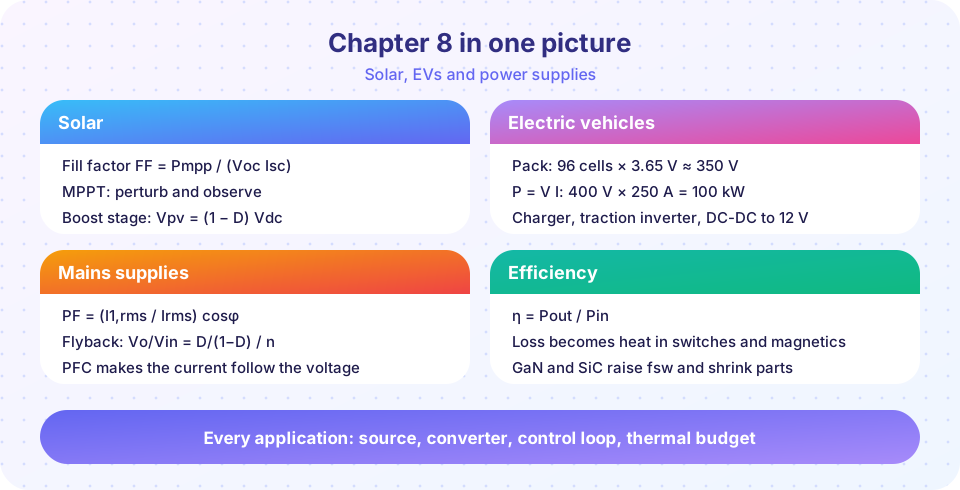
Recap table
| Topic | Key result | Lesson |
|---|---|---|
| Single-diode PV model | I = Iph − I0(e^((V+IRs)/(nNsVt)) − 1) − (V+IRs)/Rsh |
Solar power and MPPT |
| Fill factor | FF = Pmpp / (Voc · Isc) |
same |
| Irradiance, temperature | Isc ∝ G; Voc falls about 0.3 %/°C |
same |
| Boost as MPPT | Rin = (1 − D)² · RL; perturb and observe |
same |
| Single-phase grid inverter | DC link absorbs 2f power ripple | same |
| EV pack voltage | Vpack = Ns · Vcell (96 × 3.65 V ≈ 350 V) |
EV power electronics |
| Charging | P = V · I; t = ΔE / (P · η) |
same |
| Road load | ½ρCdA·v³ + Crr·m·g·v, regeneration recovers a share |
same |
| Power factor | PF = cos φ / √(1 + THDi²) |
Power supplies and PFC |
| Flyback | Vor = n(Vo + Vf), D = Vor / (Vor + Vin), Lp = Vin·D/(Ip·fsw) |
same |
Efficiency chains
When converters are in series their efficiencies multiply, and the lost power becomes heat in each stage. A string inverter with a 99.5 % MPPT stage and a 98 % inverter stage is 0.995 × 0.98 = 97.5 % efficient end to end; a 6 kW system loses 150 W as heat. A charging chain of a 98.5 % PFC, a 97 % isolated DC-DC and a battery that is 95 % efficient on charge gives 0.985 × 0.97 × 0.95 = 90.8 % from the wall to stored energy: the rest warms the car, the charger and the battery. The tool below multiplies any chain and shows where the heat appears.
Try it
The first example computes the end-to-end efficiency and the heat produced by each stage for the three applications in this chapter. The stage efficiencies are typical round numbers for illustration, not measurements of a product.
Press Run (or Ctrl + Enter) to see the result here.
Program input · what you'd type while the program runs
Type the answers before you press Run, one per line. Each time the program reads a line (with input()), it gets the next line from this box.
The second example is a practice drill. For each scenario choose the converter or concept that fits; the explanation appears after your answer.
Check your understanding
Quick check · 10 questions
of 10 answered You scored / 10 · perfect!
-
1. A module has Voc = 38 V, Isc = 9.5 A and Pmpp = 270 W. What is its fill factor?
FF = 270 / (38 × 9.5) = 270 / 361 = 0.748. -
2. A boost converter with D = 0.6 feeds a 50 Ω load. What resistance does the PV array see?
Rin = (1 − D)² RL = 0.16 × 50 = 8 Ω. -
3. A 150 kW charger works at 800 V. What is the charging current?
I = 150,000 / 800 = 187.5 A. -
4. How long does it take to add 36 kWh at 50 kW with 95 % efficiency?
36 / (50 × 0.95) = 0.76 h = 45 minutes. -
5. A rectifier has THDi = 80 % and cos φ = 0.95. What is the power factor?
PF = 0.95 / √(1 + 0.64) = 0.95 / 1.28 = 0.742. -
6. A flyback has Vo = 5 V, Vf = 0.5 V and n = 6. What is the reflected voltage?
Vor = 6 × 5.5 = 33 V. -
7. With Vor = 33 V and a minimum input of 100 V, what is the duty cycle at boundary conduction?
D = 33 / (33 + 100) = 0.248. -
8. A module's cell temperature rises from 25 °C to 65 °C. About how much maximum power is lost (0.4 % per °C)?
40 °C × 0.4 %/°C = 16 %. -
9. A 98 % PFC stage feeds a 96 % isolated DC-DC stage. What is the combined efficiency?
0.98 × 0.96 = 0.941. -
10. What happens in the traction inverter during regenerative braking?
The motor generates and the inverter rectifies its output into the DC link and battery.
Summary
- Solar: model the module, find the MPP, steer it with
Rin = (1 − D)²·RL, track with perturb and observe, and buffer the 2f ripple. - EVs: four converters, higher voltage to cut current, SiC at 1200 V, charging time
ΔE/(P·η), regeneration through the inverter. - Supplies: PFC makes the current follow the voltage; a flyback gives isolation with
Vor = n(Vo + Vf); GaN and high frequency shrink the parts. - Efficiency multiplies along a chain, and every lost watt becomes heat to manage.
Track your progress
Create a free account to tick off lessons and pick up where you left off on any device.
of Power Electronics lessons completed