


















Lesson 7 of 45 · Power Semiconductors
Power Diodes: PN, Schottky and Reverse Recovery
Understand power diodes: forward voltage, conduction loss, Schottky versus PN junction, reverse recovery charge Qrr and how to choose a diode for a converter.
The diode is the oldest power semiconductor and the one you will meet in every converter. It looks simple: current flows one way and is blocked the other way. But at power levels two imperfections matter a lot. First, when it conducts it drops some voltage, so it wastes power. Second, when it turns off it does not stop instantly: it briefly conducts backward while stored charge is swept out. Both effects show up in your efficiency numbers.
What you will learn
- How forward voltage and dynamic resistance set conduction loss.
- The difference between PN, Schottky and SiC Schottky diodes.
- What reverse recovery is, and why it causes switching loss and noise.
- How to read a power diode datasheet.
Key terms
- Forward voltage (VF): the voltage across a conducting diode.
- Reverse recovery time (trr) and charge (Qrr): how long a PN diode conducts backward when turned off, and the charge swept out.
- Reverse repetitive peak voltage (VRRM): the largest repeated reverse voltage the diode can block.
- Schottky diode: a metal-semiconductor diode with low VF and almost no stored charge.
- Freewheeling diode: a diode that carries inductor current when the main switch is off.
The ideal diode and the real one
An ideal diode has zero voltage when conducting and zero current when blocking. A first real model adds a constant voltage drop: v = VF when on. A better model adds a small series resistance: v = V0 + rd × i. Conduction loss with this model is
Pcond = V0 × Iavg + rd × Irms²
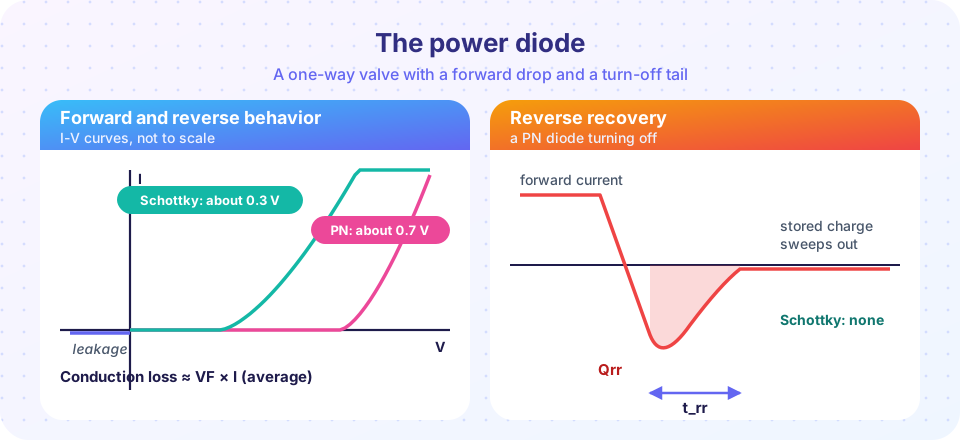
For a rough estimate, Pcond ≈ VF × Iavg. A silicon PN diode has VF near 0.7 V at small current and about 1 V at rated current. At 10 A average, 1 V means 10 W of heat, which is a lot for a single small component. This is the reason that in low-voltage supplies the diode is replaced by a MOSFET (synchronous rectification): at 10 A, a MOSFET with 5 mΩ loses only 0.5 W.
The current-voltage relationship of a PN junction follows the Shockley equation, i = Is × (exp(v / (n × VT)) − 1), where VT = kT/q ≈ 25.9 mV at room temperature. The exponential explains why the forward voltage barely changes when the current changes by a factor of ten: it moves by about 60 mV for each decade.
PN diode versus Schottky diode
PN (silicon) diodes conduct through a P-N junction. They block high voltage (hundreds to thousands of volts), but they store charge while conducting, which causes reverse recovery. They are typically used at mains frequency, where recovery does not matter.
Fast-recovery and ultrafast diodes are PN diodes with engineered lifetime so that Qrr is small. They are used at tens of kHz in PFC stages and inverters with voltages from 200 V to 1200 V.
Schottky diodes use a metal-semiconductor junction. VF is lower (typically 0.3 V to 0.6 V), and because they conduct by majority carriers, there is no significant stored charge and no reverse recovery. The drawbacks of silicon Schottky diodes are low voltage ratings (usually up to 100 V or 200 V) and higher leakage current, which also rises sharply with temperature.
SiC Schottky diodes combine the best of both: blocking voltages of 650 V to 1700 V and above with negligible recovery. They are common in high-voltage PFC and solar inverters, at a higher price.
Reverse recovery
While a PN diode conducts forward, the junction is full of stored minority carriers. When the circuit forces the current to reverse, those carriers must be removed before the diode can block. During that time, the diode acts like a short circuit for current flowing backward. The reverse current rises to a peak, then falls back as the diode starts to block. The area under the reverse current is Qrr.
Reverse recovery has three bad effects:
- The diode dissipates energy during the recovery as voltage rebuilds.
- The switch that forced the commutation sees extra turn-on current, which adds switching loss.
- The sharp end of the recovery current excites parasitic inductance and capacitance, producing voltage spikes and electromagnetic noise.
A rough estimate of the extra loss in the switch is Prr ≈ Qrr × Vbus × fsw. For Qrr = 100 nC, Vbus = 400 V and fsw = 50 kHz, Prr ≈ 100e-9 × 400 × 50e3 = 2 W. This is why using a SiC Schottky diode in a boost PFC can improve efficiency noticeably.
Reading a power-diode datasheet
| Parameter | Meaning |
|---|---|
| VRRM | maximum repetitive reverse voltage; choose 1.5 to 2 times your working voltage |
| IF(AV) | maximum average forward current at a stated case temperature |
| IFSM | one-cycle surge current rating (for inrush) |
| VF | forward voltage at a stated current and temperature |
| trr, Qrr | recovery numbers under stated di/dt and temperature |
| RθJC | thermal resistance from junction to case |
Common misconceptions
- "A Schottky diode has no reverse current." It has more leakage than a PN diode, and leakage rises quickly as it heats. A hot Schottky can run away thermally if poorly cooled.
- "VF is always 0.7 V." That number is for small-signal silicon diodes at low current. Power diodes at rated current drop 1 V or more, and Schottky diodes much less.
Try it
The first demo plots the Shockley current of a silicon PN diode and a Schottky diode on a linear and a logarithmic current axis. The saturation currents are example values chosen to give VF of about 0.7 V and 0.4 V at 1 A, a model with an ideality factor of 1 and no series resistance. They are not data from a particular product.
Press Run (or Ctrl + Enter) to see the result here.
Program input · what you'd type while the program runs
Type the answers before you press Run, one per line. Each time the program reads a line (with input()), it gets the next line from this box.
Press Run (or Ctrl + Enter) to see the console output here.
No output.
The numbers in the estimator are illustrative. Notice that the two conduction losses are close; the difference comes from the recovery loss, and the sum is what counts.
Check your understanding
Quick check · 5 questions
of 5 answered You scored / 5 · perfect!
-
1. A diode with a constant forward drop of 0.6 V carries 5 A average. What is the conduction loss?
P ≈ VF × I = 0.6 V × 5 A = 3 W. -
2. What causes reverse recovery in a PN diode?
While conducting, the junction is flooded with carriers. They must be swept out before the diode can block. -
3. Which diode has essentially no reverse recovery?
Schottky diodes conduct with majority carriers, so there is no significant stored minority charge. -
4. A diode has Qrr = 80 nC in a 300 V, 100 kHz circuit. Estimate the recovery loss Qrr × V × f.
80e-9 C × 300 V × 100e3 Hz = 2.4 W. -
5. Why is a silicon Schottky unsuitable for a 600 V PFC stage?
Silicon Schottky diodes are typically available only up to 100 to 200 V; silicon carbide Schottky diodes cover the high-voltage case.
Summary
- Diodes conduct one way; real ones drop
VFand wasteVF × I. - PN diodes block high voltage but store charge (Qrr); Schottky diodes switch cleanly but block less voltage.
- SiC Schottky diodes give both high voltage and negligible recovery.
- Reverse recovery costs loss and creates noise; estimate it with
Qrr × V × fsw. - Replace diodes with MOSFETs (synchronous rectifiers) where the drop dominates.
Next: Power MOSFETs
Track your progress
Create a free account to tick off lessons and pick up where you left off on any device.
of Power Electronics lessons completed