


















Lesson 45 of 45 · Projects and Practice
Where to go next: further study in power electronics
Plan your next steps after this course: neighbouring subjects on this site, simulation tools, hardware projects, standards and a starter simulation you can modify.
You have now travelled from semiconductor switches to complete systems: converters, inverters, control, magnetics, thermal design and three major applications. This final lesson shows how the course connects to the rest of electrical engineering, which subjects deepen each part, and which projects will turn what you know into skill.
Power electronics rewards breadth. The people who design good converters also understand devices, circuits, control, magnetics, thermal engineering, embedded software and standards. You do not need to master all of them at once; pick the one that matches the product you want to build, and let the others come as you need them.
What you will learn
- See which other subjects on this site deepen each part of power electronics.
- Choose a learning path that matches a goal such as motor drives, solar or power supplies.
- Plan hands-on projects, from simulation to a first hardware build, and know the safety rules.
- Know the standards and reference books that engineers rely on.
Key terms
Simulation: solving a circuit model on a computer, from SPICE circuits to averaged and system-level models.
Prototype: a first physical build used to test a design; usually low power.
EMC (electromagnetic compatibility): the ability of equipment to work without disturbing others or being disturbed.
Standard: a published requirement for safety, performance or compatibility, such as IEC 62368 for audio, video and IT equipment safety.
Datasheet: a manufacturer's document of device ratings and curves; the primary reference for every component.
Subjects that deepen the course
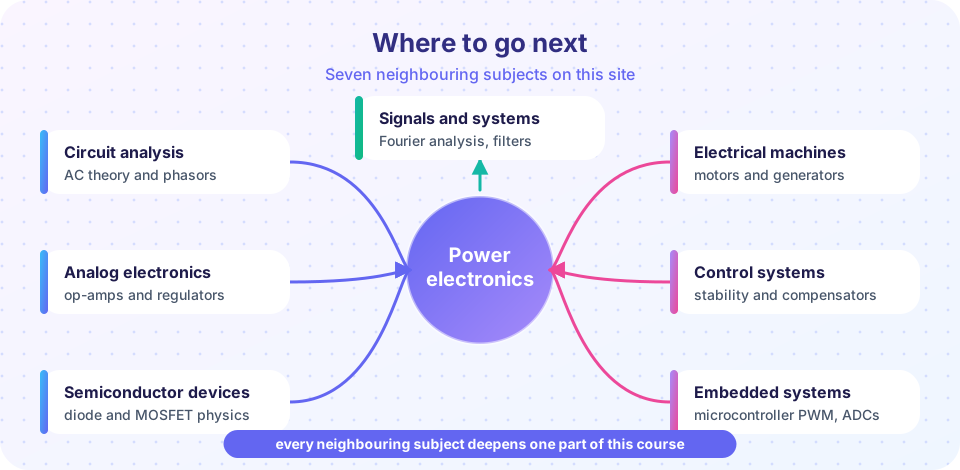
| Subject | What it adds to power electronics | Track on this site |
|---|---|---|
| Circuit analysis | Phasors, transients, three-phase circuits and the network theorems behind every converter equation | Circuit analysis |
| Analog electronics | Diodes, transistors, op-amps and linear regulators; the building blocks of gate drivers and control circuits | Analog electronics |
| Semiconductor devices | How a MOSFET, IGBT, SiC or GaN device actually works, and why the datasheet curves look the way they do | Semiconductor devices |
| Electrical machines | Induction, synchronous and DC machines, which every drive in Chapter 5 must control | Electrical machines |
| Control systems | Transfer functions, Bode and Nyquist, state-space and digital control for the loops of Chapter 6 | Control systems |
| Embedded systems | Microcontrollers, timers, ADCs and interrupts that generate PWM and run the loops in software | Embedded systems |
| Signals and systems | Fourier analysis, filtering and sampling behind harmonics, EMI and digital control | Signals and systems |
| Electricity and magnetism | The physics behind inductors, transformers and electromagnetic fields | Electricity and magnetism |
Choose a learning path
- Motor drives and electric vehicles. Electrical machines, then control systems (field-oriented control), then embedded systems. Build a three-phase inverter simulation that drives an induction motor model.
- Solar and energy storage. Circuit analysis for three-phase and grid concepts, control systems for current loops and PLLs, then standards for grid connection.
- Power supplies and adapters. Analog electronics, semiconductor devices, signals and systems (for EMI), then magnetics design in depth. Build a flyback.
- Control and digital power. Control systems and embedded systems; implement a digital compensator for the buck of the project lesson.
Projects, from easy to demanding
- Simulate the 12 V to 3.3 V buck of the project lesson in a circuit simulator. Vary L, C and fsw, and compare the results with the equations. Free simulators include ngspice and LTspice; larger systems use PLECS or MATLAB/Simulink.
- Add a loop: implement the type III compensator as difference equations and test it against a load step.
- Build a low-voltage hardware converter (for example 12 V to 5 V at 1 A) from an evaluation board or a regulator IC. Measure efficiency at several loads, then the ripple with a short ground spring.
- Generate SPWM from a microcontroller timer and drive a small three-phase motor at low voltage.
- Design and build a magnetic component: wind a gapped inductor, measure its inductance and saturation with a bench LCR meter and a pulse test.
Safety first. Work with low voltage (below 50 V DC) while you learn. Mains voltage, large capacitors, and high-energy batteries can injure or kill. Never work on mains-connected equipment without isolation, training and supervision. Use an isolation transformer, discharge capacitors, wear eye protection, and never touch a prototype that is powered.
Standards and references
- Safety: IEC 62368-1 (audio, video and IT equipment), IEC 60335 (household appliances), and ISO 6469 and UN ECE R100 for electric vehicles.
- Harmonics and EMC: IEC 61000-3-2 (harmonic current limits), CISPR 32 (emissions) and the IEC 61000-4 series (immunity).
- Grid connection: IEEE 1547 and IEC 61727 for distributed generation; national grid codes.
- Reference books: Fundamentals of Power Electronics (Erickson and Maksimović) for modelling and control; Power Electronics: Converters, Applications, and Design (Mohan, Undeland and Robbins) for a broad treatment; and McLyman's handbook on transformer and inductor design for magnetics.
- Application notes and datasheets from semiconductor manufacturers are the working engineer's daily reading. Learn to read the absolute-maximum ratings, the safe-operating-area curves and the thermal-impedance charts.
Common misconceptions
"I need to learn everything before building something." Build early and small: a simulation, then a low-voltage board. The mistakes teach faster than reading.
"Simulation replaces measurement." Simulation checks the design equations, not the layout, the parasitic inductance or the EMC performance. Measure.
"Power electronics is just analog electronics." It also needs magnetics, thermal engineering, control and regulation knowledge.
Try it
The first example is a learning-path chooser. Pick your goal and it lists the subjects in the order that will serve you best, with the reason for each step.
The second example is a starter simulation: an averaged-switch buck converter in about twenty lines that you can modify. Change the inductor, the capacitor or the load and watch the waveforms. It is the simplest model that shows the ripple and the start-up overshoot.
Press Run (or Ctrl + Enter) to see the result here.
Program input · what you'd type while the program runs
Type the answers before you press Run, one per line. Each time the program reads a line (with input()), it gets the next line from this box.
Check your understanding
Quick check · 3 questions
of 3 answered You scored / 3 · perfect!
-
1. Which subject would help most if you want to design the speed control of an electric motor drive?
You need to know the machine and how to design the control loops around it. -
2. Why should beginners work with voltages below about 50 V DC?
Mains and high-voltage systems are dangerous; learn on low-voltage prototypes. -
3. What does a simulation NOT verify?
Ideal simulations ignore the physical layout and the real parasitic elements.
Summary
- Power electronics sits among circuit analysis, analog electronics, devices, machines, control, embedded systems and signals; pick the neighbour that matches your goal.
- Progress by building: simulate, add a loop, build a low-voltage converter, generate SPWM, wind a magnetic part.
- Respect safety: low voltage first, discharge capacitors, never work on live mains.
- Standards and datasheets are part of the craft; learn to read them.
Back to the course: Power Electronics
Track your progress
Create a free account to tick off lessons and pick up where you left off on any device.
of Power Electronics lessons completed