


















Lesson 43 of 45 · Projects and Practice
Glossary of power electronics
A searchable glossary of about 80 power electronics terms: switches, converters, inverters, control, magnetics, thermal design and applications, with a flashcard game.
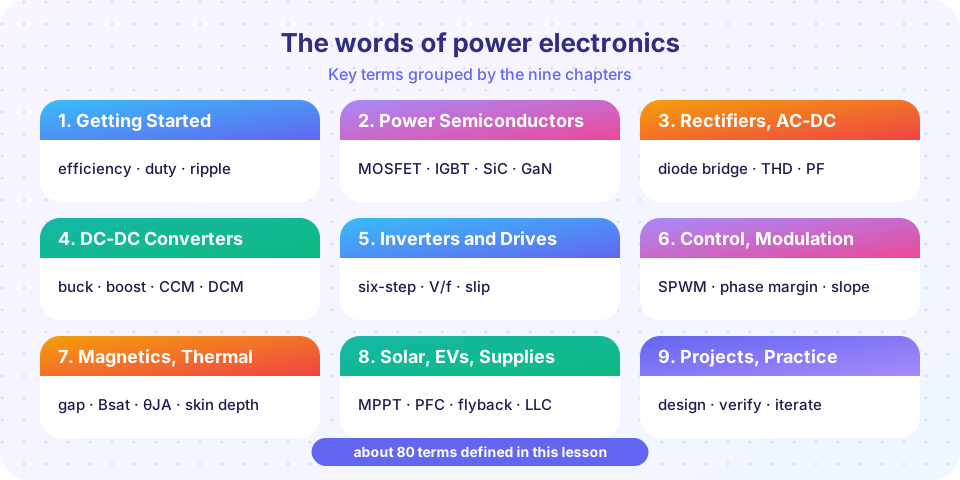
Power electronics borrows words from physics, electrical engineering, control theory and thermal engineering, and the abbreviations multiply quickly. This glossary collects the key terms of the whole course, grouped by topic, with one-line definitions you can scan in seconds. Use the search tool to find a word, and the flashcard game to test yourself.
What you will learn
- Look up any term from the course quickly.
- Connect each term to the topic and chapter in which it matters.
- Test your recall with the flashcard game.
Key terms
Glossary: an alphabetical or grouped list of terms with short definitions.
Abbreviation: a short form such as PFC or MPPT; spell it out the first time you use it.
Notation: lowercase letters such as v(t) are instantaneous values and uppercase letters such as V are DC, rms or peak values, as in the course formulas.
How to use this page
Terms are grouped by topic. A term can appear in several chapters: for example duty cycle matters for converters, for modulation and for loss calculation. Where a term has a formula, the formula is in the definition. When two terms are easy to confuse (conduction mode against conduction loss, phase margin against gain margin), reread the full lesson linked from the chapter overview.
Switching and semiconductors
| Term | Meaning |
|---|---|
| Antiparallel diode | A diode connected across a switch; it carries the load current when the switch is off. |
| Body diode | The parasitic diode inside a MOSFET between source and drain. |
| Dead time | A short interval in which both switches of a leg are off, preventing shoot-through. |
| Duty cycle | The fraction of a switching period during which a switch conducts. |
| GaN | Gallium nitride: a wide-bandgap material for fast, efficient transistors. |
| IGBT | Insulated-gate bipolar transistor: a high-voltage, high-current switch with a fixed on-state voltage offset. |
| MOSFET | The main fast power switch below about 1 kV; it behaves as a resistor when on. |
| Rds(on) | The on-state drain-to-source resistance of a MOSFET, which rises with temperature. |
| Shoot-through | Both switches of one leg on at the same time, shorting the DC link. |
| SiC | Silicon carbide: a wide-bandgap material for high-voltage, low-loss switches. |
| Switching frequency (fsw) | The number of switching periods per second. |
| Switching loss | Energy lost at each transition while voltage and current overlap, about ½·V·I·(tr+tf)·fsw. |
Converters
| Term | Meaning |
|---|---|
| Boost converter | A DC-DC converter whose output exceeds its input: Vo = Vin/(1 − D). |
| Buck converter | A DC-DC converter whose output is below its input: Vo = D·Vin. |
| CCM and DCM | Continuous and discontinuous conduction modes: the inductor current does or does not reach zero. |
| Flyback converter | An isolated converter built on a coupled inductor that stores energy and then releases it. |
| LLC converter | A resonant isolated converter that achieves soft switching at high efficiency. |
| Rectifier | A circuit that converts AC into DC. |
| Ripple | A small periodic variation superimposed on a DC voltage or current. |
| Soft switching | Switching when voltage or current is near zero, so switching loss is small. |
| Synchronous rectifier | A MOSFET used instead of a diode to reduce conduction loss. |
Inverters and motors
| Term | Meaning |
|---|---|
| DC link | The capacitor-backed DC bus that feeds an inverter. |
| Field weakening | Operation above base speed with constant voltage, so flux and torque fall as 1/f. |
| Fundamental | The sine wave at the wanted output frequency inside a switched waveform. |
| Inverter | A converter that changes DC into AC of chosen frequency and amplitude. |
| Leg | A pair of series switches whose midpoint is an output terminal. |
| Regenerative braking | Using the motor as a generator to return braking energy to the DC link or battery. |
| Six-step operation | Each switch conducts 180° and the state changes every 60°; line voltage rms is 0.816 Vdc. |
| Slip | The relative difference between the rotating field speed and the rotor speed. |
| Synchronous speed | The speed of the rotating field: ns = 120·f/p in rpm. |
| THD | Total harmonic distortion: rms of the harmonics divided by the rms of the fundamental. |
| V/f control | Keeping voltage proportional to frequency so the motor flux stays constant. |
Control and modulation
| Term | Meaning |
|---|---|
| Carrier | The triangle or sawtooth wave at the switching frequency that a reference is compared with. |
| Compensator | The circuit or code that shapes loop gain and phase for accuracy and stability. |
| Crossover frequency | The frequency at which the loop gain falls to 0 dB. |
| Feed-forward | Using a measured disturbance, such as input voltage, to correct the duty cycle immediately. |
| Frequency ratio (mf) | Switching frequency divided by output frequency. |
| Gain margin | How much the loop gain can rise before the loop becomes unstable. |
| Loop gain | The product of the compensator, modulator, plant and sensor around a feedback loop. |
| Modulation index (ma) | Reference amplitude divided by carrier amplitude; linear for ma ≤ 1. |
| Overmodulation | Operation with ma above 1, where pulses merge and low-order harmonics appear. |
| Peak current-mode control | The switch turns off when the inductor current reaches a threshold from the voltage loop. |
| Phase margin | 180° plus the loop phase at crossover; 45° to 60° is typical. |
| PWM | Pulse-width modulation: varying pulse width so the average output follows a reference. |
| RHP zero | A right-half-plane zero in boost and buck-boost converters that limits bandwidth. |
| Slope compensation | A ramp that stabilizes current-mode control above 50 % duty. |
| State-space averaging | Replacing a switched circuit by its average over one period to derive a small-signal model. |
| Subharmonic oscillation | An instability at half the switching frequency in current-mode control. |
| SVPWM | Space-vector PWM: a modulation scheme that reaches 0.707·Vdc line voltage in the linear range. |
| Third-harmonic injection | Adding a third harmonic to the references to extend the linear range by 15 %. |
| Type III compensator | An integrator with two zeros and two poles, used for voltage-mode control of an LC filter. |
Magnetics
| Term | Meaning |
|---|---|
| Air gap | A deliberate break in the magnetic path that stores most of the inductor energy. |
| Ae | The effective cross-sectional area of the core. |
| Area product (Ap) | Core area times window area: a measure of power-handling ability. |
| Bsat | The saturation flux density; about 0.3 to 0.4 T for hot power ferrite. |
| Core | The magnetic material that guides the flux: ferrite, powder, steel or alloy. |
| Flux walking | A DC flux shift caused by unequal volt-seconds in successive half-cycles. |
| Leakage inductance | Inductance of flux that links only one winding of a transformer. |
| Litz wire | A bundle of insulated thin strands that lowers AC resistance at high frequency. |
| Magnetizing inductance | The inductance seen at the primary with the secondary open. |
| Proximity effect | Extra winding loss from the magnetic field of neighbouring conductors. |
| Reluctance | The magnetic equivalent of resistance: l/(µ·A). |
| Skin effect | Current crowding near a conductor surface at high frequency; depth δ = √(ρ/(π·f·µ0)). |
| Steinmetz equation | Empirical core loss: Pv = k·f^α·B^β. |
| Volt-seconds | The integral of voltage over time; it sets the flux swing in a magnetic part. |
Thermal
| Term | Meaning |
|---|---|
| Derating | Reducing allowed power at high ambient temperature to keep the junction cool. |
| Heat sink | A finned metal body that spreads heat into the air. |
| Junction temperature (Tj) | The temperature of the semiconductor die; it must stay below its limit. |
| Thermal resistance (θ) | Temperature rise per watt along a heat path, in °C/W. |
| Thermal runaway | Loss that rises with temperature faster than cooling can follow, until failure. |
| Transient thermal impedance | The thermal resistance seen by a pulse; lower than steady state for short pulses. |
Applications
| Term | Meaning |
|---|---|
| Anti-islanding | Disconnecting a grid-tied inverter quickly when the grid disappears. |
| Burst mode | Switching in occasional bursts at light load to cut standby power. |
| Creepage and clearance | The surface and air distances that safety standards require between hazardous and touchable parts. |
| Fill factor (FF) | Pmpp divided by Voc·Isc for a solar module; typically 0.7 to 0.8. |
| HV battery | The traction battery of an electric vehicle, about 400 V or 800 V. |
| Isolation | Galvanic separation of the input from the output by a transformer. |
| MPPT | Maximum power point tracking: keeping a solar array at its best operating voltage. |
| OBC | Onboard charger: the AC-to-DC charger inside an electric vehicle. |
| PFC | Power factor correction: a stage that makes the input current follow the voltage. |
| PLL | Phase-locked loop: tracks the grid phase so an inverter can inject synchronized current. |
| Power factor | Real power divided by apparent power: cos φ / √(1 + THDi²). |
| Traction inverter | The inverter that drives an electric vehicle motor from the battery. |
Try it
The first example is a searchable glossary. Type part of a term or a definition, or choose a topic.
The second example is a flashcard game. A definition appears and you pick the right term from four choices; the score counts your correct answers.
Check your understanding
Quick check · 4 questions
of 4 answered You scored / 4 · perfect!
-
1. Which term describes both switches of one leg being on at the same time?
Shoot-through shorts the DC link; dead time is the delay that prevents it. -
2. Which term is the product of compensator, modulator, plant and sensor gains around a loop?
The loop gain decides crossover frequency and phase margin. -
3. What does MPPT stand for?
A solar converter tracks the operating point where the array power is highest. -
4. Which term means the flux swing is set by the integral of voltage over time?
The flux density change equals the volt-seconds divided by N·Ae.
Summary
- The glossary groups about 80 terms by topic: switching, converters, inverters and motors, control, magnetics, thermal and applications.
- Many terms have a formula built in; the definitions show it.
- Use the search tool to look up words and the flashcard game to build fluency.
Track your progress
Create a free account to tick off lessons and pick up where you left off on any device.
of Power Electronics lessons completed