


















Lesson 1 of 45 · Getting Started
Course Map: Welcome to Power Electronics
Meet power electronics: what it is, who this course is for, what you need first, and a map of all nine chapters from switches to solar inverters.
Your phone charger, your laptop brick, the drive in an electric car, a solar inverter on a roof and the controller in a washing machine all do the same job: they take electrical power in one form and deliver it in another. Power electronics is the engineering of that conversion. It uses semiconductor switches that are either fully on or fully off, plus inductors, capacitors and a controller, to change voltage, current, frequency and shape with very little wasted energy.
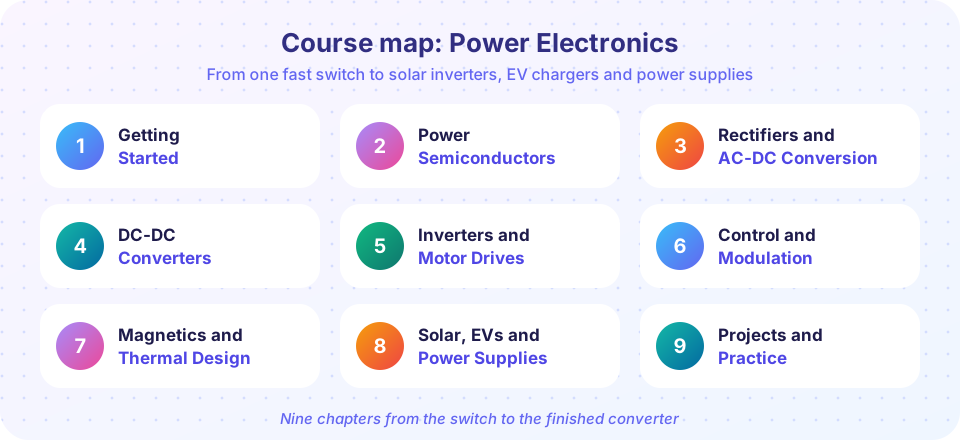
This course takes you from "what is a switching converter?" to designing and checking real converters. Every chapter starts with an overview, teaches through worked examples with numbers, and ends with a review page. You will meet equations, but each one is explained with a picture and a runnable example first.
What you will learn
- What power electronics is and why switching beats burning off the excess.
- How the chapters fit together and which ones to read first.
- What background you need and how to study the course effectively.
- How to read the simulations and calculators in the lessons.
Key terms
- Converter: a circuit that changes the form of electrical power.
- Switch-mode: operating transistors only fully on or fully off.
- Duty cycle (D): the fraction of each switching period the main switch is on.
- Efficiency (η): output power divided by input power.
- Ripple: the small unwanted wobble on top of a DC value.
Who this course is for
The course suits three groups. Students in electronics or electrical engineering will find the ideas that lectures rush through, with numbers worked out slowly. Makers and software developers who build robots, chargers or LED lights will learn why their parts get hot and how to choose them. Professionals moving into solar, electric vehicles or industrial drives get a structured tour of the field.
What you should know first
You do not need advanced mathematics. These are enough:
- Ohm's law and power:
V = I × RandP = V × I. - Capacitors and inductors: a capacitor resists changes in voltage, an inductor resists changes in current. Their basic equations are
i = C dv/dtandv = L di/dt. - Sine waves: peak and rms values, and frequency in hertz.
- Reading a simple circuit diagram.
If an inductor still feels mysterious, do not worry. Chapter 4 shows its behavior in simulations, and you can pause and experiment.
The nine chapters
- Getting Started (this chapter): why switching, efficiency, and the four families of converters.
- Power Semiconductors: diodes, MOSFETs, IGBTs, thyristors and wide-bandgap devices.
- Rectifiers and AC-DC Conversion: turning mains AC into DC, with filters and three-phase systems.
- DC-DC Converters: buck, boost and buck-boost, the workhorses inside most electronics.
- Inverters and Motor Drives: turning DC into AC for motors and the grid.
- Control and Modulation: PWM, feedback loops and stability.
- Magnetics and Thermal Design: inductors, transformers, heat sinks and reliability.
- Applications: solar, electric vehicles and power supplies.
- Projects and Practice: design exercises that tie everything together.
The big idea
Efficiency is the point
The building blocks
The four families
Where you find them
How to study this course
Read each lesson once, then run the interactive examples and change the numbers. When a result surprises you, predict it first, then test it. Power electronics is a field where intuition grows from watching waveforms, so the plots matter as much as the formulas. Keep a notebook of the key equations; the chapter reviews list them.
Every simulation in the lessons is labelled. Some are exact formulas turned into a plot, some are time-domain simulations of an idealized circuit with perfect switches, and some are calculators. None of them replaces a datasheet or a test on a real bench. Where a lesson shows typical component numbers, treat them as examples, not as specifications for a product.
Common misconceptions
"Higher voltage means more danger only at the plug." Even low-voltage converters can store a lot of energy in capacitors and inductors. Always respect the stored energy, and never work on mains-connected circuits without proper training.
"An efficient converter does not get hot." A 95% efficient 1 kW converter still turns 50 W into heat, which is more than a small soldering iron. Heat is a design topic in its own right (chapter 7).
Try it
The first comparison in the course: a linear regulator turns the voltage difference into heat, so its efficiency is the ratio Vout / Vin. A switching converter can stay near 90% or better. Change vin and see how the gap grows as the output voltage drops.
Press Run (or Ctrl + Enter) to see the result here.
Program input · what you'd type while the program runs
Type the answers before you press Run, one per line. Each time the program reads a line (with input()), it gets the next line from this box.
The shaded gap is energy that a linear regulator throws away as heat. In this example the linear regulator dissipates 14 W, about 13 W more than the switching converter.
Check your understanding
Quick check · 4 questions
of 4 answered You scored / 4 · perfect!
-
1. What is the main job of a power converter?
Power converters change voltage, current, frequency or waveform shape while wasting as little energy as possible. -
2. Which pair of components is most associated with energy storage inside a switching converter?
Inductors store energy in a magnetic field and capacitors in an electric field; together they smooth the chopped waveform. -
3. A linear regulator drops 12 V to 5 V. What is its best-case efficiency?
Efficiency is Vout/Vin = 5/12, about 42%. The rest is heat, even with a perfect regulator. -
4. Which chapter introduces the buck, boost and buck-boost converters?
Chapter 4, DC-DC Converters, covers all three.
Summary
- Power electronics converts electrical power from one form to another with switches, magnetics and capacitors.
- Switching beats dissipating the excess: efficiency can stay above 90%.
- The course has nine chapters; each has an overview, lessons and a review.
- Simulations are labelled; they are learning tools, not product specifications.
Track your progress
Create a free account to tick off lessons and pick up where you left off on any device.
of Power Electronics lessons completed