


















Lesson 21 of 45 · Inverters and Motor Drives
Chapter 5 overview: inverters and motor drives
See the big picture of DC-to-AC conversion: what an inverter does, where it is used, and how the lessons on bridges, three-phase inverters and motor drives fit together.
A rectifier turns AC into DC. An inverter does the opposite: it takes a steady DC voltage and produces an alternating one whose amplitude and frequency you choose. That sounds like magic, yet the trick is the same one you used in the DC-DC chapter: switches that are either fully on or fully off waste almost no energy, and the pattern in which you flip them shapes the output.
This chapter follows that idea from the simplest case, a single-phase bridge, to the machine that moves most of the world's industrial energy, the three-phase inverter driving an electric motor.
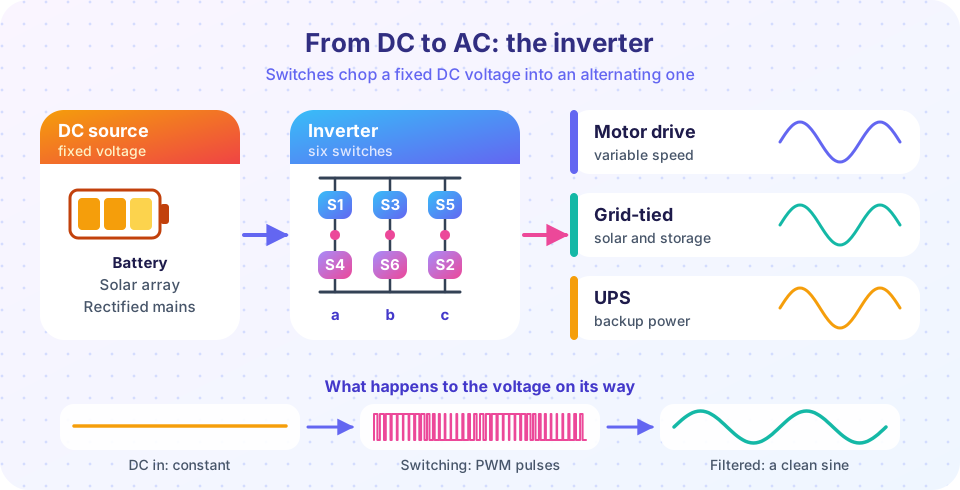
What you will learn
- Explain, in one sentence, how switches create an AC voltage from a DC one.
- Name the main applications of inverters and the voltage and power ranges they cover.
- See how the five lessons of this chapter build on each other.
Key terms
Inverter: a power converter that changes DC into AC with a chosen frequency and amplitude.
DC link (DC bus): the capacitor-backed DC voltage that feeds the inverter's switches.
Leg: a pair of switches, one upper and one lower, that connects an output terminal to either DC rail.
Fundamental: the sine wave at the wanted output frequency, hidden inside the switched waveform.
Harmonics: unwanted sine components at multiples of the fundamental frequency.
The big picture
What an inverter does
Where you find them
This chapter
Chapter 6 adds PWM to clean up the output.
Every inverter is built from the same ingredient: a leg of two switches. Close the upper switch and the output terminal sits at the positive rail; close the lower switch and it sits at the negative rail. One leg gives a square-ish wave relative to the DC midpoint. Two legs give a voltage between the two terminals that can reach both signs. Three legs give three phases that are shifted by 120 degrees, exactly what a three-phase motor wants.
Why not just use a transformer and an oscillator? Because power electronics gives you something a transformer cannot: control. By changing the switching pattern you can change the output frequency from 0 Hz to hundreds of hertz, keep the voltage proportional to the frequency, and even push energy back into the DC link when a motor brakes.
Where inverters are used
| Application | DC source | Typical power | What the inverter must do |
|---|---|---|---|
| Variable-speed drive | rectified mains, about 540 V | 0.1 kW to many MW | set motor speed and torque |
| Electric vehicle | battery, 400 V or 800 V | 100 to 400 kW | deliver torque, recover braking energy |
| Grid-tied solar | solar string, 300 to 1,000 V | 3 kW to MW | match the grid's voltage and phase |
| Uninterruptible supply | battery | 1 kW to MW | make clean mains when the grid fails |
Notice the pattern: the DC side is easy (a battery or a rectifier) and the AC side is where the intelligence goes.
Your route through the chapter
- Single-phase inverters: half bridge and full bridge builds the leg, the square wave and its harmonics.
- Three-phase inverters and six-step operation uses three legs and shows the first complete three-phase waveform.
- Motor drives and V/f control connects the inverter to an induction motor and explains why voltage must follow frequency.
- Chapter 5 review pulls the numbers together with a sizing calculator and a ten-question quiz.
Chapter 6 then shows how pulse-width modulation turns these crude waveforms into clean sines.
Common misconceptions
"An inverter amplifies power." It does not create energy. It moves energy from the DC side to the AC side, with a few percent of loss as heat.
"The output of the inverter is a sine wave." The raw switched output is a train of pulses. A sine appears only after the load's inductance or an output filter removes the high-frequency content.
Try it
The first example builds a square wave from the state of a full bridge and checks three numbers you will derive in the next lesson: the rms value, the average value and the amplitude of the fundamental. The code is a simulation of ideal switches with no dead time.
Press Run (or Ctrl + Enter) to see the result here.
Program input · what you'd type while the program runs
Type the answers before you press Run, one per line. Each time the program reads a line (with input()), it gets the next line from this box.
The second example is a tiny model of the chopping idea: a switch that is on for a fraction d of every period passes an average voltage of d × Vdc. Slide the duty cycle and watch both numbers. This is a simulation, not a measurement.
Check your understanding
Quick check · 4 questions
of 4 answered You scored / 4 · perfect!
-
1. What is a 'leg' of an inverter?
A leg has an upper and a lower switch; only one of them conducts at a time. -
2. Why does a three-phase inverter need three legs?
Each leg makes one phase, and the three phases are phase-shifted by 120 degrees. -
3. A raw inverter output is best described as
The switched waveform contains the wanted fundamental plus harmonics that the load or a filter removes. -
4. Which side of an inverter usually carries the 'intelligence'?
The DC side is a battery or rectifier; the control of the output happens in how the switches are driven.
Summary
- An inverter turns DC into AC with switches arranged in legs; the switching pattern sets the AC voltage and frequency.
- Inverters appear in drives, electric vehicles, solar systems and uninterruptible supplies.
- The raw output is a pulse train whose fundamental carries the useful power; harmonics are filtered or tolerated.
- This chapter goes from the single-phase bridge to the three-phase inverter and then to motor drives.
Track your progress
Create a free account to tick off lessons and pick up where you left off on any device.
of Power Electronics lessons completed