


















Lesson 36 of 45 · Applications: Solar, EVs and Power Supplies
Chapter 8 overview: solar, EVs and power supplies
Preview the three big applications of power electronics: solar inverters with MPPT, electric vehicle drivetrains and chargers, and mains power supplies with PFC.
Up to now you have studied the pieces: switches, rectifiers, DC-DC converters, inverters, control and thermal limits. This chapter assembles them into the three applications that account for most of the growth of power electronics today: solar power, electric vehicles and the power supplies that charge every phone and laptop. Each looks different on the outside, yet each is built from the same blocks you already know.
The aim is not to describe every product, but to show how a few requirements shape the design: a solar panel that must be operated at its maximum power point, a car that must move 100 kW of energy between a battery and the wheels, and a charger that must draw clean current from the mains in a package the size of a matchbox.
What you will learn
- Identify the power-electronic blocks in a solar system, an EV and a mains power supply.
- State the main requirement that shapes each application.
- See how the earlier chapters apply and what new ideas the chapter adds.
Key terms
MPPT (maximum power point tracking): a control method that keeps a solar array at the voltage that delivers the most power.
Traction inverter: the inverter that drives an electric vehicle's motor from the battery.
PFC (power factor correction): a front-end stage that makes a supply draw a sinusoidal current in phase with the mains voltage.
Isolated converter: a DC-DC converter with a transformer, providing galvanic isolation (for example flyback or LLC).
Power factor (PF): real power divided by apparent power at the mains input.
The big picture
Three applications
Same building blocks
This chapter
What shapes each application
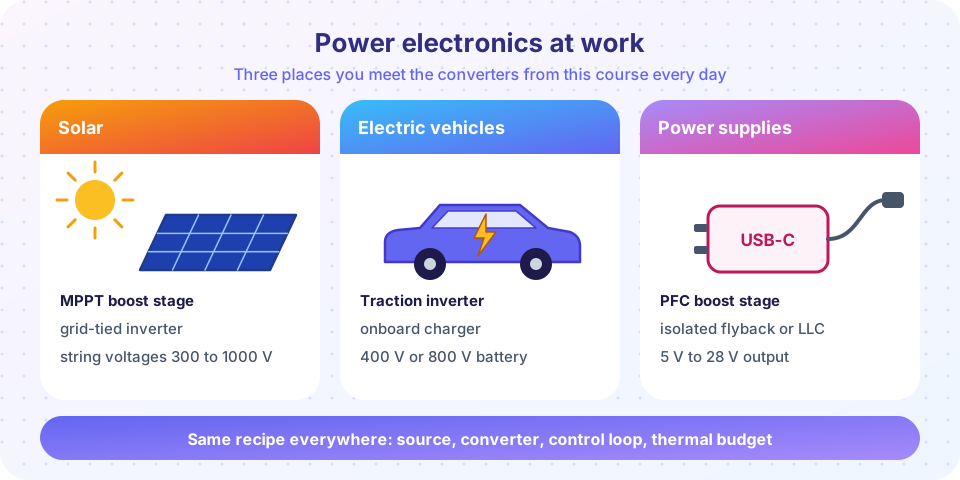
- Solar is about energy harvest. A panel is not a voltage source; its current and voltage depend on sunlight and temperature, and there is one operating voltage at which it delivers the most power. The converter's first job is to find and hold that point (MPPT). The second is to feed the grid with a clean sinusoidal current.
- Electric vehicles are about efficiency and power density. Every percent of loss in the traction inverter is range lost; every kilogram of converter is payload lost. These pressures drove the adoption of silicon-carbide devices, 800 V systems and liquid cooling.
- Power supplies are about cost, size and standby behaviour. A phone charger must pass safety and electromagnetic-compatibility tests, meet harmonic limits, waste almost nothing in standby and cost a few dollars.
The common ingredients
A boost converter appears twice: as the MPPT stage of a solar inverter and as the PFC stage of a power supply. An inverter appears as the grid-connected stage of a solar system and as the traction inverter of a vehicle. An isolated DC-DC converter appears in the onboard charger, the DC fast charger, and every power adapter. If you understood Chapters 4 to 6, you already have the tools.
Your route through the chapter
- Solar power and MPPT: the photovoltaic I-V curve, maximum power point, P&O tracking and grid-tied inverter architectures.
- Electric vehicle power electronics: the battery, traction inverter, onboard and fast chargers, DC-DC converter, and the energy needed to drive.
- Switching power supplies and PFC: the offline supply from rectifier to USB-C output, power factor and the flyback design.
- Chapter 8 review: recap, a system comparison tool and a ten-question quiz.
Common misconceptions
"A solar panel behaves like a battery." A battery holds a nearly constant voltage; a panel behaves more like a current source with a knee. Its power depends strongly on the voltage you impose.
"An EV is just a big phone." Its traction inverter handles ten thousand times the power of a phone charger, with tough demands on reliability, thermal management and safety.
"Power factor is only a utility problem." A low power factor means higher currents in the wiring and harmonics on the grid; harmonic-current rules such as IEC 61000-3-2 effectively require correction in most supplies above roughly 75 to 100 W.
Try it
The first example estimates how much energy each application moves in a day, with simple round numbers: a 6 kW solar array, an EV driven 40 km, and a household full of 20 W chargers. It is only a calculation, to give a sense of scale.
Press Run (or Ctrl + Enter) to see the result here.
Program input · what you'd type while the program runs
Type the answers before you press Run, one per line. Each time the program reads a line (with input()), it gets the next line from this box.
The second example is a cheat-sheet explorer: pick an application and see which blocks and which chapter lessons it uses. It is a simple lookup, meant as a map of what is ahead.
Check your understanding
Quick check · 4 questions
of 4 answered You scored / 4 · perfect!
-
1. Which converter stage do a solar MPPT and a PFC front end have in common?
Both raise a lower voltage to a higher one while controlling the input current or voltage. -
2. What is the first job of a solar inverter's DC side?
A panel delivers the most power at one operating voltage; MPPT keeps it there. -
3. Why is silicon carbide attractive for EV traction inverters?
SiC devices have lower switching and conduction loss at high voltage. -
4. What does power factor correction do?
PFC reshapes the input current so the supply looks like a resistor to the mains.
Summary
- Solar, EVs and power supplies are built from the same blocks: boost converters, inverters and isolated DC-DC converters.
- Solar needs MPPT and a grid-synchronized inverter; EVs need efficient high-power inverters and chargers; supplies need low cost, small size and PFC.
- The remaining lessons take them one at a time, with calculations you can run.
Next: Solar power and MPPT
Track your progress
Create a free account to tick off lessons and pick up where you left off on any device.
of Power Electronics lessons completed