


















Lesson 36 of 45 · Testing and Debugging
Chapter 7 review: testing and debugging
Review the bring-up sequence, probing technique, fault isolation, DFM, DFT and EMC habits with a poster, a recap table and a ten-question quiz.
This chapter was about the days after the board arrives, and about the decisions that make those days short. Use the poster as a bring-up card taped above your bench.
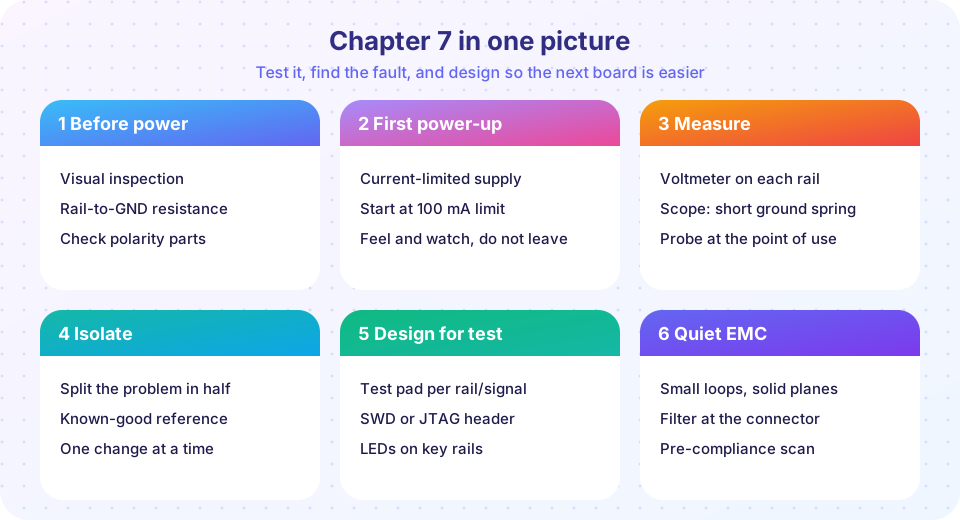
The chapter in one table
| Topic | Rule | Why |
|---|---|---|
| Before power | Inspect, then ohm every rail to GND | Finds shorts without current |
| First power | Current limit about 3× expected | A fault cannot burn the board |
| Probing | Short ground spring, ×10 probe | Long leads ring: f = 1/(2π√(LC)) |
| Isolating | Bisect, change one thing | log2(N) tests instead of N |
| DFT | Test point per rail, debug header, about 90 % net access | Saves hours |
| EMC | Small loops, solid planes, filter at entries | E ∝ f²·A·I |
Lessons: Bring-up and debugging and DFM, DFT and EMC.
Try it
Press Run (or Ctrl + Enter) to see the console output here.
No output.
Press Run (or Ctrl + Enter) to see the result here.
Program input · what you'd type while the program runs
Type the answers before you press Run, one per line. Each time the program reads a line (with input()), it gets the next line from this box.
Check your understanding
Quick check · 10 questions
of 10 answered You scored / 10 · perfect!
-
1. What is the first measurement after visual inspection?
It finds shorts before any power is applied. -
2. Which current limit suits a board expected to draw 40 mA?
About three times expected, with a floor of tens of mA: around 120 to 150 mA. -
3. A 10 nH ground spring and a 10 pF probe ring at about:
1/(2π√(10e-9·10e-12)) ≈ 503 MHz. -
4. Which is NOT part of bisection?
Bisection changes one thing at a time. -
5. How much does radiation from a small loop change when its area is quartered?
Field ∝ area: 20·log10(1/4) ≈ −12 dB. -
6. What is a ground test point near each rail test point for?
A close ground shortens the probe loop. -
7. Why filter at the cable entry?
Common-mode currents on cables radiate efficiently, so stop them at the connector. -
8. A fiducial is used by:
It marks the board position for the camera. -
9. Which edge changes emissions more at constant loop area and current?
The field scales with f². -
10. How many bisection steps for 16 suspects?
log2(16) = 4.
Summary
- Safe order: inspect, ohms, current limit, rails, clock, SWD, firmware.
- Short probe grounds; bisect faults.
- Design in test points, headers and quiet layout from the start.
Track your progress
Create a free account to tick off lessons and pick up where you left off on any device.
of PCB Design and Prototyping lessons completed