


















Lesson 32 of 45 · Manufacturing and Assembly
Chapter 6 review: manufacturing and assembly
Review stackups, vias, design rules, fabrication files, stencils, reflow and defects with a poster, a recap table and a ten-question quiz.
You have followed a board from a CAD project to a soldered assembly. The same few numbers kept coming back: a 1.6 mm board, 35 µm copper, 0.15 mm trace and ring limits, a 0.12 mm stencil and a 217 °C liquidus. This review gathers them on one page.
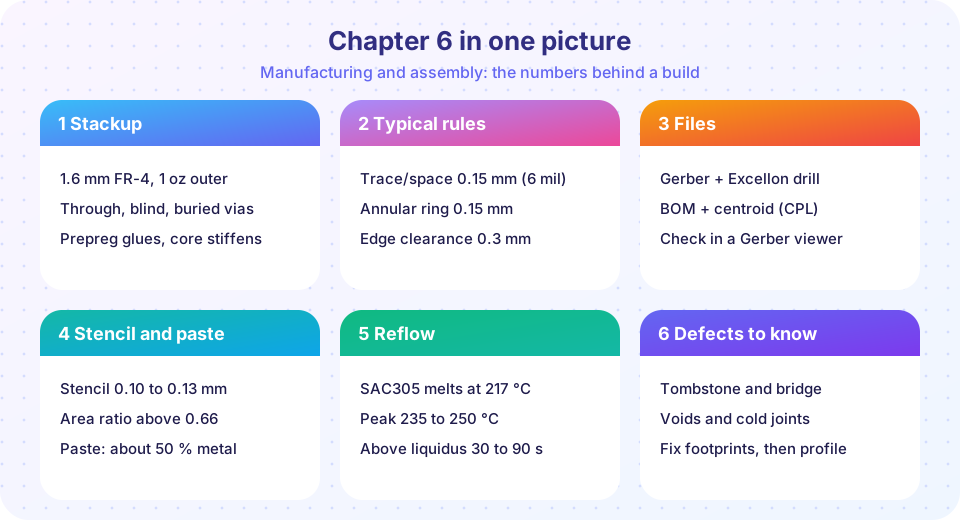
The chapter in one table
| Topic | Key point | Numbers |
|---|---|---|
| Stackup | Copper and prepreg/core laminated | 1.6 mm, 1 oz = 35 µm |
| Vias | Through, blind, buried, micro | Aspect ratio ≤ 8 to 10 |
| Rules | Set by etch and drill tolerance | 0.15 mm trace/space, 0.15 mm ring, 0.3 mm edge |
| Files | Gerber, drill, BOM, centroid | Check in an independent viewer |
| Stencil | Thin steel foil, apertures | 0.10 to 0.13 mm, area ratio > 0.66 |
| Reflow | Four zones | Peak 235 to 250 °C, 30 to 90 s above 217 °C |
| Defects | Tombstone, bridge, void, cold joint | Fix footprints, then profile |
Lessons: How a board is made, Gerbers and fabrication files, Assembly, soldering and reflow.
Try it
Press Run (or Ctrl + Enter) to see the result here.
Program input · what you'd type while the program runs
Type the answers before you press Run, one per line. Each time the program reads a line (with input()), it gets the next line from this box.
Press Run (or Ctrl + Enter) to see the console output here.
No output.
Check your understanding
Quick check · 10 questions
of 10 answered You scored / 10 · perfect!
-
1. What bonds the layers together during lamination?
Prepreg melts and cures under heat and pressure. -
2. Which via type connects only inner layers?
A buried via is invisible from both outer surfaces. -
3. Annular ring for a 0.7 mm pad and a 0.3 mm drill?
(0.7 − 0.3) / 2 = 0.2 mm. -
4. Which file holds hole positions?
Excellon files list tools and X, Y positions. -
5. Solder paste by volume is roughly:
About half the volume is solder spheres, the rest flux and solvent. -
6. Which stencil aperture prints most reliably?
Ratios above about 0.66 release paste cleanly. -
7. What is a likely cause of tombstoning?
One pad wets first and lifts the part. -
8. Typical peak temperature for a lead-free reflow?
The peak must exceed 217 °C by a safe margin without harming parts. -
9. Why preview a centroid file against the assembler's viewer?
Different tools define zero rotation differently. -
10. Which finish is best for fine-pitch BGAs?
ENIG is flat and durable.
Summary
- Know your fab's limits and design inside them.
- Deliver clean, checked files and unambiguous part numbers.
- Design symmetric pads and follow land patterns to avoid assembly defects.
Track your progress
Create a free account to tick off lessons and pick up where you left off on any device.
of PCB Design and Prototyping lessons completed