


















Lesson 13 of 45 · Components and Footprints
Packages: SMD and Through-Hole
Compare surface-mount and through-hole packages: chip sizes 0402 to 1206 in imperial and metric, SOIC, QFN, DIP and BGA, with pitch and how to choose for hand or machine assembly.
The package is the body of a component and its way of connecting to the board. The same silicon chip is often sold in several packages, and the same resistor value is made in many sizes. The package decides how large the footprint is, how you can solder it, how much heat it can shed and how dense you can make the layout.
Package names look like a secret code (0603, SOIC-8, QFN-32). The code has rules, and once you know them you can read a datasheet's package page in seconds.
What you will learn
- How chip passive codes (0402, 0603, 0805, 1206) map to millimetres
- The main IC packages and what pitch means
- How to choose between through-hole and surface-mount
- Why the same code can mean two different sizes
Key terms
Pitch: the distance from the centre of one pin to the centre of the next.
SMD / SMT: surface-mount device / technology.
THT: through-hole technology.
Exposed pad: a metal pad under a package, soldered to the board for heat and ground.
Reflow: soldering by heating a board with solder paste on it, usually in an oven.
Chip passives: reading the code
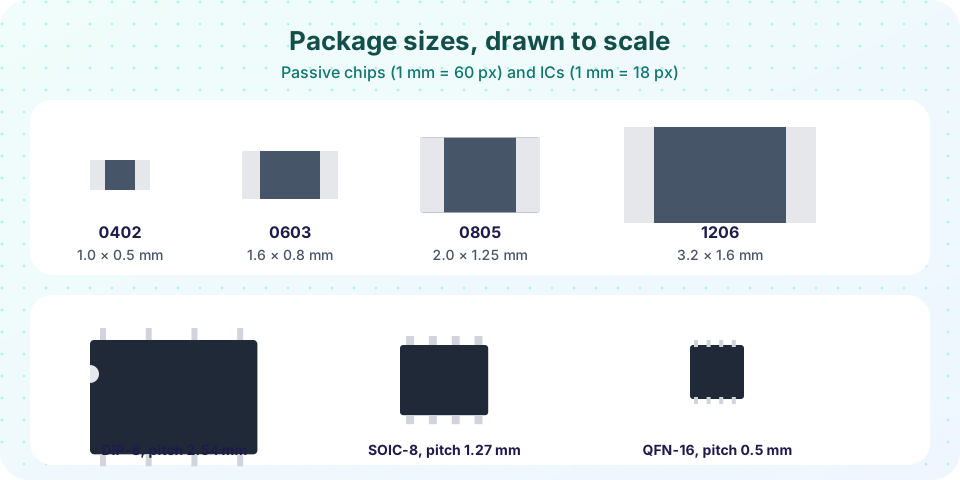
Resistors, capacitors and inductors share a family of rectangular packages named by a four-digit code. In the imperial system the code is length and width in hundredths of an inch. So 0603 means 0.06 in by 0.03 in, which is 1.6 mm × 0.8 mm. The metric code uses tenths of a millimetre: that same part is called 1608 metric.
| Imperial | Metric | Size (mm) | Typical resistor rating |
|---|---|---|---|
| 0402 | 1005 | 1.0 × 0.5 | 1/16 W |
| 0603 | 1608 | 1.6 × 0.8 | 1/10 W |
| 0805 | 2012 | 2.0 × 1.25 | 1/8 W |
| 1206 | 3216 | 3.2 × 1.6 | 1/4 W |
The ratings are typical; check the datasheet. There is a trap here: there is a smaller package whose metric code is also 0603. It is 0.6 × 0.3 mm, called 0201 imperial. If a part list uses metric codes and your library uses imperial, you can order parts that are far too small. Always write the dimensions or say which system you are using, and prefer the imperial name in this ecosystem because it is what most libraries use.
For a first board, 0603 is a good choice: easy to see, easy to place by hand with tweezers and still small. 0805 and 1206 are the easiest by hand. 0402 is small but common in dense products; hand soldering is possible with practice and a microscope.
IC packages
Integrated circuits come in a few main families.
- DIP (dual in-line package): through-hole, two rows of pins at 2.54 mm pitch. Easy to put in a socket or on a breadboard. Large.
- SOIC (small-outline IC): surface-mount, pins on two sides, 1.27 mm pitch, similar chip to a DIP in a much smaller body. Easy to solder by hand. TSSOP and MSOP are thinner, finer-pitch relatives.
- QFP (quad flat package): pins on four sides, pitches from 0.8 mm down to 0.4 mm; LQFP and TQFP are low-profile and thin versions. Hand-solderable with care.
- QFN (quad flat no-lead): no protruding leads; metal contacts at the body edge and usually an exposed pad underneath, pitch around 0.5 mm. Small, thermally good and a favorite in modern designs. Harder by hand; ideal for reflow.
- BGA (ball grid array): a grid of solder balls under the body. Very dense; needs an X-ray or special inspection and usually more layers because you route out from inside. Not for a first project.
- Transistor and regulator packages: SOT-23 (3 to 6 pins), SOT-223, TO-220 (through-hole power), DPAK.
The most important number on any IC package is the pitch. A pitch of 1.27 mm leaves you 1.0 mm or so between pads; a pitch of 0.5 mm leaves a gap of roughly 0.2 mm, which pushes the limits of cheap fabs and means every pad needs careful mask handling.
Through-hole or surface-mount?
Choose per part.
Choose through-hole for connectors that bear mechanical stress (USB plugs, power jacks, screw terminals), large electrolytic capacitors, relays, heavy inductors, and anything a student must solder with a basic iron. THT parts hold on strongly because the lead and plated barrel absorb force.
Choose surface-mount for almost everything else. Parts are smaller and cheaper, assemble automatically, work better at high frequencies because leads are short, and let you use both sides of the board. A bonus: SMD pads need no drilling, so there are fewer holes to fabricate.
Pay attention to heat. A QFN or SOT-223 loses heat through its exposed pad into the copper of the board, so the footprint has to provide a copper area (and often thermal vias). A package that looks fine on the datasheet can overheat on a board with too little copper.
Common misconceptions
"0603 means 0.6 mm by 0.3 mm." In the imperial system 0603 is 1.6 × 0.8 mm. The 0.6 × 0.3 mm part is imperial 0201 (metric 0603).
"Smaller packages are always better." Small parts are harder to assemble and inspect and more fragile. Use the biggest package that fits comfortably.
"QFN has no pins to worry about." The pins are under and along the body, so solder joints are hidden. Footprint accuracy and paste stencil design become more important.
Try it
The first example prints a table of chip sizes with the area each occupies on the board. It uses typical power ratings; always confirm them in the datasheet of the part you choose.
Press Run (or Ctrl + Enter) to see the console output here.
No output.
The second example plots the trade-off between space and power for the four sizes. It also marks the area of the pad that tells you how much room on a board each part really takes.
Press Run (or Ctrl + Enter) to see the result here.
Program input · what you'd type while the program runs
Type the answers before you press Run, one per line. Each time the program reads a line (with input()), it gets the next line from this box.
Check your understanding
Quick check · 5 questions
of 5 answered You scored / 5 · perfect!
-
1. What are the dimensions of an imperial 0603 chip?
Imperial 0603 is 0.06 in × 0.03 in, which is 1.6 × 0.8 mm. -
2. What does pitch mean?
Pitch is centre-to-centre pin spacing. -
3. Which package has a 2.54 mm pitch and through-hole leads?
DIP is the classic through-hole IC package. -
4. Which is the best reason to use a through-hole connector?
Through-hole leads and plated barrels hold strongly. -
5. A QFN with an exposed pad needs the footprint to provide
The exposed pad carries heat into the board copper.
Summary
- Imperial chip codes: 0402, 0603, 0805, 1206 equal 1.0×0.5, 1.6×0.8, 2.0×1.25, 3.2×1.6 mm.
- Metric codes differ (1608 is imperial 0603); always check which system a name uses.
- DIP, SOIC, QFP, QFN and BGA trade size for assembly difficulty; pitch is the key number.
- Use through-hole for strong connectors, surface-mount for the rest, and give thermal pads copper.
Track your progress
Create a free account to tick off lessons and pick up where you left off on any device.
of PCB Design and Prototyping lessons completed