


















Lesson 40 of 45 · Complete Projects
Chapter 8 review: complete projects
Review the decisions behind a USB-C sensor board and a 12 V to 3.3 V buck regulator: values, loops, protection, test points and the pre-order checklist, with a ten-question quiz.
You have taken two boards from requirements to a layout plan. Different circuits, the same habits: calculate first, place by priority, protect the entry, keep loops small, plan for test, and review before ordering.
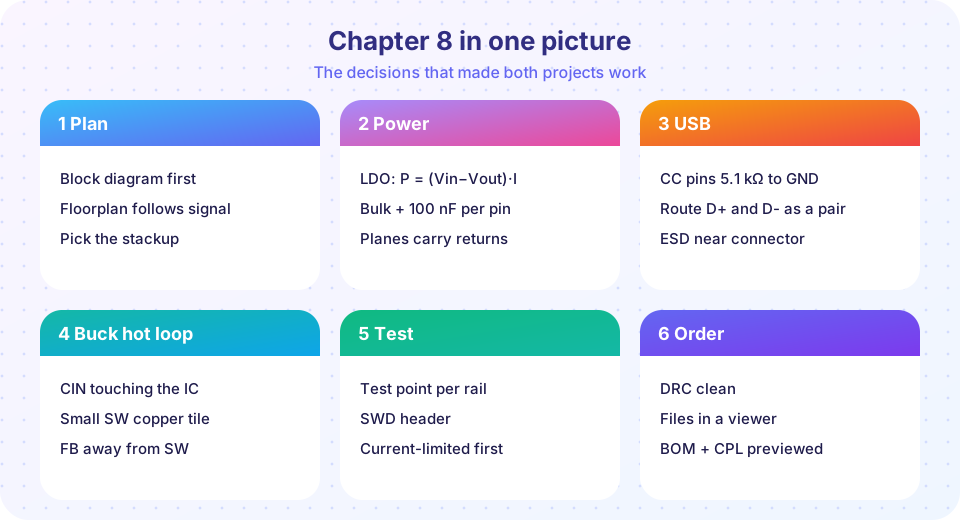
The chapter in one table
| Decision | USB-C sensor | Buck regulator |
|---|---|---|
| Biggest risk | Protection and bus quality | The hot loop |
| Key calculation | LDO heat, I2C Rp |
L, ripple, divider |
| Layout priority | Connector, protection, decoupling | CIN at the IC, small SW node |
| Stackup | Two layers, solid ground pour | Two or four layers, ground plane under loop |
| Test points | 5 V, 3.3 V, GND, reset, SDA, SCL | VIN, VOUT, SW, PGOOD, GND |
Lessons: USB-C sensor board and Buck regulator board.
Pre-order checklist
- DRC passes with the fab's rules loaded.
- Every power pin has its capacitor at the pin.
- Polarity, pin 1 and connector pinouts are checked against datasheets (not just symbols).
- Test points and a debug header exist.
- Gerbers, drill, BOM and centroid previewed in independent viewers.
- Finish, thickness, copper weight and mask color specified.
Try it
Press Run (or Ctrl + Enter) to see the result here.
Program input · what you'd type while the program runs
Type the answers before you press Run, one per line. Each time the program reads a line (with input()), it gets the next line from this box.
Press Run (or Ctrl + Enter) to see the console output here.
No output.
Check your understanding
Quick check · 10 questions
of 10 answered You scored / 10 · perfect!
-
1. Which resistors identify a USB-C sink?
5.1 kΩ pull-downs on both CC pins. -
2. A buck from 24 V to 5 V has what duty cycle?
5 / 24 = 0.208. -
3. Where does the input capacitor of a buck go?
It closes the hot loop. -
4. What dissipates (5 − 3.3) V × I in a USB board?
A linear regulator burns the voltage drop times the current. -
5. Which is the best order to place buck parts?
Hot loop first, then the rest. -
6. Why use thermal vias under the buck IC?
They conduct heat from the exposed pad to the plane. -
7. Which is not part of a pre-order check?
The font does not affect function. -
8. On a two-layer 1.6 mm board, 50 ohm microstrip needs a width of about:
About 3 mm by the IPC-2141 formula. -
9. Which pull-up fits a 400 kHz I2C bus with 100 pF?
The window is about 1 to 3.5 kΩ. -
10. Ripple of the inductor with L = 8.2 µH at 500 kHz for 12 V to 3.3 V is about:
ΔIL = (Vin − Vout)·D / (L·fsw) ≈ 0.58 A.
Summary
- Calculate, place by priority, protect, test and review.
- Two different boards share one checklist.
Next: Practice problems
Track your progress
Create a free account to tick off lessons and pick up where you left off on any device.
of PCB Design and Prototyping lessons completed