


















Lesson 8 of 45 · From Schematic to Board
Netlists, ERC and the Bill of Materials
See how a schematic becomes a netlist, how electrical rules check finds wiring errors and how a bill of materials is built and grouped for ordering parts.
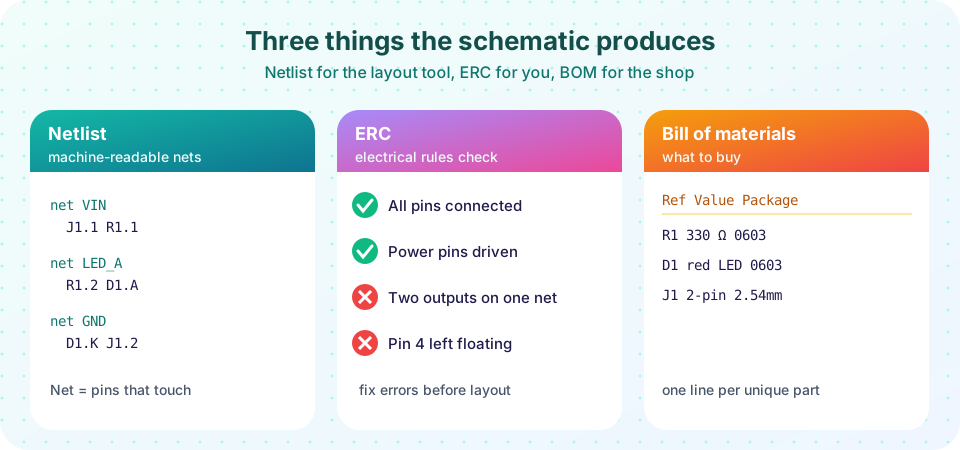
When your schematic is finished, three things come out of it. The netlist goes to the layout tool, so it knows what to connect. The ERC report tells you what you probably did wrong. The bill of materials, or BOM, tells a buyer or an assembly service what to purchase and place. All three are generated automatically, but you must understand them to trust them.
What you will learn
- What a net and a netlist are, and how connections are grouped
- Which mistakes ERC finds and which it cannot
- How a BOM groups identical parts
- A habit for reviewing a schematic before layout
Key terms
Net: all pins that are electrically connected, including through wires, labels and power symbols.
Netlist: a file listing every net and the pins on it, plus each part's footprint.
ERC (electrical rules check): a rule-based test of pin types, connections and power nets.
BOM (bill of materials): the list of parts needed, with quantities, values, footprints and often manufacturer part numbers.
MPN: manufacturer part number, the unique name of a real component.
Nets and netlists
Every pin belongs to exactly one net (a pin that is connected to nothing sits alone on a net with no name). When you draw a wire, you merge two nets. When you place a label, you give a net a name. The netlist is just the result written out: for each net, the list of reference.pin entries on it.
For the little LED circuit the netlist has three nets: VIN connects J1.1 and R1.1; LED_A connects R1.2 and D1.A; and GND connects D1.K and J1.2. It tells you nothing about size, direction or position. Plus a footprint for each part, it is all the layout tool needs to draw the "airwires": thin straight lines between pads that should be connected. Your job in layout is to turn airwires into copper.
You can think of the algorithm that builds nets as "union-find": start with every pin alone, then merge sets each time a wire joins two pins. You will build this in the first example below.
Electrical rules check
ERC is a set of rules about how pins may be connected. Each pin has a type: input, output, bidirectional, power input, power output, passive, open collector, unconnected and so on. The checker compares what is on each net to simple rules:
- Two outputs driving the same net is an error (they fight).
- A pin left floating (unconnected) triggers a warning unless you mark it "no connect" with an X symbol.
- A power input pin on a net that nothing drives is flagged. Fix with a PWR_FLAG or by connecting a real source.
- Duplicate reference designators, missing footprints and labels that appear only once are flagged.
ERC is valuable, but its limits matter. It checks the rules about pin types, not about your design. A resistor with the wrong value, a transistor with the wrong pinout and an LED the wrong way round all pass ERC. Only a human review with the datasheet in hand catches them.
A good review habit: print the schematic (or view it full-screen) and tick every pin against the datasheet's pin table. Do it once for power pins, once for inputs and outputs. It takes thirty minutes and saves weeks.
The bill of materials
The BOM is a table, normally exported as CSV. Each row represents one type of part, and the reference column lists every place it is used. Two resistors with the same value and footprint become one line with a quantity of two. A good BOM has these columns:
| Column | Example |
|---|---|
| Reference | R1, R4 |
| Quantity | 2 |
| Value | 10k |
| Footprint | R_0603 |
| MPN | manufacturer's code |
| Supplier part number | e.g. a distributor's code |
Adding the MPN is what lets a service buy exactly the right part. A line that says only "10k, 0603" leaves room for the wrong tolerance or rating. At the very least write tolerance and voltage rating into the value or a separate field for capacitors (for example "100nF 16V X7R").
You will meet the BOM again when you order assembly in Chapter 6. Keep your library tidy so that the export needs little cleaning.
Common misconceptions
"ERC passed, so the schematic is right." ERC finds rule violations, not design errors. Review pin by pin.
"I can ignore warnings about unconnected pins." A floating input can pick up noise and behave randomly. Tie unused inputs to a defined level or mark true no-connects deliberately.
"The BOM is only for the shop." The BOM is also a check: if a part you expect is missing or has a strange quantity, the schematic probably has a mistake.
Try it
The first example builds a netlist from a list of pin-to-pin wires using union-find, the same idea your EDA tool uses. It then names each net.
Press Run (or Ctrl + Enter) to see the result here.
Program input · what you'd type while the program runs
Type the answers before you press Run, one per line. Each time the program reads a line (with input()), it gets the next line from this box.
The second example groups a raw parts list into a BOM, the way an export does. Add a part or change a value and see the grouping change.
Press Run (or Ctrl + Enter) to see the console output here.
No output.
Check your understanding
Quick check · 5 questions
of 5 answered You scored / 5 · perfect!
-
1. What does a netlist list?
A netlist holds connectivity (and footprints), not geometry. -
2. Which error does ERC catch?
ERC applies pin-type rules; it cannot judge design intent. -
3. In a BOM, what does one row represent?
Identical parts are grouped and quantities are summed. -
4. Why add an MPN to the BOM?
A value alone can match many different parts. -
5. What should you do with an unused input pin on a logic chip?
Floating inputs pick up noise and cause unpredictable behavior.
Summary
- Nets are groups of connected pins; the netlist lists them for the layout tool.
- ERC applies pin-type rules and finds many wiring mistakes, but not design mistakes.
- The BOM groups identical parts and should include exact part numbers.
- Always review the schematic against datasheets before layout.
Track your progress
Create a free account to tick off lessons and pick up where you left off on any device.
of PCB Design and Prototyping lessons completed