


















Lesson 41 of 45 · Projects and Practice
Practice problems: impedance, power, copper and assembly
Ten PCB design practice problems with worked solutions: impedance, reflections, termination, decoupling, copper width, vias, stencils and a buck inductor, with a runnable answer checker.
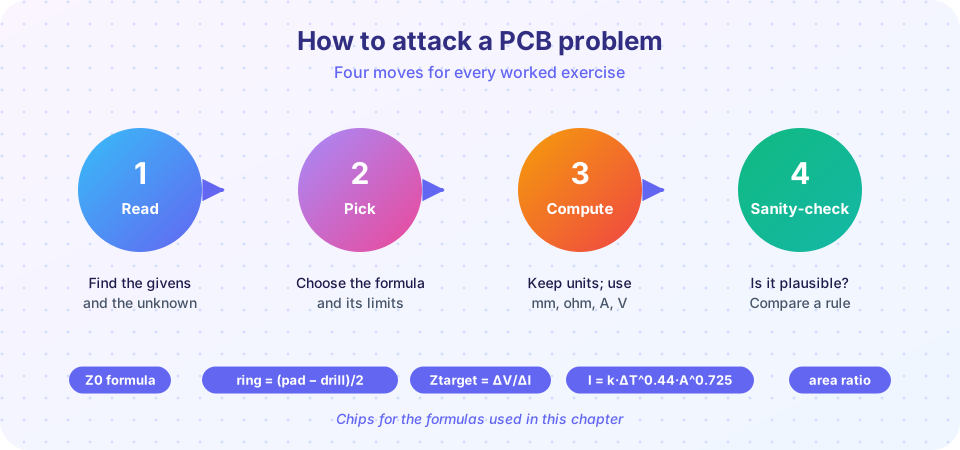
Reading about formulas is not the same as using them. This set gives you ten short problems that cover Chapters 5 to 8. Try each on paper first, then run the answer checker to compare. Every problem has a fixed method: read the givens, choose the formula, compute with units, then sanity-check the answer against a rule of thumb.
What you will learn
- Apply the course's formulas to concrete numbers.
- Check results with orders of magnitude and rules of thumb.
- Recognize which formula a problem calls for.
Key terms
Given: a number stated in the problem.
Unknown: what you are asked for.
Sanity check: a quick plausibility test (is 49 Ω reasonable for a 50 Ω design?).
Order of magnitude: the power of ten of an answer.
The problems
Use FR-4 with εr = 4.3, copper t = 0.035 mm unless stated.
- Impedance. A microstrip has
w = 0.30 mm,h = 0.15 mm. ComputeZ0withZ0 ≈ 87/√(εr+1.41)·ln(5.98h/(0.8w+t)). - Reflection. A 50 Ω line ends in a 75 Ω load. What is
Γ, and what fraction of the incident voltage amplitude returns? - Termination. A driver has 15 Ω output resistance and drives a 50 Ω line. What series resistor matches it?
- Critical length. A 2 ns edge on a surface trace (6 ns/m). What length makes the one-sixth rule apply?
- Decoupling. A 10 nF capacitor has
ESL = 0.5 nH. What is its self-resonant frequency? A 1.8 V rail allows 3 % deviation for a 1 A step: what isZtarget? - Copper. What minimum width carries 2 A on an inner 1 oz layer with a 10 °C rise (IPC-2221,
k = 0.024)? - Via. A 0.25 mm drill with 0.55 mm pad on a 1.6 mm board: annular ring and aspect ratio?
- Stencil. A 0.3 × 0.8 mm aperture in 0.10 mm foil: area ratio?
- Buck. 24 V to 5 V, 1 A, 400 kHz, ripple 30 % of Iout: duty cycle and inductor value?
- Loop ringing. 4 nH of loop inductance with 150 pF: ring frequency?
Worked solutions
0.8w + t = 0.24 + 0.035 = 0.275;5.98h = 0.897; ratio 3.262;ln = 1.182;87/√5.71 = 36.4;Z0 ≈ 43 Ω. Plausible: a narrow trace on a thin dielectric is below 50 Ω. (Check with the checker.)Γ = (75 − 50)/(75 + 50) = 0.2: 20 % of the amplitude is reflected.Rs = 50 − 15 = 35 Ω.- Flight time limit =
2 ns / 6 = 0.33 ns; length =0.33 / 6 ns/m = 0.056 m ≈ 5.6 cm. f0 = 1/(2π√(0.5e-9 · 10e-9)) ≈ 71 MHz.Ztarget = 1.8·0.03/1 = 0.054 Ω.- Area
A = (I/(k·ΔT^0.44))^(1/0.725)in mil², then width =A / 1.378 mil→ about 80 mil ≈ 2.0 mm. Inner layers need much more copper than outer ones for the same current. - Ring
(0.55 − 0.25)/2 = 0.15 mm; aspect1.6/0.25 = 6.4. 0.24 / (2·1.1·0.10) = 1.09: prints well.D = 5/24 = 0.208;ΔIL = 0.3 A;L = (24 − 5)·0.208 / (0.3 · 400 000) ≈ 33 µH.f = 1/(2π√(4e-9·150e-12)) ≈ 205 MHz.
Common misconceptions
"If the formula gives a number, it must be right." Check the validity range: the microstrip formula assumes 0.1 < w/h < 2.
"Units do not matter if I am consistent." They do: the IPC-2221 formula uses mil² and amperes; mixing mm gives nonsense.
"My answer matched the book, so I understand it." Change a given and predict the direction of the change before computing.
Try it
Press Run (or Ctrl + Enter) to see the result here.
Program input · what you'd type while the program runs
Type the answers before you press Run, one per line. Each time the program reads a line (with input()), it gets the next line from this box.
Check your understanding
Quick check · 4 questions
of 4 answered You scored / 4 · perfect!
-
1. A 50 ohm line ends in 150 ohm. What is Γ?
(150 − 50)/(150 + 50) = 0.5. -
2. A driver with 12 ohm output resistance, 50 ohm line. Series resistor?
50 − 12 = 38 ohm. -
3. Why is the inner-layer width larger for the same current?
IPC-2221 uses k = 0.024 for inner layers (0.048 outer). -
4. Ring frequency of 4 nH and 150 pF is closest to:
1/(2π√(4e-9·150e-12)) ≈ 205 MHz.
Summary
- Read, pick, compute, sanity-check.
- Formulas have validity ranges and units; check both.
- Use the answer checker, then change a given and predict the result.
Next: Mini projects
Track your progress
Create a free account to tick off lessons and pick up where you left off on any device.
of PCB Design and Prototyping lessons completed