


















Lesson 27 of 45 · Signal and Power Integrity
Chapter 5 review: signal and power integrity
Review impedance, reflections, return paths, crosstalk, decoupling and power delivery with a one-page poster, a recap table of formulas and a ten-question quiz.
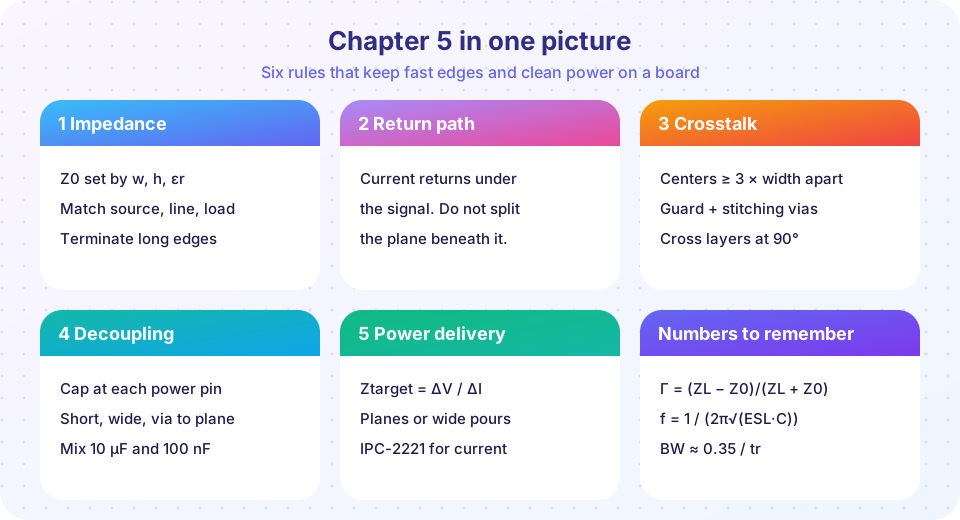
You have now met the three things that make fast boards difficult: edges that reflect, neighbors that couple, and rails that droop. The remedies all come from the same few ideas, and this review puts them on one page. Use the poster as a checklist the next time you finish a layout.
The chapter in one table
| Topic | Key idea | Formula or number | Lesson |
|---|---|---|---|
| Impedance | A trace is a line with Z0 set by geometry |
Z0 ≈ 87/√(εr+1.41) · ln(5.98h/(0.8w+t)) |
Impedance |
| Reflection | Mismatch sends part of the wave back | Γ = (ZL − Z0)/(ZL + Z0) |
Impedance |
| Termination | Match the source with a series resistor | Rs = Z0 − Rdriver |
Impedance |
| Return path | Current returns under the trace | (2/π)·atan(x/h) within ±x |
Crosstalk |
| Crosstalk | Spacing relative to height | Kb ∝ 1/(1+(s/h)²) (rough) |
Crosstalk |
| Decoupling | Short loop, right value | f0 = 1/(2π√(ESL·C)) |
Decoupling |
| Target impedance | State the requirement | Ztarget = ΔV / ΔI |
Decoupling |
| Copper | Width follows current and heat | I = k·ΔT^0.44·A^0.725 |
Decoupling |
Layout habits that pay off
- Decide the stackup first: thin dielectric between signal and plane layers, solid planes, and an impedance that matches your standard.
- Route fast signals over unbroken planes, and add a stitching via beside every layer change.
- Space aggressive neighbors, cross layers at right angles, and ground guard traces often.
- Place the capacitor before the chip's other parts in your priority list, and via straight into the planes.
- Set a target impedance for each rail, then check the combined capacitor network.
Try it
A quick calculator that reproduces the numbers in the table so you can test your own values.
Press Run (or Ctrl + Enter) to see the result here.
Program input · what you'd type while the program runs
Type the answers before you press Run, one per line. Each time the program reads a line (with input()), it gets the next line from this box.
Press Run (or Ctrl + Enter) to see the console output here.
No output.
Check your understanding
Quick check · 10 questions
of 10 answered You scored / 10 · perfect!
-
1. A 50 ohm line ends in a short circuit. What is the reflection coefficient?
Γ = (0 − 50)/(0 + 50) = −1: full reflection with inverted polarity. -
2. Which change raises the Z0 of a microstrip?
A larger h reduces capacitance to the plane and raises Z0. -
3. What series resistor terminates a driver with 18 ohm output resistance on a 50 ohm line?
50 − 18 = 32 ohm. -
4. Roughly what fraction of the high-frequency return current flows within three dielectric heights of the trace?
(2/π)·atan(3) ≈ 0.80. -
5. Why is a signal trace over a split in the ground plane a problem?
A bigger loop means more inductance, more radiation and more susceptibility. -
6. Which signature is typical of far-end crosstalk in a microstrip?
Forward crosstalk travels with the aggressor edge and arrives as a narrow spike. -
7. What is the main reason a capacitor stops helping above its self-resonant frequency?
Above resonance the series inductance dominates and impedance rises with frequency. -
8. A rail allows 100 mV deviation for a 0.25 A step. What is Ztarget?
0.1 V / 0.25 A = 0.4 ohm. -
9. Which is the best placement for a 100 nF capacitor?
Minimizing the loop between the capacitor and the pin minimizes inductance. -
10. Which edge speed needs more care for trace length?
The faster the edge, the shorter the critical length, regardless of the clock rate.
Summary
- Match impedance, keep the return path whole, space the neighbors and decouple at the pin.
- Remember three formulas: reflection coefficient, capacitor self-resonance and target impedance.
- Calculators tell you what to aim for; the layout makes it real.
Track your progress
Create a free account to tick off lessons and pick up where you left off on any device.
of PCB Design and Prototyping lessons completed