


















Lesson 2 of 47 · Getting Started
What is nutrition science?
Learn what nutrition science studies, how it grew from the scurvy trials to modern research, and why its questions look different at four scales.
Ask ten people what nutrition is and you will hear ten answers: calories, diets, vitamins, "clean eating", weight loss, allergies. Nutrition science is narrower and more interesting than any of those. It is the study of how the substances in food, and the patterns in which people eat them, affect growth, function, health and disease.
That sounds simple, but it hides a difficulty. Food is not a single chemical you can dose in a test tube. It is a mixture of thousands of compounds, eaten in combinations, shaped by cooking, culture, money and habit, and consumed by people who differ in genes, age, activity and microbes. This lesson maps the field so that the rest of the course has a place to hang each idea.
What you will learn
- A working definition of nutrition and of nutrition science.
- The four scales at which nutrition questions are asked.
- A short history from the scurvy trial to modern cohort studies.
- How nutrition science differs from dietetics, food science and public health.
Key terms
- Nutrition: the processes by which an organism takes in and uses food for growth, maintenance and energy.
- Nutrient: a food component the body needs, such as protein, iron or water.
- Dietetics: the applied profession that uses nutrition science to advise people and manage disease; dietitians are regulated professionals in many countries.
- Public health nutrition: nutrition work aimed at the health of whole populations.
- Bioactive compound: a food component, such as a polyphenol, that has biological effects but is not classified as an essential nutrient.
A working definition
A nutrient is a substance in food that the body uses and that, for the essential nutrients, it cannot make in sufficient amounts for itself. A diet is the whole pattern of what you eat. Nutrition is what happens between the fork and the cell: ingestion, digestion, absorption, transport, use and excretion. Nutrition science studies those processes and their consequences, and also the reverse question: given a health outcome, which dietary factors might have contributed?
Two ideas run through the entire subject. The first is dose. Almost every nutrient shows a U-shaped relationship with health: too little causes deficiency, the right amount supports health, and too much can cause harm. Vitamin A is needed for vision but excess in pregnancy can harm a baby; even water can be dangerous in extreme excess. The second is context: the same food acts differently depending on what else is eaten, the person's age, and their health.
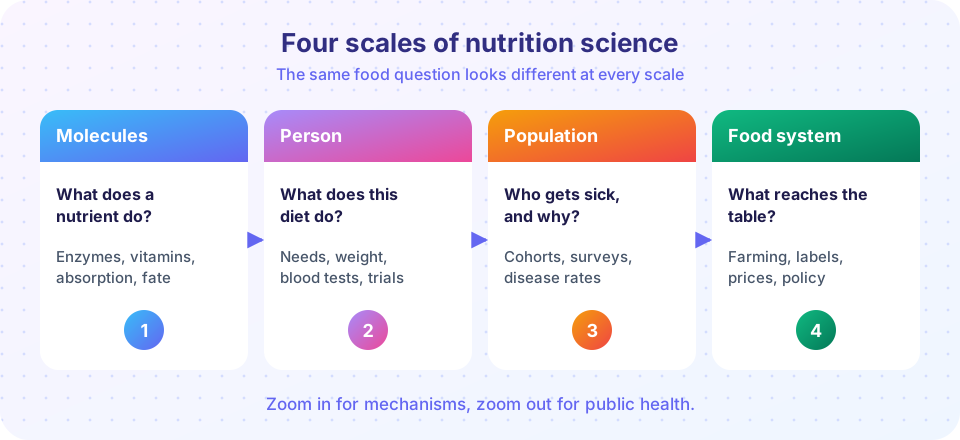
Four scales of nutrition
It helps to ask the same question at four scales.
Molecules and cells. How is a vitamin turned into a coenzyme? How does the gut absorb glucose? This is biochemistry and physiology, studied in lab experiments, animal models and carefully controlled human studies.
The person. How much energy does a teenage athlete need? What happens to blood glucose after a meal? Methods include feeding trials, metabolic studies, body measurements and blood tests.
Populations. Do people who eat more fiber develop less bowel cancer? Which regions have high rates of anemia? Here the tools are surveys, cohort studies and registries, and the statistics are about groups, not individuals.
The food system. Who grows food, how is it processed and sold, what does it cost, and what does it do to the planet? This scale connects nutrition to economics, agriculture, law and ecology, and it is the subject of Chapter 8.
Skilled nutrition scientists move between the scales. A claim that works at one scale may fail at another: a nutrient can be vital to a cell and still make no difference to a well-fed population.
A short history
Early nutrition thinking was about food and fate. The real science began with the question "what is missing?" In 1747 the Scottish naval surgeon James Lind gave twelve sailors with scurvy different treatments in pairs. The two who received oranges and lemons recovered fastest. It was an early controlled comparison, small by modern standards, but it showed that something in citrus fruit prevented a deadly disease.
In the late 1700s Antoine Lavoisier showed that respiration is a slow form of combustion, so that food is fuel and the body's heat can be measured. In the 1890s Wilbur Atwater burned foods in a calorimeter and measured what people absorb, giving the energy factors still used on labels. At about the same time Christiaan Eijkman noticed that chickens fed polished rice developed a disease like human beriberi, and that rice bran cured it. In 1912 Casimir Funk coined the word "vitamine" for such substances, and over the next decades chemists isolated and named them. Szent-Györgyi isolated vitamin C in 1928.
The twentieth century moved from deficiency to chronic disease. The Framingham Heart Study began in 1948 and showed that blood cholesterol and blood pressure predicted heart disease. In 1958 Ancel Keys launched the Seven Countries Study. In 1991 a large British trial, the MRC Vitamin Study, showed that folic acid before pregnancy reduced neural tube defects, leading to folic acid fortification of flour in many countries. In 1997 the DASH trial showed that a diet rich in fruit, vegetables and low-fat dairy lowered blood pressure.
Press Run (or Ctrl + Enter) to see the result here.
Program input · what you'd type while the program runs
Type the answers before you press Run, one per line. Each time the program reads a line (with input()), it gets the next line from this box.
Related fields: who does what?
Nutrition science produces knowledge. Dietetics applies it to individuals, often in hospitals, and is a regulated profession. Public health nutrition applies it to groups through programs such as school meals and fortification. Food science studies the chemistry, safety and technology of food itself. Sports nutrition focuses on performance and recovery. Nutritional epidemiology studies diet and disease in populations. The overlap is large, but the questions differ: a food scientist asks why bread goes stale; a nutritional epidemiologist asks whether bread type predicts heart disease.
You will also hear the word nutritionist. In some countries it is a protected title, in many it is not, so anyone may use it. For personal medical advice, look for a registered dietitian or a physician.
Why nutrition is hard to study
Compared with physics, nutrition has awkward features. People cannot be locked in a lab for years, so long-term effects are hard to test. Diets are complex and people misreport what they eat. Foods are eaten together, so one component is hard to isolate. And effects of one nutrient on disease may be small and slow, which needs large studies. Lesson 3 of this chapter explains how scientists cope. For now, remember that "unclear" is a fair answer to many food questions.
Common misconceptions
- "Nutrition is just calories." Energy matters, but the same 2,000 kcal can be adequate or deficient in protein, iron, fiber or vitamins. Quality and quantity both count.
- "A single food or nutrient causes or cures a disease." A few deficiency diseases do have a single cause (scurvy, vitamin C). Most chronic diseases arise from many factors over decades, and no single food cures them.
- "If a little is good, more is better." Most nutrients have an upper limit. Dose decides the effect.
Try it
The calculator below turns a day's menu into energy and protein totals. It uses simple rounded values, and shows the arithmetic that nutrition databases and food-label software do automatically. The second demonstration shows the U-shaped dose-response idea with an invented curve, clearly labelled as a model.
Press Run (or Ctrl + Enter) to see the result here.
Program input · what you'd type while the program runs
Type the answers before you press Run, one per line. Each time the program reads a line (with input()), it gets the next line from this box.
Press Run (or Ctrl + Enter) to see the result here.
Program input · what you'd type while the program runs
Type the answers before you press Run, one per line. Each time the program reads a line (with input()), it gets the next line from this box.
Check your understanding
Quick check · 5 questions
of 5 answered You scored / 5 · perfect!
-
1. Which description best fits nutrition science?
Nutrition science is a research discipline about food and health; weight-loss advice and supplements are applications or products. -
2. In Lind's 1747 trial, which treatment helped sailors with scurvy fastest?
The pair given oranges and lemons recovered fastest, pointing to something in citrus fruit that prevents scurvy. -
3. Which question belongs to the population scale?
Population questions compare disease rates between groups with different diets, usually in cohort studies. -
4. What does the U-shaped dose-response idea say?
Most nutrients have an adequate range with risk on both sides, which is why upper limits exist. -
5. Who applies nutrition science to individual patients in a regulated profession?
Dietitians apply nutrition science to individuals and manage diet in disease; the title is regulated in many countries.
Summary
- Nutrition science studies how food and the way we eat affect growth, function and health.
- Questions come at four scales: molecules, the person, populations and the food system.
- Its history runs from Lind's scurvy trial and Atwater's calorimeter to cohort studies and trials.
- Dose and context decide effects; most nutrients have a safe range with risk on both sides.
- Nutrition science, dietetics, food science and public health are related but different.
Track your progress
Create a free account to tick off lessons and pick up where you left off on any device.
of Nutrition Science lessons completed