


















Lesson 12 of 47 · Carbohydrates, Fats and Proteins
Carbohydrates: sugars, starch and fiber
Learn the three sizes of carbohydrate, how they are digested, what the glycemic index measures, how much sugar is too much, and why fiber matters.
Carbohydrates are the most widely eaten nutrient on Earth. Rice, wheat, maize, potatoes, fruit, milk and honey all supply them. They are also the most argued about, because the word covers things as different as a spoonful of sugar and a bowl of beans. To judge a carbohydrate food you need to know its size, how fast it is digested, and what comes packed with it.
This lesson gives you that vocabulary and the key numbers: how much carbohydrate and fiber you need, how added sugars are limited, and how the glycemic index and load work.
What you will learn
- The three sizes of carbohydrate and their food sources.
- How sugars, starch and fiber are digested, stored and used.
- What the glycemic index and glycemic load measure and their limits.
- Reference intakes for carbohydrate, fiber and added sugars.
Key terms
- Monosaccharide: a single sugar unit, such as glucose or fructose.
- Glycogen: the branched storage form of glucose in animals, held in the liver and muscles.
- Dietary fiber: carbohydrates (and related substances) that humans cannot digest in the small intestine.
- Glycemic index (GI): how strongly a food's available carbohydrate raises blood glucose compared with pure glucose.
- Free sugars: sugars added to foods plus those naturally present in honey, syrups and fruit juice.
Three sizes
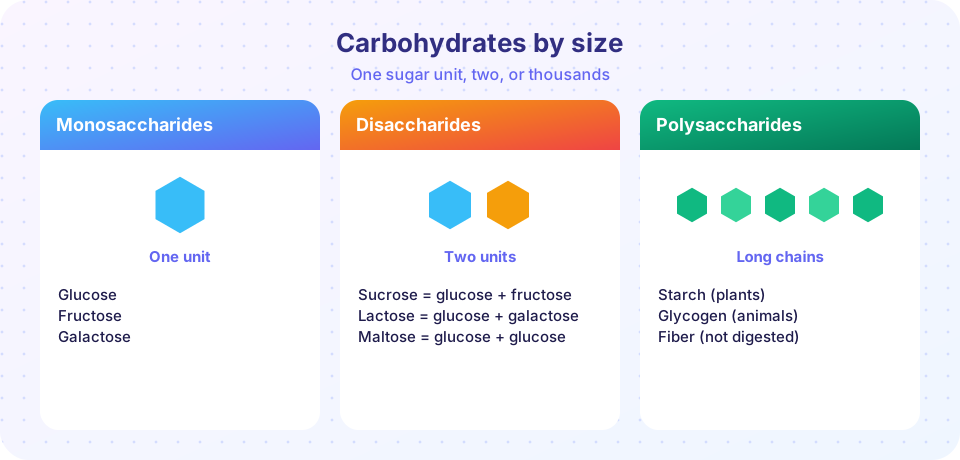
Monosaccharides have one unit. Glucose is the body's main fuel and circulates in the blood; fructose is found in fruit and honey and is metabolized mostly by the liver; galactose occurs mainly in milk sugar.
Disaccharides have two units. Sucrose (table sugar) is glucose plus fructose. Lactose (milk sugar) is glucose plus galactose. Maltose is two glucose units, produced when starch is broken down in malted grain.
Polysaccharides have many units. Starch is the plant's energy store, made of two forms: amylose (long straight chains) and amylopectin (branched), which is digested faster because it has more ends for enzymes to attack. Glycogen is the animal equivalent, found in meat in only negligible amounts. Fiber is the structural material of plants: cellulose, pectin, beta-glucans, gums and others.
Digestion and fate
Digestible carbohydrate is broken by amylase and brush-border enzymes into glucose, fructose and galactose, which are absorbed (digestion and absorption). The liver converts fructose and galactose largely into glucose or its products. Glucose has three fates:
- Used as fuel straight away, by the brain, muscles and red blood cells (which depend on glucose).
- Stored as glycogen. The liver holds about 100 g and the muscles hold about 300 to 500 g; liver glycogen maintains blood glucose between meals, muscle glycogen fuels exercise.
- Converted to fat if the stores are full and energy is in surplus.
Blood glucose is held in a narrow range by the hormones insulin (which lowers it after a meal) and glucagon (which raises it during fasting). When this control fails, the result is diabetes, a condition you should discuss with a health professional.
The body needs at least about 130 g of carbohydrate per day (the RDA for adults), set by the glucose needs of the brain. Even so, the body can make glucose from amino acids and glycerol, and in prolonged low-carbohydrate states it produces ketones as an alternative fuel for the brain.
Fiber: indigestible but not useless
Fiber is the part of plant food that resists human enzymes. It reaches the colon mostly intact. Soluble, viscous fibers such as oat beta-glucan and pectin form a gel that slows the absorption of sugar and binds bile acids, lowering LDL cholesterol modestly. Insoluble fibers such as wheat bran add bulk and speed transit. Many fibers are fermented by gut bacteria into short-chain fatty acids. Modern researchers prefer to describe fibers by these properties (viscous, fermentable, bulking) rather than only soluble and insoluble.
Reference intakes: the US sets an AI of 14 g per 1,000 kcal, about 25 g for women and 38 g for men; the UK recommends 30 g a day. Typical intakes in many countries are around half of that. Large reviews of cohort studies link higher fiber and whole grain intakes with lower risks of heart disease, type 2 diabetes and bowel cancer, with the clearest effects up to about 25 to 29 g a day. Good sources: beans, lentils, whole grains, vegetables, fruit, nuts and seeds. Increase fiber gradually and drink enough fluid.
Sugars: how much is too much?
Sugars occur naturally in whole fruit and milk, packaged with fiber, water and other nutrients. Free sugars (added sugars plus those in honey, syrups and juice) are the target of guidelines, because they are easy to over-consume and add energy with few other nutrients. The WHO recommends that free sugars supply less than 10 percent of energy, with a further reduction to below 5 percent (about 25 g or 6 teaspoons on a 2,000 kcal diet) suggested for additional benefit. US Dietary Guidelines also advise less than 10 percent of calories from added sugars. Sugar-sweetened drinks are the largest source in many countries, and trials and cohort studies link them to weight gain and type 2 diabetes. Teeth are affected by how often free sugars are eaten, as much as by the amount.
A teaspoon of sugar is about 4 g. A 330 mL can of cola holds roughly 35 g, close to nine teaspoons.
The glycemic index
The glycemic index (GI) ranks carbohydrate foods by how they raise blood glucose in the two hours after eating, compared with glucose. A volunteer eats a portion with 50 g of available carbohydrate; the area under their blood glucose curve is compared with that after 50 g of glucose, which is given a value of 100. Low GI is 55 or less, medium is 56 to 69, and high is 70 or more. Examples (approximate, because variety, ripeness and cooking change values): lentils about 30, apples about 35, rolled oats about 55, white bread about 75, boiled white rice 70 to 80.
GI has limits. It tells the speed but not the amount of carbohydrate in a normal serving. The glycemic load (GL) corrects this: GL = GI x grams of available carbohydrate in the serving / 100. Watermelon has a high GI but little carbohydrate per slice, so its GL is low. Also, the response depends on the mixed meal: fat, protein and fiber slow a high-GI food. GI is most useful as a tool within people managing diabetes, and for choosing between similar foods (for example oat porridge over a sugary cereal), rather than as a ranking of "good" and "bad" foods. Many high-GI foods, such as potatoes, are nutritious, and some low-GI foods, such as chocolate, are not.
Common misconceptions
- "Sugar causes diabetes directly." The risk of type 2 diabetes rises with excess weight, inactivity and genetics. High intakes of sugary drinks raise risk, mostly via energy excess and weight gain.
- "Fruit sugar is as bad as added sugar." Whole fruit contains fiber and water, and eating fruit is linked to better health. Fruit juice and smoothies are closer to free sugars.
- "Brown sugar, honey or 'raw' sugar are healthy sweeteners." They count as free sugars with trivial extra nutrients.
- "Low-carb is the only way to lose weight." Studies find that diets with different carbohydrate shares produce similar weight loss when energy is matched and followed; what matters is a pattern a person can keep.
Try it
The first demonstration converts grams of sugar into teaspoons and compares it with the WHO limits. The second calculates glycemic load. The third charts the fiber content of common foods.
Press Run (or Ctrl + Enter) to see the result here.
Program input · what you'd type while the program runs
Type the answers before you press Run, one per line. Each time the program reads a line (with input()), it gets the next line from this box.
Press Run (or Ctrl + Enter) to see the result here.
Program input · what you'd type while the program runs
Type the answers before you press Run, one per line. Each time the program reads a line (with input()), it gets the next line from this box.
Check your understanding
Quick check · 5 questions
of 5 answered You scored / 5 · perfect!
-
1. Which disaccharide is made of glucose and fructose?
Sucrose is glucose plus fructose. Lactose is glucose plus galactose, and maltose is two glucoses. -
2. Where is most of the body's glycogen stored?
Muscles store roughly 300 to 500 g and the liver about 100 g of glycogen. -
3. A food has GI 60 and a serving contains 20 g of available carbohydrate. What is its glycemic load?
GL = 60 x 20 / 100 = 12. -
4. WHO advice on free sugars is
The strong recommendation is under 10 percent of energy; a conditional one suggests under 5 percent. -
5. Which is true of dietary fiber?
Fiber escapes human enzymes; bacteria ferment part of it to short-chain fatty acids.
Summary
- Carbohydrates come in three sizes: monosaccharides, disaccharides and polysaccharides (starch, glycogen, fiber).
- Glucose is used, stored as glycogen, or converted to fat; blood glucose is controlled by insulin and glucagon.
- Fiber is not digested but feeds gut bacteria and links to lower disease risk; aim for roughly 25 to 38 g a day.
- Keep free sugars under 10 percent of energy, ideally less.
- GI ranks foods by blood glucose response; glycemic load includes the serving size; both have limits.
Next: Fats and fatty acids
Track your progress
Create a free account to tick off lessons and pick up where you left off on any device.
of Nutrition Science lessons completed