


















Lesson 4 of 47 · Getting Started
Reference intakes and food labels
Understand EAR, RDA, AI and UL, why they are ranges rather than magic numbers, and how to read a Nutrition Facts label and percent daily value.
How much vitamin C do you need? Many sources say 90 mg for men and 75 mg for women. But those are not the amounts that stop scurvy (about 10 mg does that), and they are not the highest you may safely take (2,000 mg). They are a carefully chosen point in the middle. To read nutrition information sensibly you must know what each number on the page is for.
This lesson explains the vocabulary of reference intakes, the logic behind it, and how the same ideas appear on food labels as the percent daily value.
What you will learn
- The meaning of EAR, RDA, AI, UL and AMDR, and which one is used for what.
- Why the RDA is derived from the EAR with a simple rule.
- How other systems (EFSA, WHO, UK) fit together.
- How to read serving size and percent daily value on a Nutrition Facts label.
Key terms
- Dietary Reference Intakes (DRIs): the family of values used in the United States and Canada to plan and assess diets of healthy people.
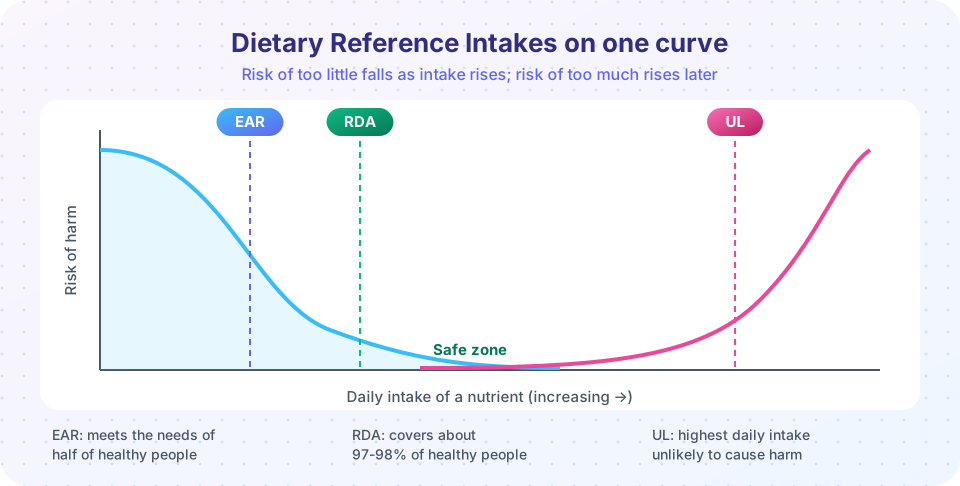
- EAR (Estimated Average Requirement): the intake that meets the needs of half of healthy people in a group.
- RDA (Recommended Dietary Allowance): the intake that meets the needs of about 97 to 98 percent of healthy people in a group.
- AI (Adequate Intake): a best estimate used when there is not enough evidence to set an EAR.
- UL (Tolerable Upper Intake Level): the highest daily intake unlikely to cause harm for almost everyone.
Requirements vary between people
No two people need exactly the same amount of a nutrient. Body size, age, sex, genes, pregnancy, and health all play a part. If you measure the requirement of a thousand healthy adults, the values form a bell-shaped distribution. The middle of the bell is the EAR: half of people need less, and half need more. Planning a diet to the EAR for a group would leave half of them short.
So the RDA is set higher, at the EAR plus two standard deviations. In a normal distribution, that point covers about 97.5 percent of the group. When the standard deviation is not known, the committees assume a coefficient of variation (SD divided by the mean) of 10 percent, giving the rule RDA = 1.2 x EAR. Protein and some others use 12.5 or 15 percent.
The RDA is a target for individuals. It is not a minimum below which you will fall ill: intakes between the EAR and the RDA are still adequate for many people, and short-term low intakes rarely cause harm, because the body stores many nutrients.
When data are thin: the AI
For some nutrients, such as calcium in some age groups, fiber, potassium, vitamin K and water, the evidence is not strong enough for an EAR. The committee then sets an Adequate Intake, based on observed intakes of healthy groups or on experiments. An AI is less certain than an RDA, but it is used the same way: a goal for individuals.
The upper limit
The UL protects against excess, which matters most for supplements and fortified foods. It is the highest daily intake from all sources that is unlikely to cause adverse effects. Intakes above the UL are not necessarily harmful, but the risk rises and the safety margin disappears. Some examples for adults: vitamin D 100 µg (4,000 IU), zinc 40 mg, and, for preformed vitamin A, 3,000 µg per day. For some nutrients (for example vitamin K, which has no known toxicity from food) no UL could be set; that does not mean that unlimited amounts are safe.
Macronutrient ranges and energy
For the energy nutrients, the DRIs give the Acceptable Macronutrient Distribution Range (AMDR): carbohydrate 45 to 65 percent of energy, fat 20 to 35 percent, and protein 10 to 35 percent for adults. There is an Estimated Energy Requirement (EER) for weight maintenance, but note that energy is the exception: no one recommends going above the average on energy, because excess is stored as fat. There is no RDA for energy.
Other countries, similar ideas
The same logic exists everywhere with different names. The European Food Safety Authority publishes Population Reference Intakes (PRIs) and Adequate Intakes; the UK uses Dietary Reference Values (including a Reference Nutrient Intake); the World Health Organization and FAO publish joint requirements; Japan, Australia and New Zealand have their own Nutrient Reference Values. The numbers can differ a little because committees weigh evidence differently and populations differ. Where you see a difference, it is a sign of uncertainty, not of error.
Reading a Nutrition Facts label
Labels use a related idea: the Daily Value (DV). A DV is a single reference amount used for everyone over four years old, so one label can serve a whole population. In the United States the current DVs include total fat 78 g, saturated fat 20 g, sodium 2,300 mg, total carbohydrate 275 g, dietary fiber 28 g, added sugars 50 g, protein 50 g, calcium 1,300 mg, iron 18 mg, potassium 4,700 mg and vitamin D 20 µg, all based on a 2,000 kcal diet.
To read a label:
- Check the serving size first. All numbers are for one serving, which may be much smaller than what you eat. If the pack holds two servings and you eat it all, double everything.
- Look at calories per serving, then the nutrients to limit (saturated fat, sodium, added sugars) and those to get enough of (fiber, vitamin D, calcium, iron, potassium).
- Use the %DV rule of thumb: 5 percent or less is low, and 20 percent or more is high. Choose foods low in saturated fat, sodium and added sugars, and high in fiber and the nutrients you need.
- Read the ingredient list. Ingredients are listed in descending order by weight, so the first ingredient is the biggest.
In the EU and UK, labels list values per 100 g or 100 ml so products can be compared directly, and many countries add a front-of-pack scheme such as traffic-light colors or a letter grade. Claims such as "high in fiber" or "low fat" are regulated and require stated thresholds; for example, in the EU "source of fiber" requires at least 3 g per 100 g.
Common misconceptions
- "The RDA is the minimum I must hit every day." It is a target that covers nearly everyone. Averaging near it over days is what counts.
- "If the RDA is good, a megadose is better." Above the UL, risks rise and benefits do not.
- "%DV tells me how much of my own needs a food provides." It uses one reference value for everyone, so it is approximate for any one person, especially children, athletes and pregnant women.
- "'Natural' or 'no added sugar' means low in sugar." Check the label: fruit juice has no added sugar but plenty of free sugars.
Try it
The first demonstration shows why the RDA sits above the EAR. The second is a label calculator: enter the amounts in one serving and see the percent daily value and whether it counts as low or high.
Press Run (or Ctrl + Enter) to see the result here.
Program input · what you'd type while the program runs
Type the answers before you press Run, one per line. Each time the program reads a line (with input()), it gets the next line from this box.
Check your understanding
Quick check · 5 questions
of 5 answered You scored / 5 · perfect!
-
1. What does the EAR represent?
The EAR is the median requirement: half of the group need less and half need more. -
2. If the EAR of a nutrient is 50 mg and the assumed coefficient of variation is 10 percent, what is the RDA?
RDA = EAR + 2 SD = 50 + 2 x 5 = 60 mg, which equals 1.2 x EAR. -
3. When is an Adequate Intake (AI) used?
An AI is a best estimate from observed intakes or experiments when no EAR can be set. -
4. A label says 22% DV for sodium per serving. By the rule of thumb this is
20 percent or more of the Daily Value is considered high. -
5. You eat the whole pack, which contains two servings of 150 kcal each. How many kilocalories did you eat?
Label values are per serving, so two servings give 2 x 150 = 300 kcal.
Summary
- Requirements vary, so reference intakes are statistical: EAR (half covered), RDA (about 97 to 98 percent), AI (best estimate), UL (upper safe limit).
- RDA is usually 1.2 times the EAR; it is a goal for individuals, not a cliff edge.
- AMDRs give healthy ranges for the shares of energy from carbohydrate, fat and protein.
- Other regions use similar systems with different names and slightly different numbers.
- On labels, check the serving size first and use %DV: 5 percent or less is low, 20 percent or more is high.
Next: Chapter 1 review
Track your progress
Create a free account to tick off lessons and pick up where you left off on any device.
of Nutrition Science lessons completed