


















Lesson 30 of 47 · Nutrition Across the Lifespan
Chapter 6 review: nutrition across the lifespan
Review nutrient needs from pregnancy and infancy to childhood, adolescence, adulthood and older age with a summary table and a ten-question quiz.
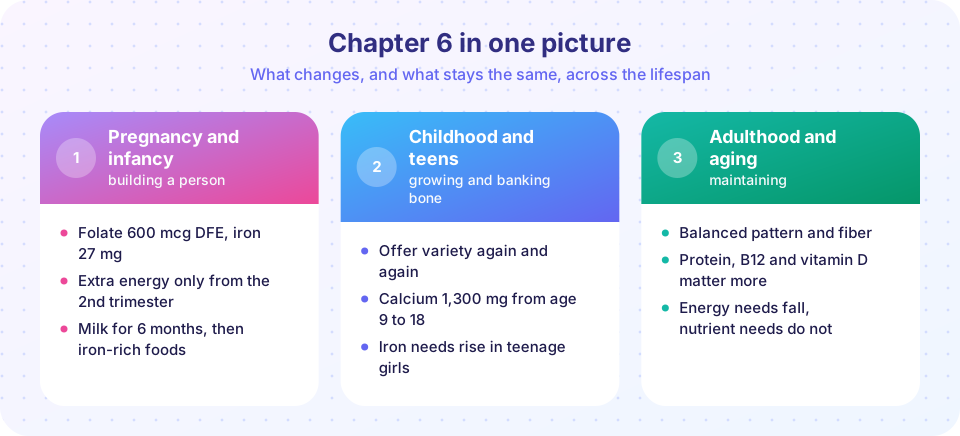
This chapter covered the whole life course. The central lesson is that the right diet depends on the life stage: pregnancy needs more of a few nutrients, infants need milk and then iron-rich foods, teenagers need to build bone, and older adults need nutrient-dense food and protein with fewer calories. Use this page to consolidate the key numbers and ideas.
What you will learn
- The most important nutrient priorities at each life stage.
- Which numbers from the chapter are worth remembering.
- How to avoid common errors when applying recommendations to individuals.
Recap table
| Stage | Priorities | Key numbers |
|---|---|---|
| Pregnancy | Folate before and early on, iron, iodine, food safety | +340 kcal (2nd trimester), +450 kcal (3rd); folate 600 mcg DFE; iron 27 mg |
| Lactation | Energy, fluids, iodine, choline | About +330 kcal in months 0-6, +400 kcal after |
| Infancy | Milk, vitamin D and K, iron-rich foods, early allergen introduction | Exclusive milk to about 6 months; honey only after 12 months |
| Childhood | Variety, iron, calcium, water | Calcium 700 mg (1-3 y), 1,000 mg (4-8 y) |
| Adolescence | Bone building, iron, regular meals | Calcium 1,300 mg; iron 15 mg (girls), 11 mg (boys) |
| Adulthood | Balance, fiber, healthy weight | Fiber 25 g (women), 38 g (men) AI |
| Older age | Protein, B12, vitamin D, calcium, fluids | Protein 1.0-1.2 g/kg suggested; B12 2.4 mcg from fortified foods or supplements |
Key terms to know: DRI, EAR, RDA, AI, UL, gestational weight gain, neural tube defect, exclusive breastfeeding, complementary foods, percentile, peak bone mass, sarcopenia, anabolic resistance, nutrient density.
Common mistakes to avoid
- Treating the RDA as a personal target: it is a group-level target for healthy people.
- Believing pregnancy doubles food needs rather than raising specific nutrient needs.
- Reading a single growth measurement instead of the trajectory.
- Assuming older adults should eat less of everything, rather than less energy but dense nutrients.
Worked scenarios
Scenario 1. A mother asks whether her 8-month-old can have a spoonful of honey. Honey is advised against before 12 months, because of the rare risk of infant botulism. She could offer mashed lentils or fortified cereal instead, which also supply iron.
Scenario 2. A 15-year-old girl avoids dairy. Her calcium RDA is 1,300 mg and her iron RDA is 15 mg. Fortified plant milks, calcium-set tofu, canned fish with bones, beans and fortified cereals can help, and a doctor or dietitian can check whether a supplement is needed.
Scenario 3. A woman of 72 is eating less since her partner died. Her protein target of 1.0 to 1.2 g per kg, her need for 20 micrograms of vitamin D and 2.4 micrograms of B12 from fortified foods or a supplement, and social aspects of eating are all relevant. Unintentional weight loss warrants a clinician's review.
Working through short scenarios like these is the fastest way to turn the tables of numbers into usable knowledge.
Try it
The JavaScript demonstration below computes a few of the chapter's rules in one place: an infant's feeding stage, a child's calcium target and an older adult's protein range.
Press Run (or Ctrl + Enter) to see the console output here.
No output.
Check your understanding
Quick check · 10 questions
of 10 answered You scored / 10 · perfect!
-
1. In which trimester does the extra energy requirement begin?
The estimate is zero extra in the first trimester, about 340 kcal in the second. -
2. Why is 400 micrograms of folic acid recommended for people who could become pregnant?
Closure occurs about four weeks after conception. -
3. Which food should not be given to an infant under 12 months?
Honey carries a small risk of infant botulism. -
4. What did the LEAP trial show?
The eating group had far less peanut allergy at age five. -
5. What is the calcium RDA for 9-18 year olds?
It is the highest of any life stage because teenagers are building peak bone mass. -
6. A child's weight moves from the 25th to the 5th percentile over a year. What is the best interpretation?
Crossing percentiles is more informative than either number alone, though it is not itself a diagnosis. -
7. Why do girls aged 14-18 have a higher iron RDA than boys?
Iron lost with menstruation increases needs. -
8. What is sarcopenia?
It describes muscle loss that affects function. -
9. Which recommendation changes for everyone over 70?
The vitamin D RDA rises to 20 micrograms from age 71. -
10. Why is B12 from fortified foods favored for older adults?
Food-bound B12 needs stomach acid, which often declines with age.
Summary
- Needs differ by life stage; DRIs describe groups, not individuals.
- Early life nutrition may have lasting effects; milk, then iron-rich foods, then variety is the pathway.
- Teens bank bone; older adults need protein, B12, vitamin D and calcium within fewer calories.
Track your progress
Create a free account to tick off lessons and pick up where you left off on any device.
of Nutrition Science lessons completed