


















Lesson 42 of 47 · Projects and Practice
Project 2: plan meals around energy and macronutrients
Estimate energy needs, set macronutrient ranges, convert percentages to grams, add fiber and limits, and check a draft menu with a planner you build yourself.
Analysis looks backward at what someone ate. Planning looks forward: given a person and a goal, what should a day of eating look like? Dietitians do this when they write meal plans for athletes, patients or schools. In this project you will use the energy tools from chapter 5 and the reference ideas from chapter 6 to build a planner step by step, and then check a menu against it using the method from the previous project.
Educational exercise only. The planner uses general ranges for healthy adults. It is not a prescription: people with medical conditions, pregnancy, eating disorders or special needs should get individual advice.
What you will learn
- How to estimate a daily energy target and adjust it for a goal.
- What the acceptable macronutrient distribution ranges (AMDR) are and how to turn percentages into grams.
- How to set fiber, saturated fat, sugar and sodium limits.
- How to spread a day's food over meals and check the plan.
Key terms
- AMDR: acceptable macronutrient distribution range, the range of energy shares associated with adequate nutrition and lower chronic disease risk: carbohydrate 45-65 percent, fat 20-35 percent and protein 10-35 percent for adults.
- Energy target: the planned daily intake in kilocalories.
- Energy deficit / surplus: a planned intake below or above estimated expenditure.
- Meal pattern: how food is distributed across meals and snacks.
- Added sugars: sugars added during processing or preparation, as opposed to those naturally in whole fruit and plain milk.
Step 1: estimate needs
Start with an estimate of TDEE using the Mifflin-St Jeor equation and an activity factor. For a 35-year-old woman of 65 kg and 168 cm with light activity (factor 1.375):
BMR  = 10 x 65 + 6.25 x 168 - 5 x 35 - 161 = 1,364 kcal
TDEE = 1,364 x 1.375 = about 1,875 kcal
Estimates have a wide error, as the earlier lesson stressed. A planner should treat TDEE as a starting point, check what happens to weight over several weeks and adjust. If the goal is weight maintenance, target intake equals TDEE. For gradual weight loss, planners often choose a moderate deficit of 10-20 percent (not more, to protect protein, micronutrients and adherence); for gain, a modest surplus. Very low energy intakes should be supervised by a clinician.
Step 2: choose macronutrient shares
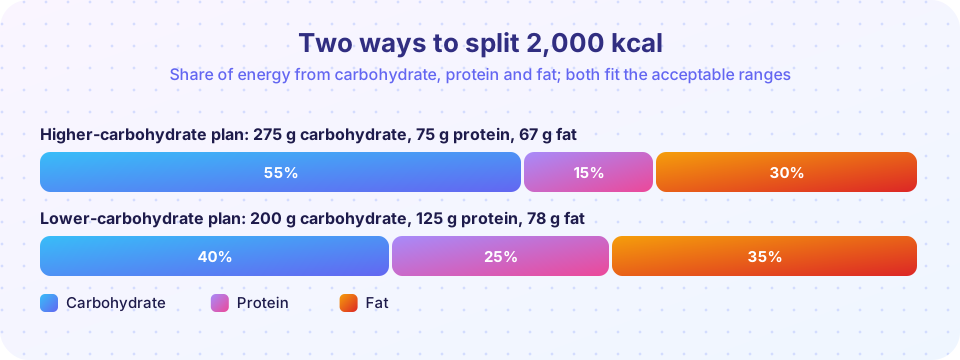
Within the AMDR there is room for different patterns. The picture above shows two examples at 2,000 kcal. To convert shares to grams, use the Atwater factors from lesson 1 of chapter 5:
carbohydrate grams = energy x share / 4
protein grams      = energy x share / 4
fat grams          = energy x share / 9
A person who wants a protein target in grams per kilogram can work backward: 1.2 g per kg for a 65 kg person is 78 g, which is 312 kcal, or about 16 percent of a 1,900 kcal day.
Step 3: add the other targets
- Fiber: 14 g per 1,000 kcal is the basis for adequate intake (about 25 g for women and 38 g for men).
- Saturated fat: under 10 percent of energy (US guidelines; some bodies advise lower).
- Added sugars: under 10 percent of energy, and the WHO suggests that going below 5 percent has further benefit.
- Sodium: under 2,300 mg (WHO: under 2,000 mg).
- Micronutrients: take targets from the DRIs for the person's age and sex, then check the final menu.
Step 4: distribute across the day
Most people eat three meals with one or two snacks. A simple division is breakfast 25 percent, lunch 30, dinner 30 and snacks 15 percent of energy. Spreading protein over meals (about 20-30 g each) is commonly advised for older adults and active people. Cultural and personal habits matter more than any template, and a plan that does not fit someone's life will not be followed.
Press Run (or Ctrl + Enter) to see the console output here.
No output.
Step 5: build the menu and test it
Turn the plan into foods using food groups: a base of whole grains or starchy vegetables, vegetables and fruit at most meals, a protein source (legumes, fish, eggs, dairy, poultry, lean meat, tofu) and unsaturated fats (olive oil, nuts, seeds). Then use the analyzer from the previous project to total the menu and compare it with the plan: energy within about 5 to 10 percent of target, macronutrient shares inside the ranges, fiber at or above target, and micronutrients close to the DRIs. Adjust and repeat. This loop is how professional meal plans are built.
The widget below lets you explore the AMDR visually: drag the sliders for carbohydrate and protein (fat is what is left) and watch the grams and the range check.
Practice problems
- A 70 kg man has a TDEE of 2,600 kcal and wants about 1.6 g of protein per kg. How many grams of protein, and what share of energy? (Answer: 112 g, which is 448 kcal or about 17 percent.)
- A 1,800 kcal plan has 30 percent fat. How many grams of fat? (Answer: 60 g.)
- What is the fiber target for a 2,400 kcal plan using 14 g per 1,000 kcal? (Answer: about 34 g.)
- A plan gives 55 percent carbohydrate, 15 percent protein and 30 percent fat. Is it within the AMDR? (Answer: yes.)
Common misconceptions
- "There is one best macronutrient split." Trials such as DIETFITS show that people lose similar weight on different splits; adherence and food quality matter.
- "A bigger deficit is always better." Large deficits risk losing muscle, missing nutrients and rebound; moderate deficits are easier to sustain.
- "Plans are fixed." The best plan is revised using real-world feedback.
A worked example: building a day
Take the 1,876 kcal plan for the 35-year-old woman above, with 50 percent carbohydrate, 20 percent protein and 30 percent fat, which is about 234 g of carbohydrate, 94 g of protein and 63 g of fat. Breakfast (about 470 kcal) could be oatmeal with milk, a banana and a handful of nuts. Lunch (about 560 kcal) could be lentil soup with whole-grain bread and a side of vegetables and yogurt. Dinner (about 560 kcal) could be grilled fish or tofu with brown rice, broccoli and a little olive oil. Snacks (about 280 kcal) could be fruit, a small portion of cheese or a glass of milk. Then run the menu through the analyzer from the first project: does it reach the energy target within 10 percent, the fiber target of about 26 g, the calcium and iron targets? If iron is low, add more legumes and a vitamin C food; if sodium is high, reduce processed items. This cycle of plan, test and adjust is the real skill, because the first draft is rarely right.
Check your understanding
Quick check · 5 questions
of 5 answered You scored / 5 · perfect!
-
1. How many grams of carbohydrate are in 1,800 kcal at 50 percent carbohydrate?
1,800 x 0.5 = 900 kcal; divide by 4 kcal per gram. -
2. How many grams of fat are in a 2,000 kcal diet with 30 percent fat?
600 kcal divided by 9 kcal per gram. -
3. Which is the AMDR for protein in adults?
The ranges are carbohydrate 45-65, fat 20-35, protein 10-35 percent. -
4. Why is a very large energy deficit usually not advised?
Moderate deficits are easier to maintain and protect nutrition. -
5. What is the step that closes the planning loop?
Plan, analyze, adjust and repeat.
Summary
- Estimate TDEE, set an energy target and convert macronutrient shares to grams with 4-4-9.
- Add fiber, saturated fat, sugar and sodium targets and micronutrient DRIs.
- Build the menu from food groups, test it with an analyzer and revise.
- Many splits within the AMDR are healthy; the right one fits the person.
Next: Project 3: case studies
Track your progress
Create a free account to tick off lessons and pick up where you left off on any device.
of Nutrition Science lessons completed