


















Lesson 21 of 47 · Energy Balance and Metabolism
Chapter 5 overview: energy balance and metabolism
A map of energy balance: how food energy is measured, how the body spends it, how weight is regulated, and what each lesson in this chapter covers.
Every living cell needs a constant supply of energy. You get that energy from food, you spend it keeping warm, pumping blood, digesting, thinking and moving, and anything left over is stored. This chapter follows that flow from the plate to the body and back out as heat and work. It also asks the question behind most public debate about diet: why does body weight change, and why is it so hard to change on purpose?
What you will learn
- How the energy in food is defined, measured and printed on labels.
- What makes up daily energy expenditure and how to estimate it.
- How the brain and hormones regulate appetite and body weight.
- Why the simple rule "calories in, calories out" is true but incomplete.
The big picture
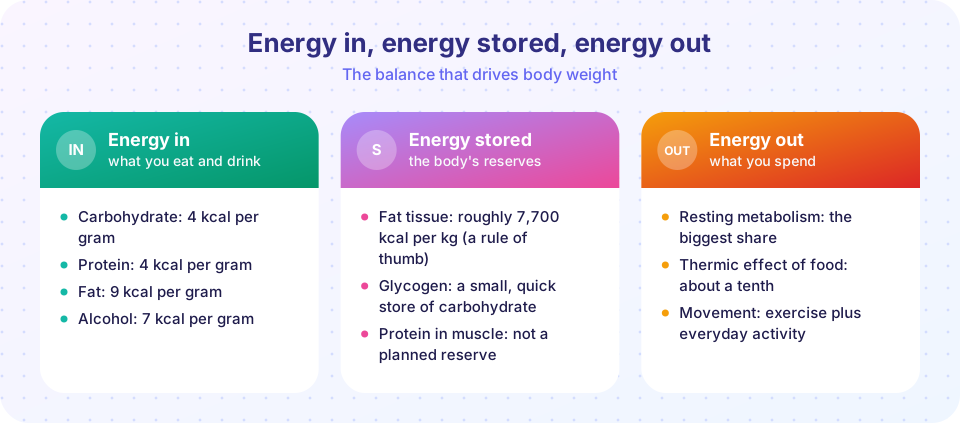
The first law of thermodynamics says energy is neither created nor destroyed. Applied to a person, it says that change in stored energy = energy intake - energy expenditure. If you eat more energy than you spend, the surplus is stored, mostly as body fat. If you spend more than you eat, the body draws on its stores. That statement is an accounting identity, so it is always true.
What makes nutrition science interesting is everything the identity hides. Intake is not simply what you put in your mouth: some energy is lost in feces, and the amount depends on the food and the person. Expenditure is not a fixed number: it shifts with body size, body composition, temperature, the amount you move and, importantly, with how much you have been eating recently. And the brain is not a neutral bystander: it adjusts hunger and fidgeting in ways that you rarely notice.
Energy in
Energy out
Regulation
Why it is hard
What each lesson covers
- Units and measurement: kilocalories and kilojoules, the bomb calorimeter, Atwater factors, and what a food label does and does not tell you.
- Energy expenditure: basal and resting metabolic rate, prediction equations, the thermic effect of food, activity, and total daily energy expenditure.
- Energy balance and body weight: the rule of thumb for weight change, appetite hormones, adaptive thermogenesis and why weight loss is hard to keep.
- Chapter review: a one-page summary and a ten-question quiz.
This chapter gives educational information, not personal advice. Calculators here give estimates with wide error bars, and nothing here replaces a health professional who knows your history.
Three ideas to hold on to
- Energy is a budget, not a verdict. Calories are a unit of accounting. A food with many calories is not "bad", and a food with few is not "good": what matters is the whole day, the whole diet and the needs of the person eating it.
- Averages hide people. Every equation in this chapter was built from averages of many people, and every individual departs from the average. Treat estimates as starting points that you adjust with real-world feedback.
- The body answers back. Appetite, movement and metabolism respond to what you eat. This feedback is why short experiments can mislead and why weight is better understood as a regulated variable than as a simple sum.
As you read, keep asking two questions of every number: where did it come from, and how uncertain is it? The units lesson shows that even the energy printed on a food package has an error margin, and the lessons that follow show that the same is true of expenditure.
Try it
The widget below shows the accounting identity in action. Change the daily intake and expenditure and see how a small daily gap adds up over weeks, using the common rule of thumb of about 7,700 kcal per kilogram of body fat. It is a simplified demonstration: real bodies adjust, so the later lessons show why long-run results are smaller.
Check your understanding
Quick check · 4 questions
of 4 answered You scored / 4 · perfect!
-
1. What does the energy balance identity state?
It is an application of the conservation of energy: any surplus is stored and any deficit is drawn from stores. -
2. Which statement is the best description of 'calories in, calories out'?
The identity cannot be wrong, but expenditure and appetite both change when intake changes. -
3. Which is the largest component of daily energy expenditure for most people?
Keeping the body running at rest usually takes about 60 to 70 percent of the day's energy. -
4. Why does the widget's prediction overestimate long-term weight change?
Metabolism and appetite adapt, so a fixed daily gap does not keep producing the same loss.
Summary
- Energy balance is an accounting identity: stored energy changes by intake minus expenditure.
- Food energy, expenditure and appetite each have their own complexities.
- The rest of the chapter measures energy, estimates expenditure and explains regulation.
Next: Units and measurement
Track your progress
Create a free account to tick off lessons and pick up where you left off on any device.
of Nutrition Science lessons completed