


















Lesson 17 of 47 · Vitamins and Minerals
Fat-soluble vitamins: A, D, E and K
Learn what vitamins A, D, E and K do, which foods supply them, the deficiency diseases, safe upper limits, and why they need fat to be absorbed.
Four vitamins dissolve in fat rather than water: A, D, E and K. They have little in common chemically, but they share how the body handles them. They are absorbed with dietary fat, ride in chylomicrons through the lymph, and are stored in the liver and fat tissue. Storage is a double-edged sword. It protects against short gaps in intake but allows excess to accumulate.
This lesson takes each in turn: what it does, where it comes from, what a lack looks like and how much is too much.
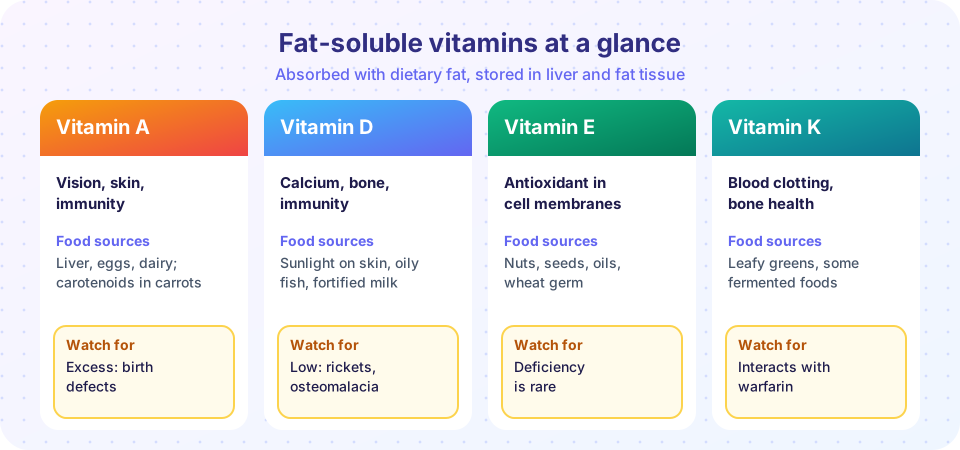
What you will learn
- The main function, food sources and deficiency of each fat-soluble vitamin.
- How vitamin D is made in the skin and why latitude, season and skin color matter.
- The reference intakes and upper limits for adults.
- Why supplements of these vitamins need caution.
Key terms
- Retinol: the active, preformed form of vitamin A found in animal foods.
- Carotenoid: a plant pigment, some of which (like beta-carotene) the body converts to vitamin A.
- RAE (retinol activity equivalents): the unit for vitamin A that accounts for different forms: 1 µg RAE = 1 µg retinol = 12 µg dietary beta-carotene.
- 25-hydroxyvitamin D: the form measured in blood to assess vitamin D status.
- Antioxidant: a substance that prevents oxidation of other molecules.
Vitamin A
Vitamin A is essential for vision: retinal, made from it, is part of the light-detecting pigment in the eye, and the first sign of deficiency is night blindness. It also keeps skin and the linings of the gut, lungs and eyes healthy, supports the immune system, and controls how genes are switched on during growth.
Two kinds of source exist. Preformed vitamin A (retinol) occurs in liver, egg yolk, whole milk, butter and fortified foods. Provitamin A carotenoids such as beta-carotene occur in orange and dark green plants such as carrots, sweet potato, pumpkin, mango, spinach and kale, and are converted in the body as needed. The RDA is 900 µg RAE for men and 700 µg RAE for women.
Vitamin A deficiency is a major global problem: it is a leading cause of preventable childhood blindness and raises the risk of death from infections such as measles. Programs of vitamin A supplementation and fortification save many lives.
Because it is stored, excess preformed vitamin A is toxic. The UL is 3,000 µg RAE a day for adults. High intakes in early pregnancy can cause birth defects, so pregnant women are advised to avoid liver and vitamin A supplements beyond recommended doses. Carotenoids from food are safe, though a lot of carrots can turn the skin harmlessly orange. However, large trials found that beta-carotene supplements increased lung cancer in smokers, a reminder that "natural" supplements are not automatically safe.
Vitamin D
Vitamin D is unusual: your skin can make it. When ultraviolet B light strikes a cholesterol derivative in the skin, it is converted to vitamin D3, which the liver converts to 25-hydroxyvitamin D (the storage and measuring form) and the kidney to calcitriol, the active hormone. Calcitriol raises calcium and phosphate absorption in the gut, which hardens bone.
Deficiency causes rickets in children (soft, bowed legs, delayed growth) and osteomalacia in adults (bone pain and weakness), and raises the risk of falls and fractures in older adults. Vitamin D also acts on muscle and immune cells, but trials of supplements in people who are already replete have not confirmed broad effects on cancer or heart disease.
Few foods contain much vitamin D: oily fish (salmon, herring, sardines), cod liver oil, egg yolks, UV-exposed mushrooms and fortified milk, margarine, cereals and plant drinks. Sunlight is the main source for most people, but synthesis depends on latitude (little UVB in winter above about 40 degrees north), season, time of day, skin pigmentation (more melanin reduces production, so people with darker skin living at higher latitudes are at greater risk), age, clothing and sunscreen. Skin cancer risk limits how much deliberate sun exposure can be recommended.
US reference values: RDA 15 µg (600 IU) for ages 1 to 70 and 20 µg (800 IU) above 70, with an AI of 10 µg (400 IU) for infants; the UL is 100 µg (4,000 IU). Note 1 µg = 40 IU. In the UK, 10 µg per day is advised for all people in autumn and winter, and all year for those with little sun exposure. Breastfed infants are usually given a supplement.
Vitamin E
Vitamin E, mainly alpha-tocopherol, sits in cell membranes and acts as an antioxidant, stopping the chain of oxidation in membrane fats. It also affects immune cells and blood platelets. Sources are vegetable oils (sunflower, wheat germ, olive), nuts (almonds, hazelnuts), seeds and some green vegetables. The RDA is 15 mg a day. Deficiency is rare in healthy people; it occurs in conditions with severe fat malabsorption (cystic fibrosis, some liver diseases) and in premature infants, causing nerve and muscle damage. The UL for supplements is 1,000 mg. High-dose supplements can interfere with clotting, and trials of large doses to prevent heart disease and cancer did not show benefit; the SELECT trial found a small increase in prostate cancer with vitamin E alone.
Vitamin K
Vitamin K, from the German Koagulation, is required to make clotting factors in the liver (factors II, VII, IX and X) and certain bone proteins. Vitamin K1 (phylloquinone) comes from leafy greens such as spinach, kale, broccoli and lettuce, and from some oils. Vitamin K2 (menaquinones) is made by bacteria and found in fermented foods such as natto, and some cheeses. Gut bacteria make K2 but the contribution to needs is uncertain. The AI is 120 µg for men and 90 µg for women. Newborns have low stores and a gut without bacteria, so a vitamin K injection at birth is standard to prevent a rare, life-threatening bleeding disorder.
No UL has been set for K because toxicity from food is unknown. An important interaction: the anticoagulant warfarin works by blocking vitamin K recycling, so people who take it must keep their vitamin K intake steady, not avoid greens.
Absorption and risk groups
All four need fat in the meal and bile for absorption. A salad with a little oil improves carotenoid absorption several-fold. Conditions that reduce fat absorption (cystic fibrosis, celiac disease, liver and gallbladder disease, some weight-loss surgery, orlistat) put people at risk of deficiency. Very low-fat diets with few fats may reduce absorption.
Common misconceptions
- "Vitamin D from supplements is as good as eating plenty of everything else." Supplements help those who are deficient or at risk, but trials in healthy people show little extra benefit.
- "Carrots give you perfect eyesight." They help prevent deficiency-related night blindness but will not improve normal vision. (The wartime story that pilots ate carrots to see in the dark is generally thought to have helped hide the use of radar.)
- "If a little vitamin A is good, more is better." Excess preformed vitamin A is harmful, especially in pregnancy.
- "Sun is the only source of vitamin D, so avoid sunscreen." Short, incidental sun is part of normal life; for most people the right balance is moderate sun, sensible protection and dietary or supplemental sources when needed.
Try it
The first demonstration converts a food list to vitamin A in RAE, and checks it against the RDA. The second compares supplement doses against the upper limits.
Press Run (or Ctrl + Enter) to see the result here.
Program input · what you'd type while the program runs
Type the answers before you press Run, one per line. Each time the program reads a line (with input()), it gets the next line from this box.
Press Run (or Ctrl + Enter) to see the result here.
Program input · what you'd type while the program runs
Type the answers before you press Run, one per line. Each time the program reads a line (with input()), it gets the next line from this box.
Check your understanding
Quick check · 5 questions
of 5 answered You scored / 5 · perfect!
-
1. Which deficiency disease is caused by lack of vitamin D in children?
Rickets causes soft, bowed bones in children; scurvy is vitamin C and beriberi is thiamin deficiency. -
2. Vitamin A in plant foods comes mainly as
Plants contain carotenoids, which the body converts to vitamin A as required. -
3. People taking warfarin should
Warfarin blocks the vitamin K cycle, and sudden changes in K intake affect its action. -
4. Which vitamin helps absorb calcium by acting as a hormone?
Calcitriol, the active form of vitamin D, increases calcium and phosphate absorption. -
5. Why is high-dose preformed vitamin A avoided in pregnancy?
Excess retinol is teratogenic; the UL is 3,000 ug RAE a day.
Summary
- Vitamin A supports vision, immunity and epithelia; deficiency causes night blindness; excess preformed A is toxic.
- Vitamin D is made in skin under UVB and acts like a hormone for calcium; deficiency causes rickets and osteomalacia.
- Vitamin E is a membrane antioxidant; deficiency is rare, and high-dose supplements have not shown benefit.
- Vitamin K makes clotting factors and bone proteins; keep it steady with warfarin.
- All four need dietary fat for absorption and are stored, so caution is needed with high-dose supplements.
Next: Water-soluble vitamins
Track your progress
Create a free account to tick off lessons and pick up where you left off on any device.
of Nutrition Science lessons completed