


















Lesson 9 of 47 · Foundations of Nutrition
Water and hydration
Learn why water is the most urgent nutrient, how the body balances intake and loss, how much people typically need, and what dehydration and overhydration do.
You can survive weeks without food but only days without water. Yet water gets little attention in nutrition because it is cheap, calorie-free and everywhere. It is nonetheless the largest single component of your body and the medium in which every reaction of life takes place.
This lesson treats water as the nutrient it is: what it does, where it is found, how your body keeps its amount steady, how much people usually need, and what happens when there is too little or too much.
What you will learn
- How much of the body is water and where it is held.
- The main functions of water.
- The sources and routes of loss, and how the body regulates balance.
- Reference intakes and why "eight glasses a day" is not a rule.
- The effects and risks of dehydration and overhydration.
Key terms
- Total body water: all the water in the body, about 50 to 60 percent of adult body weight.
- Intracellular fluid (ICF): water inside cells, about two thirds of total body water.
- Extracellular fluid (ECF): water outside cells, including blood plasma and fluid between cells.
- Osmolality: the concentration of dissolved particles in body fluids; it triggers thirst and hormone release.
- Metabolic water: water produced when the body oxidizes fuels.
Water in the body
Total body water is roughly 60 percent of body weight in adult men and 50 to 55 percent in adult women, because fat tissue holds less water than muscle. It is higher, about 75 percent, in newborns, and it falls with age. Two thirds of it is inside cells (ICF) and one third is outside (ECF), including blood plasma. Muscle is about 75 percent water and fat tissue about 10 to 20 percent. A 70 kg man therefore carries about 40 liters.
Water carries out jobs that no other substance can do as well. It is the solvent in which nutrients and waste dissolve, the transport medium of blood, a reactant in digestion (hydrolysis), a lubricant for joints and the eye, a coolant through sweat evaporation (water takes a lot of heat to evaporate), and a shock absorber for the brain and spinal cord.
Balance: sources and losses
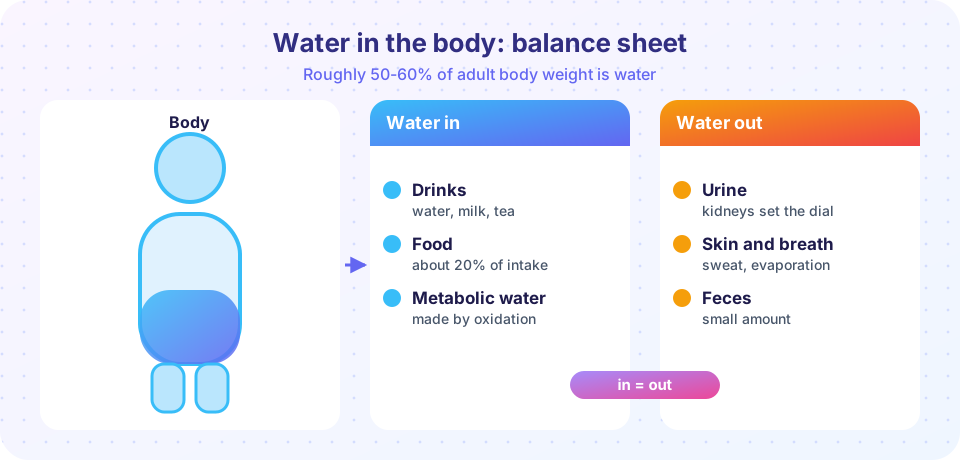
An adult in a mild climate typically takes in and loses around 2 to 3 liters a day.
Sources. Drinks provide most of it. Food provides about 20 percent on average, and much more if you eat plenty of fruit, vegetables and soups (cucumber is 95 percent water, bread about 35 percent). Metabolic water, produced when carbohydrates, fats and proteins are oxidized, adds a few hundred milliliters per day.
Losses. The main route is urine, around 1 to 2 liters per day, set by the kidneys. Skin loses water by sweat and by invisible evaporation, lungs lose it as humid breath (you can see this on a cold day), and feces carry out about 100 to 200 mL. In heat, hard exercise or fever, sweat losses can reach one to two liters per hour.
The kidneys must excrete a minimum volume of urine to remove waste (about 0.5 liter per day), so you cannot drink less than this and stay healthy.
How the body regulates water
Balance is controlled by a feedback loop. When you lose water, the concentration (osmolality) of the blood rises slightly. Sensors in the brain detect a rise of only 1 to 2 percent, trigger thirst, and cause the pituitary gland to release antidiuretic hormone (ADH, also called vasopressin). ADH tells the kidneys to reclaim water, so urine becomes small in volume and dark. When you drink, osmolality falls, ADH release stops, and the kidneys produce larger amounts of pale urine. This system is accurate: most healthy people maintain body weight to within about one percent day after day. Thirst is a good guide for most people, but it can lag behind needs during intense exercise, in older adults whose thirst sense weakens, and in young children who cannot get their own drinks.
How much is enough?
There is no single correct number. US reference values (Adequate Intakes) are about 3.7 liters of total water per day for adult men and 2.7 liters for adult women, including water from food and all beverages. European guidance (EFSA) gives about 2.5 liters for men and 2.0 liters for women. Since food provides roughly 20 percent, this means about 2.5 to 3 liters of fluids for men and 2 to 2.2 liters for women in the US figures. These are the typical amounts of healthy, mostly sedentary people in temperate climates, not goals for everyone; needs rise with heat, altitude, exercise, fever, pregnancy and breastfeeding.
The famous "eight glasses of water a day" has no clear scientific origin. A related 1945 US statement noted that an adult needs about 1 mL of water per kilocalorie of food, but added that most of this comes from food. The second part was forgotten. All beverages count, including tea, coffee and milk: caffeine causes a small, short-lived diuresis, but habitual drinkers still retain most of the fluid.
A practical check is urine color: pale straw suggests good hydration and dark amber suggests low intake, though certain vitamins, foods and medicines change the color, so it is a rough guide.
Dehydration
Dehydration is a net loss of body water. A fluid deficit of 1 to 2 percent of body weight causes thirst, a slight drop in concentration, headache and fatigue. A deficit of around 2 percent or more can reduce endurance performance, and larger deficits (5 percent and more) cause marked weakness, dizziness and confusion; severe dehydration is a medical emergency. Causes include sweating without replacement, vomiting and diarrhea (the leading cause of child deaths from dehydration worldwide, which is why oral rehydration solution, a precise mix of water, glucose and salts, is considered one of the most important medical advances of the last century), fever, and illness. In older people and babies, the risk is higher.
Overhydration
Drinking far more than the kidneys can excrete, which is up to about one liter per hour at best, dilutes the sodium in the blood, causing hyponatremia. Symptoms range from nausea and headache to seizures and, rarely, death. Cases occur among endurance athletes who over-drink during long events, in people who drink excessive water in contests, and in some medical conditions and medications. The lesson: the aim is to replace what you lose, not to "flush" the body.
Common misconceptions
- "If you feel thirsty, you are already badly dehydrated." Thirst starts with a small rise in blood concentration, long before dehydration is serious, so thirst is an early signal.
- "Coffee and tea dehydrate you." In regular drinkers, caffeinated drinks contribute to fluid intake; the diuretic effect is mild.
- "Everyone must drink 2 to 3 liters of plain water." Total water includes food and other drinks, and needs vary with body size, weather and activity.
- "You can never drink too much." Excess water can dilute blood sodium dangerously.
Try it
The first demonstration is a balance simulator. Move the sliders to set intake and losses and see the net change. The second is a calculator that converts a body weight loss during exercise into a fluid estimate. Both are teaching models, not recommendations for any individual.
Press Run (or Ctrl + Enter) to see the result here.
Program input · what you'd type while the program runs
Type the answers before you press Run, one per line. Each time the program reads a line (with input()), it gets the next line from this box.
Check your understanding
Quick check · 5 questions
of 5 answered You scored / 5 · perfect!
-
1. Roughly what fraction of an adult man's body weight is water?
Total body water is around 60 percent in adult men and 50 to 55 percent in women, because fat holds less water than muscle. -
2. Which hormone tells the kidneys to conserve water?
ADH increases water reabsorption in the kidney, producing smaller volumes of concentrated urine. -
3. A typical US Adequate Intake of total water for adult women is about
The US AI is 2.7 L total water for women and 3.7 L for men, with about 20 percent coming from food. -
4. A runner drinks far too much plain water over hours and develops confusion. A likely cause is
Excess water dilutes blood sodium, which can cause swelling of brain cells and symptoms such as confusion. -
5. Which statement about coffee and fluid intake is best supported?
Caffeine has a mild, short-lived diuretic effect, but the fluid in the drink still counts.
Summary
- Water makes up about 50 to 60 percent of adult body weight, two thirds of it inside cells.
- It dissolves, transports, lubricates, cools and takes part in reactions.
- Intake comes from drinks, food and metabolic water; loss through urine, skin, breath and feces; the kidneys, thirst and ADH keep balance.
- Reference total water is about 2.0 to 3.7 L a day depending on sex and country, but individual need varies a lot.
- Both dehydration and overhydration (hyponatremia) can be harmful.
Next: Chapter 2 review
Track your progress
Create a free account to tick off lessons and pick up where you left off on any device.
of Nutrition Science lessons completed