


















Lesson 36 of 47 · Food Systems and Policy
Chapter 8 overview: food systems and policy
See nutrition as a system: from farm to fork, food safety, labels, food security, sustainability and the policies that shape what people eat. Includes a lesson map.
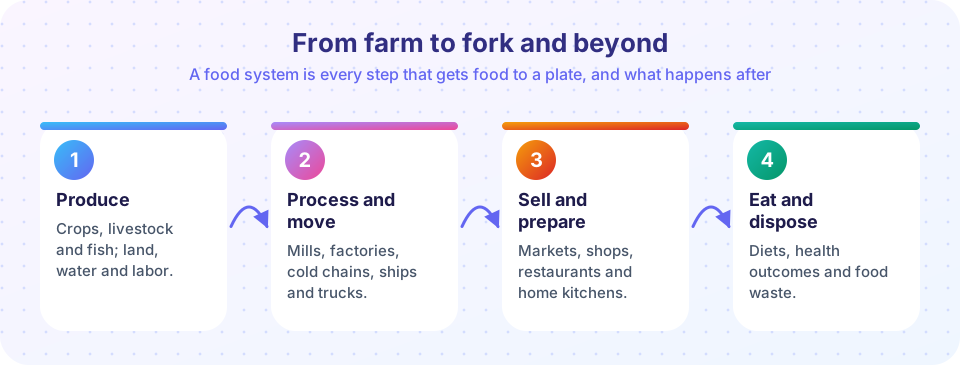
So far this course has treated food as something a person chooses: which nutrients to eat, how much, at what age. But people do not choose from an empty space. What they can afford, what is on the shelf, what is safe to eat, what the label says, what is advertised to their children, what grows in their region and what the planet can sustain all shape the menu long before anyone sits down to eat. This chapter widens the lens from the plate to the food system, the whole web of activities that gets food from land and sea to your table and beyond.
What you will learn
- What a food system is and who takes part in it.
- Why food safety, labeling, food security, sustainability and policy are all nutrition topics.
- How the world's nutrition problems fit together: hunger, micronutrient deficiencies and obesity.
- How governments and communities change diets, and what evidence there is that it works.
Key terms
- Food system: all the people, activities and resources involved in producing, processing, distributing, preparing, consuming and disposing of food.
- Food environment: the physical, economic and social setting in which people choose food: prices, shops, advertising, school and workplace menus.
- Food security: a state in which everyone, at all times, has access to enough safe and nutritious food for an active, healthy life.
- Triple burden of malnutrition: undernutrition, micronutrient deficiency and overweight or obesity, often present in the same country or even household.
- Food policy: laws, taxes, standards and programs that shape what is grown, sold and eaten.
Why the system matters for nutrition
Take three well-known examples from earlier chapters. Folate deficiency causing neural tube defects fell sharply when countries added folic acid to flour, a system intervention that required no one to change what they ate. Trans fats largely disappeared from food supplies when governments regulated them, again without asking consumers to read every label. And iodine deficiency, once a leading cause of preventable intellectual disability, retreated as salt iodization spread. In each case a change at the level of the food supply achieved more than any education campaign alone could.
The same system also produces problems. Hunger persists in places where food exists but cannot be afforded or distributed. Cheap, energy-dense, heavily processed foods are marketed everywhere, so obesity and diet-related disease rise even in poorer countries. About a third of the food produced is lost or wasted, while agriculture uses roughly half of the world's habitable land and is a major source of greenhouse gases. These are not separate problems: they share causes, and solutions in one area affect the others.
Safe food
Clear information
Food security
Sustainability
Policy
What each lesson covers
- Food safety and labeling: foodborne illness, the Five Keys, HACCP and Codex, additives and allergens, and how to read nutrition labels.
- Food security and sustainability: the four pillars, the triple burden of malnutrition, food loss, emissions and what a sustainable diet looks like.
- Dietary guidelines and food policy: how guidelines are made, fortification, taxes, school meals, labels and the evidence on what works.
- Chapter review: summary and ten questions.
Try it
Click through the stages of the food system and see what nutrition-related issues arise at each. The widget is a map of ideas for the rest of the chapter, not data.
Check your understanding
Quick check · 4 questions
of 4 answered You scored / 4 · perfect!
-
1. What is a 'food system'?
It covers production, processing, distribution, preparation, consumption and disposal. -
2. Why did folic acid fortification of flour work so well?
Changes in the food supply protect everyone who eats the fortified food. -
3. What does the 'triple burden of malnutrition' mean?
Many countries face all three at once. -
4. What is the food environment?
It includes availability, affordability, advertising and information.
Summary
- Diets are shaped by the food system and food environment, not just personal choice.
- Population-level changes (fortification, regulation) can achieve large effects without effort from individuals.
- Safety, labels, security, sustainability and policy are the topics of the next lessons.
Next: Food safety and labeling
Track your progress
Create a free account to tick off lessons and pick up where you left off on any device.
of Nutrition Science lessons completed