


















Lesson 39 of 47 · Food Systems and Policy
Dietary guidelines and food policy: what works?
How national dietary guidelines are made, and what evidence says about fortification, sugar taxes, salt reduction, school meals and front-of-pack labels as public health tools.
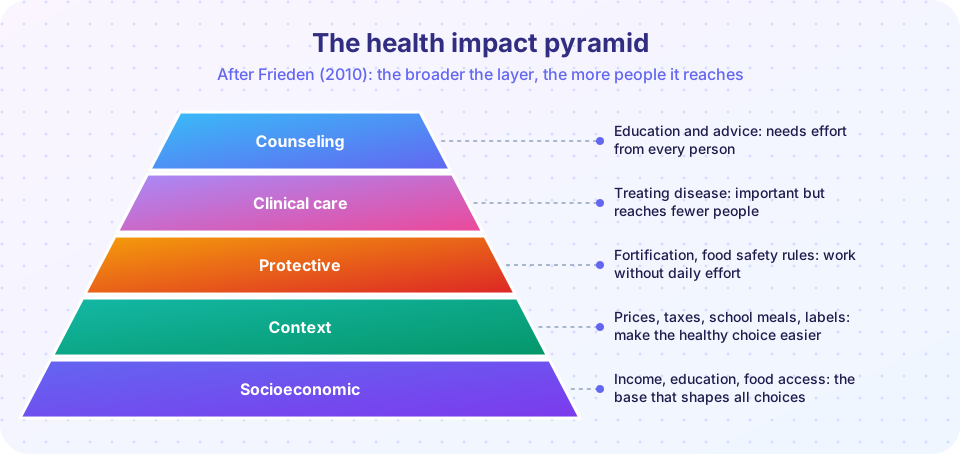
When governments and health agencies want to improve diets, they have two broad kinds of tools. The first is advice: dietary guidelines, campaigns and labels that tell people what to eat. The second is changing the system: rules, prices and programs that alter what is in food and what is easy to choose. Research in public health suggests the second often reaches more people with less effort, which is why many of nutrition's biggest successes came from fortifying flour, reformulating salt and banning trans fats rather than from telling people to eat better. This lesson looks at both kinds of tools and at the evidence on each.
What you will learn
- How national dietary guidelines are developed and how they are presented.
- The main policy tools: fortification, taxes, regulation, labeling, school meals and social programs.
- What evidence there is that each works, and what the trade-offs are.
- How to think about policy fairly, including equity and unintended consequences.
Key terms
- Food-based dietary guidelines (FBDGs): national advice on what foods to eat, as opposed to nutrient numbers.
- Fortification: adding vitamins or minerals to foods during processing.
- Reformulation: changing a recipe, for example to cut salt or sugar.
- Price elasticity: the percentage change in quantity bought when price changes by 1 percent.
- Equity: fair distribution of benefits and burdens across groups, including poorer households.
How dietary guidelines are made
Guidelines begin with an expert committee that reviews evidence, often using systematic reviews of the sort described in the evidence chapter, and grades how strong it is. Reference values (DRIs, see the lifespan overview) say how much of each nutrient a population needs; guidelines translate those into foods, taking into account local diets, culture, cost and food supply. More than 100 countries now publish food-based guidelines, according to the FAO.
Familiar examples:
- United States: the Dietary Guidelines for Americans, published jointly by the Departments of Agriculture and Health every five years since 1980, are the legal basis for federal food programs. Their graphic has changed: the Food Guide Pyramid (1992), MyPyramid (2005) and MyPlate (2011).
- United Kingdom: the Eatwell Guide shows the proportions of food groups on a plate.
- Canada: the 2019 Food Guide recommends about half the plate as vegetables and fruit, a quarter whole grains and a quarter protein foods (with an emphasis on plant proteins), and water as the drink of choice, and dropped servings counts and a separate dairy group.
- Brazil: the 2014 guide is notable for being built around degree of processing (the NOVA classification) rather than nutrients, with the golden rule of preferring natural or minimally processed foods and freshly made dishes.
Common messages across guidelines include eating plenty of vegetables, fruit, whole grains and legumes; choosing unsaturated over saturated fat; limiting salt, sugar and processed meat; and staying active. Where they differ (for example on dairy or on red meat) reflects local diets and shifting evidence. Guidelines have their critics: their text is limited by the evidence, and political lobbying and industry ties have been alleged in several countries, which is why transparent processes and conflict-of-interest rules matter.
Policy tools and what the evidence says
Fortification and enrichment
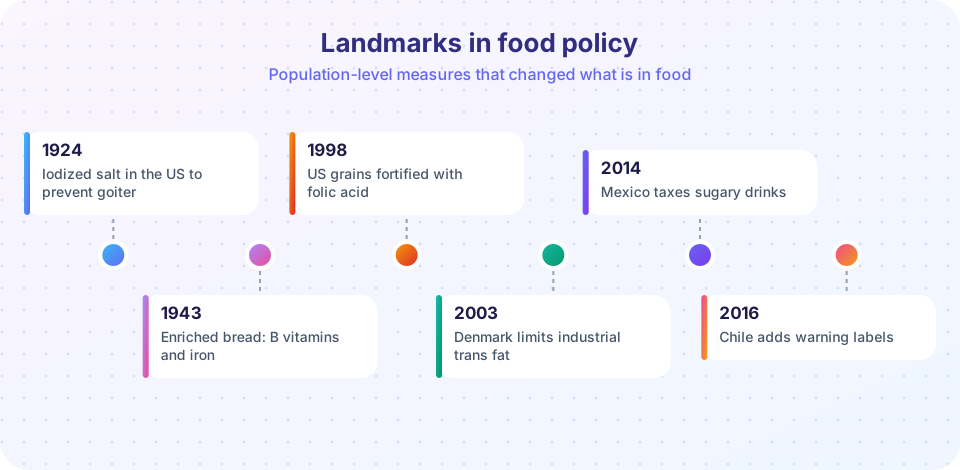
Adding nutrients to staple foods is among the most successful and cost-effective nutrition policies ever tried, because it works through foods people already eat. Salt iodization began in Switzerland and the United States in the early 1920s and, together with later worldwide programs, sharply reduced goiter and the mental impairment of iodine deficiency; enrichment of white flour and bread in the US in the 1940s helped end pellagra and beriberi; folic acid fortification of grain products (the US in 1998 and many countries since) was followed by lower neural tube defect rates; and vitamin D added to milk helped nearly eliminate rickets in some countries. Biofortification breeds crops with more nutrients, such as orange-fleshed sweet potato rich in provitamin A. Fortification needs monitoring, so that levels are right and the vehicle reaches the people in need, and it cannot fix a poor diet on its own.
Taxes and subsidies
Many governments tax sugar-sweetened drinks, aiming both to reduce consumption and to push producers to cut sugar. Mexico introduced a tax of about one peso per liter in 2014 and studies reported that purchases of taxed drinks fell by roughly 6 to 8 percent on average over the first two years, with larger falls among lower-income households. The UK Soft Drinks Industry Levy (2018) charged by sugar content in two tiers; the main effect was reformulation, with manufacturers cutting sugar in drinks by roughly a third while sales volumes were broadly steady. Studies commonly estimate price elasticities of around -1 for sugary drinks, meaning that a 10 percent rise in price lowers purchases by about 10 percent. Questions remain about long-term effects on body weight, about substitution to other sugary products and about the burden on poorer households, though poorer households also gain most in health. Subsidies work in the other direction: farm subsidies shape what is cheap, and vouchers or incentives for fruit and vegetables can raise purchases.
Press Run (or Ctrl + Enter) to see the result here.
Program input · what you'd type while the program runs
Type the answers before you press Run, one per line. Each time the program reads a line (with input()), it gets the next line from this box.
Regulation and reformulation
Mandatory rules can reach whole supplies. Trans fat: Denmark's limit (2003) was followed by bans or limits in many countries, with falls in trans fat intake and, in studies, in heart disease. Salt: the UK's program from 2003 (targets for food companies, a public campaign and clear labels) was followed by a fall in average salt intake of about 15 percent over about eight years. Voluntary agreements are easier to agree but less reliable than mandatory limits. Restricting marketing of unhealthy foods to children is recommended by the WHO because exposure is linked to preference and consumption, and several countries restrict it.
Labels and information
Front-of-pack labels can help shoppers compare products and can push manufacturers to reformulate. Evidence from experiments is that simple, interpretive labels (traffic lights, Nutri-Score, warnings) steer choices more than nutrient tables, and the Chilean example in the labeling lesson combined labels with restrictions on marketing. Menu calorie labels in restaurants lead to small average reductions in calories ordered.
School meals and social programs
Schools reach almost every child. National school-meal standards, free meals, and rules about vending machines shape diets and also support attendance and learning. The US WIC program (for pregnant women, infants and young children), started in 1974, is associated with better birth outcomes and diets, and programs such as SNAP, cash transfers and community gardens help access. Brazil's school feeding law requires that at least 30 percent of the budget buys food from family farms, linking nutrition and local agriculture.
Weighing policy fairly
Policy debates mix evidence and values. People differ on how much government should intervene, so a good analysis separates what works from what is acceptable. Evaluate any policy by asking:
- Effectiveness: does it change diets or health, how much, in whom?
- Equity: who gains and who pays? A sugar tax is regressive in cost but may deliver larger health gains for low-income groups.
- Unintended effects: substitution to other unhealthy foods, industry reformulation with substitutes (sweeteners), black markets.
- Cost and feasibility: fortification is cheap per person reached; clinical treatment of disease is expensive.
- Evidence quality: many policy evaluations are natural experiments with comparison groups, not randomized trials, so they carry the biases of observational design.
Common misconceptions
- "Policies take away freedom of choice." Many policies only change defaults, information or prices, and the existing food environment is already shaped by commercial and political decisions.
- "Education is enough." Education matters, but evidence shows environment and price changes usually reach more people.
- "If a policy is voluntary it works as well." Mandatory standards usually achieve larger and more consistent changes.
Check your understanding
Quick check · 6 questions
of 6 answered You scored / 6 · perfect!
-
1. What distinguishes food-based dietary guidelines from nutrient reference values?
DRIs say how much of each nutrient; guidelines say what foods to eat to meet them. -
2. Which policy works by changing the food supply without requiring individual effort?
Fortification reaches everyone who eats the food. -
3. If the price elasticity of sugary drinks is about -1, what happens to purchases when the price rises 10 percent?
Elasticity of -1 means a 1 percent price rise lowers quantity by about 1 percent. -
4. What was the main effect of the UK Soft Drinks Industry Levy?
The tiered levy gave a strong incentive to lower sugar content. -
5. What is special about Brazil's 2014 dietary guidelines?
They rely on the NOVA classification and advise preferring natural or minimally processed foods. -
6. In the health impact pyramid, which layer reaches the most people?
Changes to income, education and the context in which people live affect whole populations.
Summary
- Dietary guidelines translate nutrient needs into food advice; formats and emphases differ by country.
- Fortification, regulation, taxes, labels and school meals have good evidence, with trade-offs to weigh.
- Interventions lower on the impact pyramid reach more people and rely less on individual willpower.
- Good policy analysis separates effectiveness, equity, side effects and cost.
Next: Chapter review
Track your progress
Create a free account to tick off lessons and pick up where you left off on any device.
of Nutrition Science lessons completed