


















Lesson 19 of 47 · Vitamins and Minerals
Minerals in the body
Learn what calcium, iron, zinc, iodine, sodium, potassium and other minerals do, how absorption is helped or blocked, and the deficiency and excess risks.
Minerals are the chemical elements of nutrition. They make bones hard, carry the electrical signals of nerves, tie oxygen to the blood, and sit at the center of hundreds of enzymes. Unlike vitamins, they cannot be destroyed by cooking, but they can be locked up by other food components, which is why the amount in a food and the amount you absorb can differ greatly.
This lesson gives you a working knowledge of the minerals that matter most for health: calcium and bone, iron and blood, iodine and the thyroid, zinc and immunity, and the electrolytes sodium and potassium that set blood pressure and fluid balance.
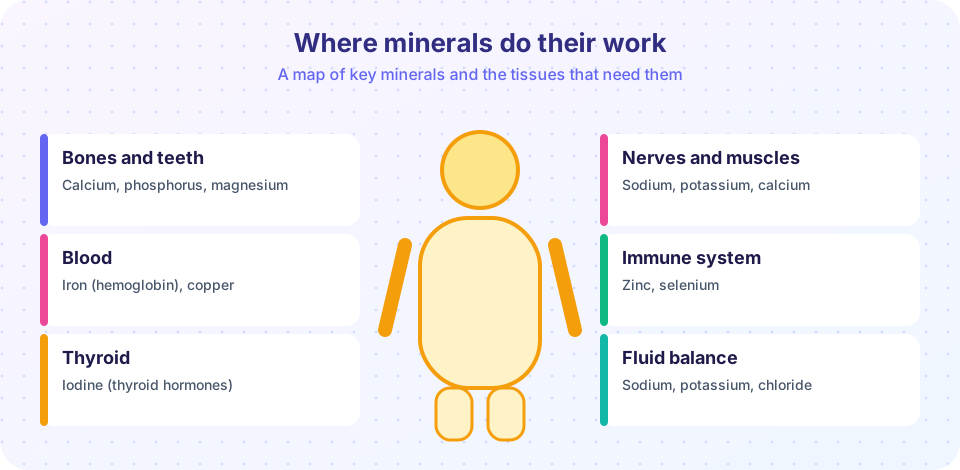
What you will learn
- The main role, sources and reference intakes of calcium, iron, zinc, iodine, sodium and potassium.
- Why iron deficiency is so common and how absorption is helped or blocked.
- How sodium and potassium relate to blood pressure.
- Which interactions between minerals matter in practice.
Key terms
- Heme iron: iron bound in the heme group of hemoglobin and myoglobin in animal foods; well absorbed.
- Non-heme iron: iron from plants and fortified foods; less well absorbed and strongly influenced by other foods.
- Phytate: a compound in whole grains, legumes and seeds that binds minerals and reduces their absorption.
- Electrolyte: a mineral that carries an electric charge in water, such as sodium, potassium and chloride.
- Osteoporosis: a disease of low bone mass and fragile bones.
Calcium and bone
About 99 percent of the body's calcium is in bones and teeth, where it forms crystals with phosphate. The rest, in the blood and cells, is essential for nerve signals, muscle contraction and blood clotting, and the body keeps it within a tight range by drawing on the bone reservoir when intake is short. Bone is living tissue, constantly broken down and rebuilt. Bone mass builds through childhood and adolescence and peaks around age 30, then slowly declines, so the calcium and activity of the first decades set up a bank for the rest of life. Osteoporosis is the result of too little bone mass or too much loss, and risk rises after the menopause.
The RDA is 1,000 mg a day for most adults, 1,200 mg for women over 50 and men over 70, and 1,300 mg for teenagers. Sources include milk, yogurt and cheese, fortified plant drinks, tofu set with calcium, canned fish with edible bones, and some leafy greens such as kale and bok choy. Spinach is rich in calcium on paper, but its oxalate binds it so little is absorbed. Calcium absorption needs vitamin D. A UL of 2,500 mg applies to adults under 50 (2,000 mg above 50); very high supplemental doses can cause kidney stones and constipation. Weight-bearing exercise and adequate protein support bone, too; calcium supplements alone have limited effect in people who already eat enough.
Iron and oxygen
Iron sits at the center of hemoglobin, the red blood cell protein that carries oxygen, and of myoglobin in muscle. It is also needed in many enzymes. Because iron is dangerous in excess (it promotes damaging free radicals), the body has a strict system: there is no way to excrete excess, so absorption is controlled by the hormone hepcidin, which falls when stores are low.
Iron deficiency is the most common micronutrient deficiency in the world. It develops in stages, ending in iron-deficiency anemia: fatigue, pallor, breathlessness and reduced ability to concentrate. At risk: women with heavy periods, pregnant women, infants and toddlers, teenage girls, vegetarians and endurance athletes. The RDA is 8 mg for men and for women over 50, 18 mg for women aged 19 to 50, and 27 mg in pregnancy.
Food sources and absorption differ. Heme iron from red meat, poultry and fish is absorbed at roughly 15 to 35 percent. Non-heme iron from beans, lentils, tofu, dark greens, fortified cereals and dried fruit is absorbed at roughly 2 to 20 percent. Vitamin C, and meat or fish in the same meal, increase non-heme absorption; tea, coffee, calcium and phytates reduce it. So a practical tip for people who rely on plant iron: add a source of vitamin C (pepper, citrus, tomato) to the meal and leave tea and coffee for between meals. Vegetarians are often advised to aim for about 1.8 times the usual iron intake.
Too much iron is also harmful: the UL is 45 mg, accidental overdose of iron tablets is a leading cause of poisoning in young children, and the inherited condition hemochromatosis causes iron overload. Do not take iron supplements without a reason; test first.
Iodine and the thyroid
The thyroid gland needs iodine to make thyroid hormones, which regulate metabolic rate, growth and brain development. Deficiency enlarges the thyroid (goiter) and, in pregnancy and infancy, impairs brain development, causing intellectual disability. Iodine deficiency is the world's leading preventable cause of brain damage, and the use of iodized salt has been one of the greatest public-health successes. Sources: seafood, seaweed (very variable and sometimes excessive), dairy, eggs and iodized salt. RDA 150 µg for adults and 220 µg in pregnancy. Too much (UL 1,100 µg) can also disturb the thyroid.
Zinc and selenium
Zinc is a part of over 300 enzymes and is important for growth, immune function, wound healing and taste. Sources: oysters (exceptionally rich), red meat, poultry, seafood, legumes, nuts and seeds. Phytates in whole grains and beans reduce absorption, so plant-based diets may need more. RDA 11 mg (men) and 8 mg (women). Excess zinc (UL 40 mg) causes nausea and, over time, copper deficiency. Selenium (RDA 55 µg) is part of antioxidant enzymes and thyroid hormone metabolism. Brazil nuts are extremely rich in it, and the soil content of a region affects the selenium in local crops. Both zinc and selenium have a narrow window between enough and too much.
Sodium, potassium and blood pressure
Sodium and chloride (together in salt) and potassium are the main electrolytes. Sodium is the chief mineral outside cells, potassium inside, and the pump that keeps the difference uses a large share of the body's energy. They govern fluid balance, nerve signals and muscle contraction, including the heartbeat.
Sodium is needed (an adequate intake is 1,500 mg a day), but most people eat much more. The WHO recommends less than 2 g of sodium (5 g of salt) per day for adults, and the US figure is a chronic-disease risk reduction level of 2,300 mg. Typical intakes are roughly 3 to 4 g of sodium. To convert, salt (g) = sodium (g) x 2.5, so 2.3 g sodium is almost 6 g of salt, about a level teaspoon. Excess sodium raises blood pressure in many people, and high blood pressure is a leading risk factor for stroke and heart disease. The DASH-sodium trial found that lowering sodium reduced blood pressure and that the effect was greatest in people with higher blood pressure and on a DASH diet. Most sodium (over 70 percent in the US) comes from processed and restaurant foods, such as bread, cheese, processed meat, soups and sauces, not from the salt shaker.
Potassium works in the other direction: higher intake lowers blood pressure and stroke risk. The AI is 3,400 mg for men and 2,600 mg for women; the WHO suggests at least 3.5 g. Most people fall short. Sources: beans, potatoes, bananas, yogurt, leafy greens, tomatoes, fish, avocado and nuts. People with kidney disease or on certain drugs can accumulate potassium dangerously and need medical advice.
Other minerals
Phosphorus (RDA 700 mg) works with calcium in bone and in ATP, widely available in protein foods. Magnesium (400 to 420 mg men, 310 to 320 mg women) is needed for over 300 enzymes and bone; sources are nuts, seeds, whole grains and greens. Fluoride strengthens tooth enamel and reduces cavities, which is why water fluoridation and toothpaste are used. Copper, manganese, chromium and molybdenum are needed in tiny amounts and deficiency is uncommon.
Interactions to remember
- Vitamin D improves calcium absorption; vitamin C improves non-heme iron absorption.
- Phytates and oxalates (whole grains, legumes, spinach) bind minerals; soaking, sprouting, fermenting and leavening bread reduce phytate.
- Calcium and iron compete a little when taken together as high-dose supplements.
- Zinc in large doses reduces copper absorption.
- Sodium and potassium are partners: a high-potassium, low-sodium diet is best for blood pressure.
Common misconceptions
- "Sea salt is healthier than table salt." Both are about 98 to 99 percent sodium chloride; the trace minerals in sea salt are nutritionally trivial.
- "Spinach is a great source of iron and calcium." The oxalate and phytate in spinach bind them, so absorption is low.
- "I need more calcium than I can get from food, so I should take large supplements." Meeting needs from food is best; excess supplements may raise the risk of kidney stones.
- "Only athletes need to think about sodium." Most people eat too much; excess is far more common than shortage.
Try it
The first demonstration is a mineral explorer you can click. The second converts between sodium and salt and tallies a sample day against the WHO limit.
Press Run (or Ctrl + Enter) to see the result here.
Program input · what you'd type while the program runs
Type the answers before you press Run, one per line. Each time the program reads a line (with input()), it gets the next line from this box.
Check your understanding
Quick check · 5 questions
of 5 answered You scored / 5 · perfect!
-
1. Roughly how much of the body's calcium is in bones and teeth?
Nearly all calcium is stored in the skeleton; the small amount in blood and cells is tightly regulated. -
2. Which pairing improves absorption of iron from plant foods?
Vitamin C increases non-heme iron absorption, whereas tea and calcium reduce it. -
3. 2.3 g of sodium is about how much salt?
Salt = sodium x 2.5, so 2.3 x 2.5 = 5.75 g, about a level teaspoon. -
4. Which mineral deficiency is the leading preventable cause of brain damage in children?
Iodine deficiency during pregnancy and infancy impairs brain development; iodized salt prevents it. -
5. Which statement about potassium and blood pressure is supported?
Potassium-rich diets, especially with reduced sodium, lower blood pressure in many people.
Summary
- Calcium builds bone, with vitamin D, and peak bone mass is built in youth; RDA 1,000 to 1,300 mg.
- Iron carries oxygen; deficiency is the most common worldwide; heme iron is absorbed better than non-heme, helped by vitamin C and blocked by tea, calcium and phytate.
- Iodine, zinc and selenium each have a narrow window between deficiency and excess.
- Salt (g) = sodium (g) x 2.5; most people eat too much sodium, mostly from processed foods, and too little potassium.
- Minerals interact: vitamin D with calcium, vitamin C with iron, phytate binding, and sodium with potassium.
Next: Chapter 4 review
Track your progress
Create a free account to tick off lessons and pick up where you left off on any device.
of Nutrition Science lessons completed