


















Lesson 26 of 47 · Nutrition Across the Lifespan
Chapter 6 overview: nutrition across the lifespan
See how nutritional needs change from pregnancy and infancy through childhood, adolescence, adulthood and older age, and what each lesson in this chapter covers.
Nobody eats for the same reasons at six months, sixteen years and sixty. A baby must triple its weight in a year. A teenager is laying down the bone that will have to last another seventy years. An older adult needs fewer kilocalories but just as many vitamins, and often cannot absorb them as well. Good nutrition is not one list of rules; it is a moving target that depends on life stage. This chapter walks through that journey and explains how the recommendations were derived and what they are for.
Educational information only. This chapter describes general recommendations for populations. It does not give personal medical or dietary advice. Pregnancy, infant feeding, children's growth and the care of older adults all benefit from individual guidance from a doctor, midwife, dietitian or nurse.
What you will learn
- Why nutrient needs are different at each life stage.
- What Dietary Reference Intakes (DRIs) are and how to read them.
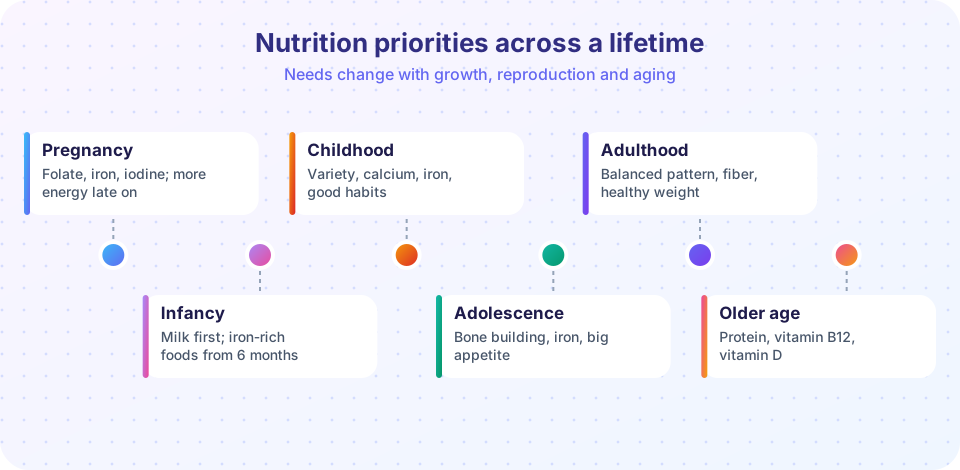
- The main nutrition priorities in pregnancy, infancy, childhood, adolescence, adulthood and older age.
- Why the first 1,000 days of life are of special interest to researchers.
How recommendations are made
Most countries publish nutrient recommendations in a consistent family of values. In the United States and Canada they are called Dietary Reference Intakes, and similar systems exist in the UK, the EU, Australia and elsewhere, plus joint FAO/WHO reports. The main terms are:
| Term | Meaning |
|---|---|
| EAR (Estimated Average Requirement) | Intake that meets the needs of half of healthy people in a group |
| RDA (Recommended Dietary Allowance) | Intake that meets the needs of almost everyone (about 97-98%); set about two standard deviations above the EAR |
| AI (Adequate Intake) | A best estimate used when evidence is too thin for an EAR |
| UL (Tolerable Upper Intake Level) | The highest intake unlikely to cause harm |
Values are published for groups defined by age and sex, with separate rows for pregnancy and lactation. They are targets for groups of healthy people, not tests of one person's diet.
The first 1,000 days
Researchers use the phrase "the first 1,000 days" for the period from conception to a child's second birthday. The idea draws on the work of David Barker and others, who noticed in the 1980s that adults in England and Wales who had low birth weight had higher rates of heart disease later in life. Further evidence came from people exposed in the womb to the Dutch famine of 1944-45 (the "Hunger Winter"), who in later life had higher rates of some metabolic problems. This led to the idea of developmental origins of health and disease: nutrition in early life may shape organs and metabolic set-points. The field is active and the strength of the evidence varies with the outcome, but it is one reason that nutrition in pregnancy and infancy receives so much attention.
Pregnancy
Infancy
Childhood and teens
Adulthood
Older age
What each lesson covers
- Pregnancy and infancy: extra needs in pregnancy, weight gain guidance, folate, food safety, breastfeeding and formula, complementary foods and allergy prevention.
- Childhood and adolescence: growth, iron, calcium and the peak bone mass window, picky eating, and growth charts.
- Adulthood and older age: maintaining health, menopause and bone, sarcopenia and protein, B12 and vitamin D, appetite and hydration, plus the science of dietary restriction and aging.
- Chapter review: a one-picture summary and ten questions.
Try it
This lookup shows how recommendations step up and down with age and sex. The values are US/Canada DRIs for a few nutrients; compare columns to see where needs differ most.
Check your understanding
Quick check · 4 questions
of 4 answered You scored / 4 · perfect!
-
1. What does an RDA represent?
RDAs are set above the average requirement so that nearly everyone is covered. -
2. What is an Adequate Intake (AI)?
AI is a best estimate of adequate intake based on observed intakes or experiments. -
3. Why is the period from conception to age 2 given special attention?
Developmental origins research links early-life nutrition to later outcomes. -
4. Which sentence about recommendations is correct?
DRIs describe requirements of groups defined by age, sex and life stage.
Summary
- Nutrient recommendations (DRIs) are published by age, sex and life stage.
- EAR, RDA, AI and UL each have a different meaning and use.
- Early life is a period of particular research interest; needs shift again in adolescence and older age.
Next: Pregnancy and infancy
Track your progress
Create a free account to tick off lessons and pick up where you left off on any device.
of Nutrition Science lessons completed