


















Lesson 22 of 47 · Energy Balance and Metabolism
Food energy: units, calorimetry and Atwater factors
Learn what a kilocalorie is, how a bomb calorimeter works, why food provides 4, 4, 9 and 7 kcal per gram, and why labels are good estimates, not exact numbers.
When a food label says "250 kcal", it makes a surprisingly bold claim: that your body will extract about that much usable energy from the food. How would anyone know? The answer is a story that starts with a metal chamber and a spark in the 1800s, passes through an American chemist who fed volunteers and measured everything they excreted, and ends with the label factors we still use today. Knowing where the numbers come from tells you how far to trust them.
What you will learn
- The units of energy and how to convert between kilocalories and kilojoules.
- How a bomb calorimeter measures the gross energy of a food.
- Why metabolizable energy is lower than gross energy, and where Atwater's factors come from.
- The limits of label energy values, and what they can and cannot tell you.
Key terms
- Kilocalorie (kcal): the energy needed to warm 1 kg of water by 1 degree Celsius, about 4,184 joules. Food "Calories" with a capital C are kilocalories.
- Kilojoule (kJ): the SI unit used on labels in many countries. 1 kcal = 4.184 kJ.
- Gross energy: the total heat released when a food is burned completely.
- Metabolizable energy: gross energy minus the energy lost in feces and urine. This is the number that matters for the body.
- Atwater factors: average values of metabolizable energy per gram of protein, fat and carbohydrate.
Units: calorie, Calorie, joule
The scientific calorie (lowercase) is the heat needed to raise 1 gram of water by 1 degree Celsius, about 4.184 joules. Nutrition uses the kilocalorie, which is 1,000 of those, and writes it kcal or, informally, "Calorie" or just "calorie". The International System of Units prefers the joule, and many countries, including those in Europe and Australia, print kilojoules (kJ) alongside or instead of kcal.
Conversion is a single multiplication:
kJ = kcal x 4.184
kcal = kJ / 4.184
So a 2,000 kcal day is about 8,368 kJ, and a 1,000 kJ snack is about 239 kcal. When you read an article, check which unit it uses: a figure of 8,000 would be a huge number of kcal but a normal number of kJ.
Measuring the energy in a food: the bomb calorimeter
The oldest direct method is bomb calorimetry. A weighed, dried sample of food is sealed in a strong steel chamber (the "bomb") filled with pure oxygen under pressure and set inside a container of water. An electric spark ignites the sample, which burns completely. All its chemical energy appears as heat, which warms the surrounding water. Because the mass of water and its specific heat are known, the temperature rise gives the heat released:
energy released = mass of water x specific heat x temperature rise
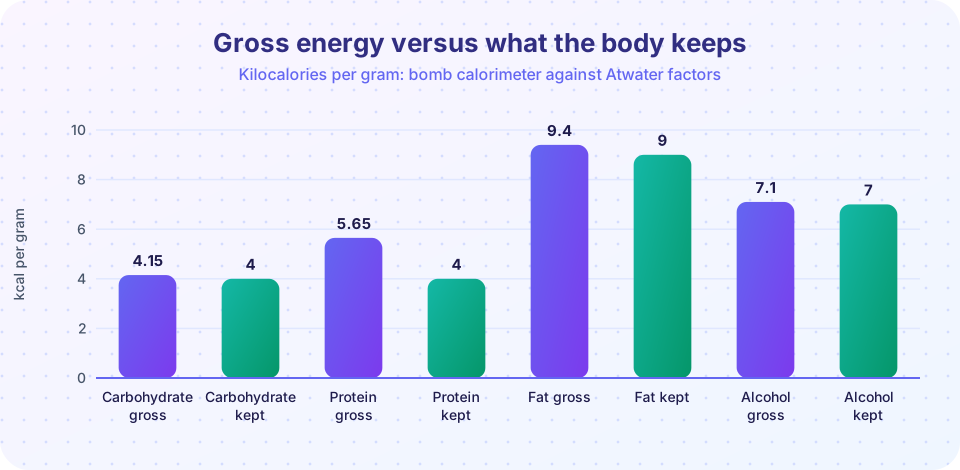
(Real instruments also correct for the heat absorbed by the metal parts, calibrated with a standard such as benzoic acid.) The result is the food's gross energy: about 4.1 kcal per gram of pure starch or sugar, about 9.4 kcal per gram of fat, and about 5.65 kcal per gram of protein.
From gross to metabolizable energy
Your body is not a bomb calorimeter. It does not burn everything completely. Part of the food is never absorbed and leaves in the feces. Of the protein that is absorbed, the nitrogen cannot be oxidized to the end; it leaves as urea in urine, carrying chemical energy with it. Fat and carbohydrate burn cleanly to carbon dioxide and water, so their losses are small.
Wilbur Olin Atwater, an American chemist working in the 1890s, tackled this with a remarkable piece of engineering: a human-sized respiration calorimeter, an insulated chamber in which a volunteer could live for days while the heat produced and the gases exchanged were measured. Together with hundreds of digestion trials in which food eaten and wastes excreted were weighed and burned, he derived average digestibilities and losses for each nutrient. The result is a set of factors:
| Nutrient | Gross energy (kcal/g) | Digestibility (approx.) | Metabolizable (kcal/g) |
|---|---|---|---|
| Protein | 5.65 | about 92% minus urea loss | 4 |
| Fat | 9.4 | about 95% | 9 |
| Carbohydrate | 4.15 | about 97-98% | 4 |
| Alcohol (ethanol) | 7.1 | nearly 100% absorbed | 7 |
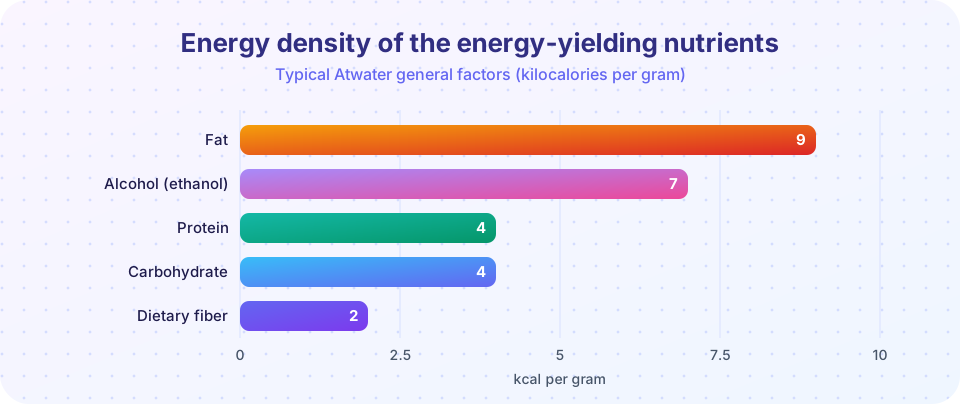
Rounded, these are the famous 4-4-9 (and 7 for alcohol). Atwater also noticed that dietary fiber yields little energy on average, since human enzymes cannot digest it but colon microbes ferment part of it into short-chain fatty acids that you absorb. Many systems assign about 2 kcal per gram to fiber, and some countries use more detailed, food-specific factors.
Energy on a food label
How does a manufacturer calculate the number on a package? There are three common routes:
- Analysis and general factors. Measure protein, fat, available carbohydrate and alcohol, multiply by 4, 9, 4 and 7, add them up.
- Specific factors. Use factors tailored to a food group, because, for example, the protein in some cereals is less digestible than in meat or eggs.
- Calculation from a recipe. Look up each ingredient in a food composition database and sum.
Label energy is deliberately rounded and rules allow an error margin, which varies by country. Treat "250 kcal" as "somewhere around 250".
How good are the estimates?
The factors are averages over mixed diets, so they are best at the level of a whole diet and less reliable for single foods. Several examples show the limits:
- Whole nuts. In controlled feeding studies, people have absorbed noticeably less energy from whole almonds than label factors predict, apparently because some fat stays locked inside intact cell walls and is not digested. The difference was on the order of a quarter. Grinding or roasting changes how much is released.
- Processing. Cooking and milling break down cell walls and starch granules, so a cooked and mashed potato gives more usable energy than a raw one eaten whole. Some researchers argue that heavily processed foods deliver more net energy than their label suggests, partly because they cost the body less energy to digest.
- People differ. The gut microbiome and transit time vary between individuals, so the same meal may supply slightly different amounts of energy to different people.
None of this makes labels useless. For comparing foods and planning diets, the 4-4-9 system works well, and the errors are usually small compared with the uncertainty in how much people eat.
Common misconceptions
- "A calorie is a calorie, so food quality does not matter for energy." Energy content per gram is the same chemistry, but foods differ in how filling they are, how much is absorbed, and what else comes with the energy (fiber, protein, micronutrients). These matter for health even when the kilocalories match.
- "Burning a food in a bomb tells you what your body gets." Gross energy is an upper bound. Metabolizable energy is what counts.
- "Alcohol calories do not count." Ethanol supplies about 7 kcal per gram and is absorbed almost completely.
Try it
The first demonstration computes energy from the macronutrients on a label, in kcal and kJ. The second plots the loss between gross and metabolizable energy. Both are calculators and charts, built on the factors in the table above.
Press Run (or Ctrl + Enter) to see the result here.
Program input · what you'd type while the program runs
Type the answers before you press Run, one per line. Each time the program reads a line (with input()), it gets the next line from this box.
Press Run (or Ctrl + Enter) to see the result here.
Program input · what you'd type while the program runs
Type the answers before you press Run, one per line. Each time the program reads a line (with input()), it gets the next line from this box.
Check your understanding
Quick check · 5 questions
of 5 answered You scored / 5 · perfect!
-
1. How many kilojoules are in 100 kcal?
Multiply by 4.184: 100 x 4.184 = 418.4 kJ. -
2. Why is the metabolizable energy of protein (4 kcal/g) lower than its gross energy (about 5.65 kcal/g)?
The body cannot oxidize nitrogen, so urea in urine carries away chemical energy. -
3. What did Atwater's respiration calorimeter allow him to do?
A human-sized chamber measured heat and gas exchange for people living inside it. -
4. Which food property can make the label energy value an overestimate?
Whole nuts are a documented example: part of the fat is not absorbed. -
5. How much energy does 10 g of fat contain by Atwater general factors?
10 g x 9 kcal per gram = 90 kcal.
Summary
- Food energy is measured in kcal or kJ; 1 kcal = 4.184 kJ.
- A bomb calorimeter gives gross energy; the body keeps less because of fecal and urinary losses.
- Atwater's general factors are 4 (protein), 4 (carbohydrate), 9 (fat) and 7 (alcohol) kcal per gram, with about 2 for fiber.
- Labels are good estimates for whole diets and weaker for single foods, especially whole or minimally processed ones.
Track your progress
Create a free account to tick off lessons and pick up where you left off on any device.
of Nutrition Science lessons completed