


















Lesson 11 of 47 · Carbohydrates, Fats and Proteins
Chapter 3 overview: carbohydrates, fats and proteins
A map of chapter three: what the three energy nutrients do, how their recommended shares of energy (AMDR) work, and what the next lessons cover.
Carbohydrates, fats and proteins make up nearly all of what you eat apart from water. They are called macronutrients because they are eaten in grams, not milligrams. Together they supply the energy that powers the body and the raw material for growth and repair. Public debates about diets, from low-carb to low-fat to high-protein, are largely arguments about their proportions.
Chapter 3 treats each in depth. This overview gives the shared concepts: what each does, how recommended shares of energy are set, and how to avoid the trap of treating each class as one thing.
What you will learn
- The main job of each macronutrient.
- What an AMDR is and why it is a range.
- Why each class contains very different members.
- What each lesson of the chapter covers.
Key terms
- Macronutrient: a nutrient eaten in large amounts: carbohydrate, fat, protein.
- AMDR: Acceptable Macronutrient Distribution Range, the share of daily energy from each macronutrient associated with low chronic disease risk and adequate nutrients.
- Energy share: the percentage of total kilocalories supplied by one macronutrient.
- Nutrient density: the amount of nutrients per kilocalorie of a food.
- Quality: the type of carbohydrate, fat or protein, not just the amount.
The three jobs
Carbohydrates are the body's preferred and most flexible fuel. The brain normally uses glucose almost exclusively, about 120 g a day for an adult. Carbohydrate foods also supply fiber and, when whole, many vitamins and minerals.
Fats are the densest source of energy and the form in which the body stores it. They build cell membranes, carry fat-soluble vitamins, make hormones and cushion organs. Two fats are essential.
Proteins are the body's building and working material: enzymes, muscle, antibodies, transport molecules and structure. They can supply energy, but their main job is not fuel, and the nine essential amino acids must come from food.
How the ranges are set
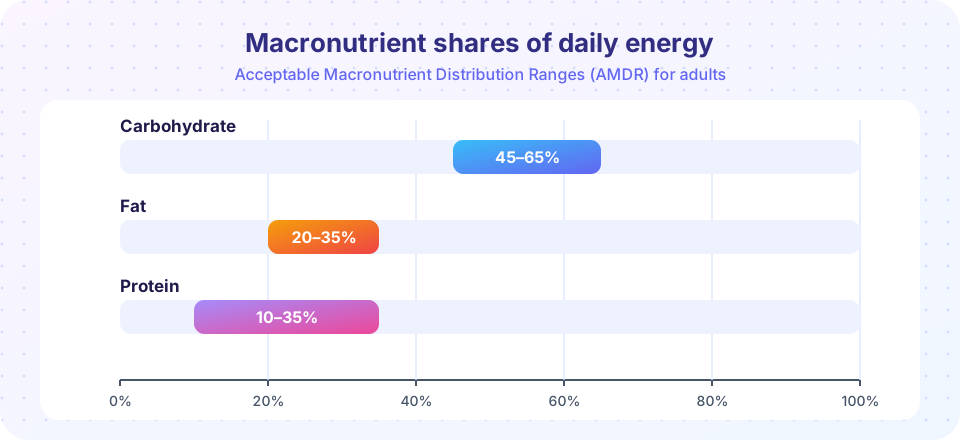
The DRI committees set Acceptable Macronutrient Distribution Ranges: carbohydrate 45 to 65 percent of energy, fat 20 to 35 percent, protein 10 to 35 percent for adults. The ranges are wide for a reason. Populations around the world thrive on traditional diets that are very high in carbohydrate (rice or maize-based), or high in fat (some northern diets), and the evidence does not show a single ideal mix. The lower edge of each range protects against deficiency; the upper edge, against rising risk of chronic disease. Inside the range, the quality of each macronutrient matters more than the exact percentage.
Remember that the three shares add up to 100 percent of energy from foods, so if one goes up another must go down. A person at the top of the protein range (35 percent) cannot also be at the top of the carbohydrate range.
Quality over quantity
Each macronutrient hides a spectrum:
- Carbohydrates run from whole grains, beans and fruit (rich in fiber) to sugary drinks (rapidly absorbed, few other nutrients).
- Fats run from unsaturated oils in nuts, fish and olive oil to industrial trans fats.
- Proteins run from lentils and fish to heavily processed meat.
Comparing "low-carb" and "low-fat" diets without asking which carbs and fats is like comparing "transport" without saying whether it is a bicycle or a truck. Large reviews tend to find that the replacement matters: swapping saturated fat for unsaturated fat, or refined carbohydrate for whole grains, usually improves risk markers, whereas swapping fat for refined carbohydrate does not.
What each lesson covers
Chapter 3 roadmap
Chapter 3 skills
- Carbohydrates: sugars, starch and fiber covers the three sizes of carbohydrate, the glycemic index, added sugars and the many roles of fiber.
- Fats and fatty acids explains saturated, unsaturated and trans fats, omega-3 and omega-6, cholesterol and lipoproteins.
- Proteins and amino acids covers amino acids, protein quality, how much you need, and plant versus animal sources.
- Chapter 3 review pulls it together.
Common misconceptions
- "Carbohydrates make you fat." Excess energy from any source can be stored as fat. Carbohydrate-rich whole foods are generally filling, and many healthy populations eat a lot of them.
- "Fat in the diet becomes fat on your body, and so should be avoided." Dietary fat is essential and satiating; the issue is the type and the total energy.
- "More protein is always better." Needs are met by the RDA for most people; extra is burned as fuel or stored as fat, and very high intakes have no proven extra benefit for most.
Try it
Use the first demonstration to test whether a day's intake falls within the AMDR. The second lets you move two sliders to see the shares change.
Press Run (or Ctrl + Enter) to see the result here.
Program input · what you'd type while the program runs
Type the answers before you press Run, one per line. Each time the program reads a line (with input()), it gets the next line from this box.
Check your understanding
Quick check · 4 questions
of 4 answered You scored / 4 · perfect!
-
1. What is the AMDR for carbohydrate in adults?
Carbohydrate 45 to 65, fat 20 to 35, protein 10 to 35 percent of energy. -
2. Why are the AMDRs wide?
Evidence supports a range of patterns, with food quality mattering more than the exact split. -
3. A diet provides 2,000 kcal with 700 kcal from fat. What share is fat?
700 / 2,000 = 0.35, which is the top of the fat AMDR. -
4. Which statement about quality is best supported?
The type of carbohydrate, fat and protein matters, not only the amount.
Summary
- Carbohydrates are the main fuel, fats the dense store and builder, proteins the working material.
- AMDRs: carbohydrate 45 to 65 percent, fat 20 to 35 percent, protein 10 to 35 percent of energy.
- Ranges are wide because people thrive on many mixes.
- Quality inside each class decides health more than small shifts in percentage.
Track your progress
Create a free account to tick off lessons and pick up where you left off on any device.
of Nutrition Science lessons completed