


















Lesson 29 of 47 · Nutrition Across the Lifespan
Nutrition in adulthood and older age
How energy and nutrient needs change from midlife to old age: menopause and bone, sarcopenia and protein, vitamin B12 and D, appetite, hydration and what research says about aging.
For most of adult life nutrition looks like maintenance: eating a varied diet, staying at a healthy weight and avoiding the dietary patterns linked to chronic disease, which later chapters cover in detail. But as the decades pass, the body quietly changes. Muscle and bone are lost, absorption of some vitamins falls, thirst and appetite weaken and medicines start to interfere with food. The result is a paradox of older age: energy needs drop, but needs for most nutrients stay the same or rise. Meeting them in fewer calories means every bite has to count, which is the idea of nutrient density.
Educational information only. Older adults often have medical conditions and take medicines that affect nutrition. Individual advice from a physician or dietitian matters more than any general guideline here.
What you will learn
- Why energy needs fall with age while nutrient needs do not.
- How menopause and aging affect bone, and what protects it.
- What sarcopenia is and how protein and resistance exercise counter it.
- Why vitamin B12 and vitamin D need attention, and what large trials say about supplements.
- What is known about calorie restriction and aging.
Key terms
- Nutrient density: the amount of nutrients per kilocalorie of food.
- Sarcopenia: age-related loss of muscle mass and strength.
- Osteoporosis: a disease of low bone density and weakened bone structure that raises fracture risk.
- Atrophic gastritis: thinning of the stomach lining that reduces stomach acid and the release of food-bound vitamin B12.
- Anorexia of aging: the decline in appetite and food intake that occurs in many older people.
Energy needs fall
Resting metabolism declines with age mostly because muscle and organ mass decline, and people tend to become less active. In the US/Canada equations for estimated energy requirement, each additional year of age lowers the estimate by roughly 7 to 10 kcal a day, which adds up to 70 to 100 kcal per decade for the same weight and activity. A person who keeps eating as they did at 30 will gain weight; a person who eats less without choosing foods carefully risks falling short on vitamins and minerals.
Press Run (or Ctrl + Enter) to see the console output here.
No output.
Bone, menopause and osteoporosis
As the previous lesson showed, bone mass peaks around age 30 and then slowly declines. In women, the fall of estrogen at menopause (around 51 on average) accelerates bone loss for several years. By older age, osteoporosis affects a large fraction of postmenopausal women and a smaller but significant fraction of men, and fractures of the hip and spine are major causes of disability.
Prevention is a package:
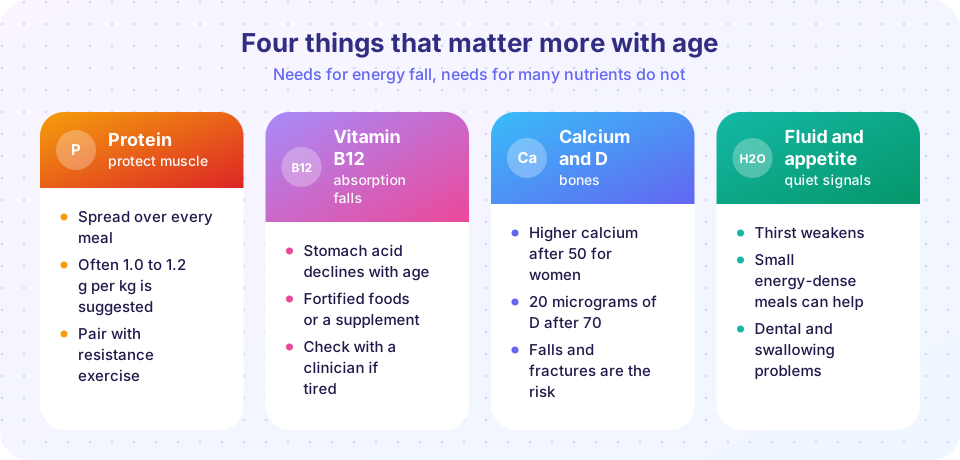
- Calcium: RDA 1,000 mg for adults, increased to 1,200 mg for women from age 51 and for everyone over 70.
- Vitamin D: 15 micrograms (600 IU) up to age 70 and 20 micrograms (800 IU) beyond, because skin synthesis falls with age and older people spend less time in the sun.
- Protein adequate for bone matrix and muscle.
- Weight-bearing and resistance exercise, which signals bone to strengthen.
- Avoiding smoking and heavy alcohol use.
Evidence on supplements is nuanced. Large randomized trials in generally healthy people, such as the US VITAL trial (about 25,000 participants, vitamin D3 2,000 IU per day), did not show reductions in cancer or cardiovascular disease and found no fracture benefit in people who were not deficient. These results do not mean vitamin D is unimportant: they suggest that supplements help people who are deficient or at high risk, not everyone, and extremely high doses can cause harm. Calcium supplements are best used to fill the gap left by diet rather than in addition to adequate intake.
Muscle: sarcopenia and protein
From about age 30, muscle mass declines slowly, with estimates in the range of a few percent per decade that speed up after age 60 if people are inactive. Sarcopenia is the point where loss of muscle and strength affects daily life: difficulty climbing stairs, rising from a chair, a higher chance of falls, and slower recovery from illness.
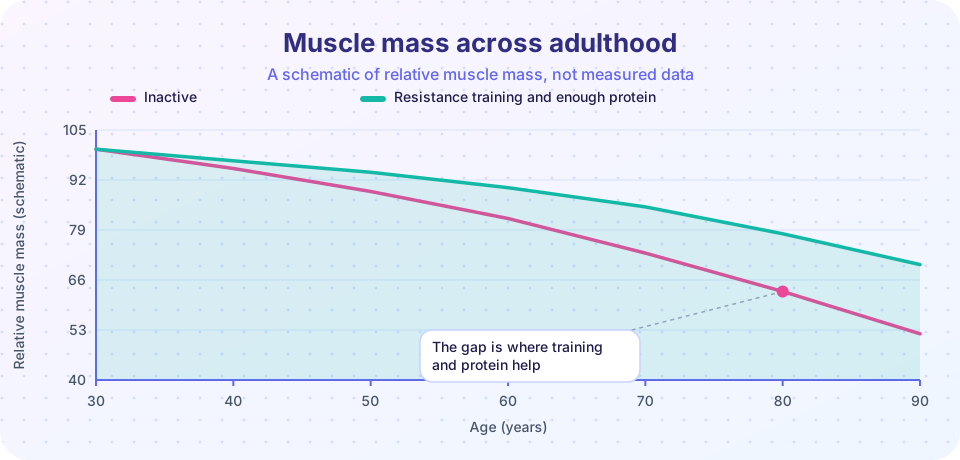
Two things protect muscle: resistance exercise and protein. The adult RDA for protein is 0.8 g per kg of body weight per day, set to prevent deficiency in healthy adults. Several expert groups, including the PROT-AGE study group, suggest that healthy older adults may do better at about 1.0 to 1.2 g per kg, and higher for people with illness or injury, because muscle in older people responds less strongly to a given amount of protein (a phenomenon called anabolic resistance). It also helps to spread protein across meals (about 25 to 30 g at each) rather than eating most of it at dinner, though evidence for the benefit of distribution is modest. Kidney disease is an important exception; people with it need individual advice.
Press Run (or Ctrl + Enter) to see the result here.
Program input · what you'd type while the program runs
Type the answers before you press Run, one per line. Each time the program reads a line (with input()), it gets the next line from this box.
Vitamin B12
Vitamin B12 is released from the proteins in food by stomach acid and pepsin, then bound to intrinsic factor in the gut for absorption. Many older adults, often cited as 10 to 30 percent, have atrophic gastritis, low stomach acid, or take medicines (such as acid-reducing drugs and metformin) that reduce absorption of food-bound B12. The crystalline B12 in fortified foods and supplements does not need acid to be released, which is why guidelines recommend that adults over 50 meet most of their B12 needs (2.4 micrograms a day) from fortified foods or supplements. Deficiency can cause anemia, nerve damage and cognitive symptoms, and is diagnosed by blood tests; people following vegan diets need a B12 source at any age.
Appetite, taste and hydration
Hunger, thirst, taste and smell weaken with age, and illness, dental problems, difficulty swallowing (dysphagia), depression, loneliness and some drugs reduce appetite further. Undernutrition in older adults is common, especially in hospitals and care homes, and strongly linked to poor outcomes. Practical measures include small frequent meals, energy- and nutrient-dense foods, social meals, attention to dentures and swallowing, and screening tools that clinicians use to catch weight loss early. Because the thirst sensation declines, dehydration can develop quietly, and older adults have less reserve when sick, so regular drinks matter.
What does research say about aging and diet?
- Dietary patterns. Observational studies link Mediterranean-style and other plant-rich patterns with lower mortality and a lower risk of some chronic diseases. Trials for cognition are less clear: a 2023 US trial of 604 older adults found that the MIND diet did not improve cognition more than a mildly calorie-reduced control diet over three years, although both groups improved.
- Calorie restriction. In many laboratory animals, eating roughly 20 to 40 percent fewer calories while remaining well nourished extends lifespan. In rhesus monkeys, the two long studies had different results, one showing longer life and the other not, with differences in diets and study design. In the human CALERIE trial, healthy adults aimed for 25 percent restriction for two years, but achieved about 12 percent; they improved several cardiometabolic markers. Whether these effects translate into longer lives in humans is unknown, and extreme restriction can harm older people by costing muscle and bone.
- Interventions that help function. The strongest evidence for staying independent is for physical activity, including resistance training, plus adequate protein and keeping weight stable in older age.
Common misconceptions
- "Older people need less of everything." Energy needs fall; needs for protein, calcium, vitamin D and B12 do not.
- "Weight loss is always good in older age." Unintentional weight loss often signals illness, and loss of muscle in older people raises risk.
- "A supplement can replace a healthy diet." Supplements fill specific gaps; foods provide fiber, protein and many other components.
Try it
The widget gives the recommended intake for a few nutrients at ages across adulthood and lets you compare. It is the same table as the chapter overview, but arranged for an older-adult audience.
Check your understanding
Quick check · 5 questions
of 5 answered You scored / 5 · perfect!
-
1. Which statement about aging and nutrition is correct?
Lower calorie needs make nutrient-dense foods more important. -
2. Why is vitamin B12 from fortified foods or supplements recommended for adults over 50?
Low stomach acid is common with age and reduces release of food-bound B12. -
3. What protein intake do some expert groups suggest for healthy older adults?
Because of anabolic resistance, somewhat more than the RDA of 0.8 g/kg is suggested. -
4. What did the VITAL trial suggest about vitamin D3 supplements in generally healthy adults?
Benefits are expected mainly for people who are deficient or at particular risk. -
5. What best protects muscle in older age?
Exercise and protein together are the best-supported strategy.
Summary
- Energy needs decline with age, but protein, calcium, vitamin D and B12 needs remain.
- Menopause accelerates bone loss; calcium, vitamin D, protein and exercise protect bone.
- Sarcopenia is countered by resistance training and 1.0-1.2 g/kg protein.
- B12 absorption falls, appetite and thirst weaken; calorie restriction results in humans are still uncertain.
Next: Chapter review
Track your progress
Create a free account to tick off lessons and pick up where you left off on any device.
of Nutrition Science lessons completed