


















Lesson 45 of 47 · Projects and Practice
Glossary of nutrition science terms
A plain-language glossary of more than sixty terms from energy balance, lifespan nutrition, diet and disease evidence, and food systems, with a flashcard practice tool.
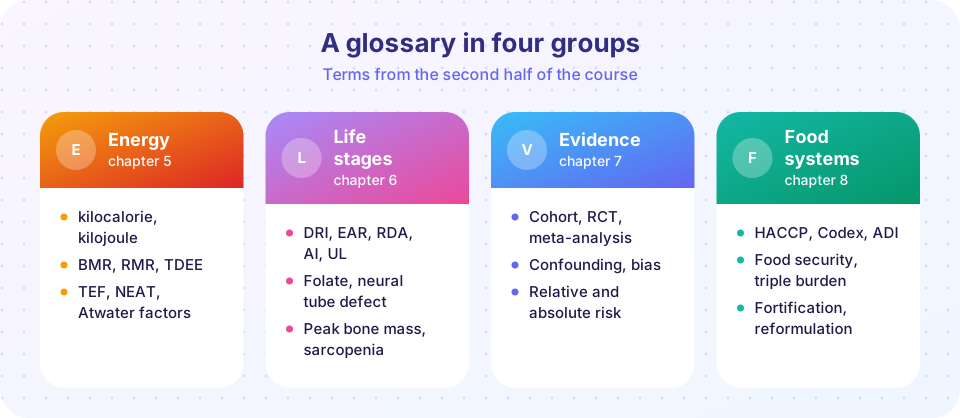
Specialist vocabulary can feel like a wall, but most nutrition terms are simple ideas wearing technical names. This glossary collects the key terms from the second half of the course, grouped and in alphabetical order inside each group, with one-line definitions. Use it as a reference while you read, and use the flashcards at the end to test yourself.
What you will learn
- The precise meaning of the main terms in chapters 5 to 8.
- How terms relate to each other within each group.
- Which terms are easy to confuse (RDA and AI, BMR and RMR, relative and absolute risk).
Energy and metabolism (chapter 5)
| Term | Meaning |
|---|---|
| Adaptive thermogenesis | A fall in energy expenditure after weight loss that exceeds what lost body mass explains |
| Atwater factors | Average metabolizable energy per gram: 4 (protein), 4 (carbohydrate), 9 (fat), 7 (alcohol) |
| Basal metabolic rate (BMR) | Energy used at complete rest, fasted, awake and in a warm room |
| Bomb calorimeter | A sealed chamber used to measure the gross energy of a food by burning it |
| Doubly labeled water | A method that measures free-living energy expenditure from isotope elimination |
| Energy balance | Intake minus expenditure; positive balance stores energy, negative draws on stores |
| Gross energy | Total heat released when a food is burned completely |
| Hypothalamus | The brain region that integrates hunger and fullness signals |
| Kilocalorie (kcal) | The energy to warm 1 kg of water by 1 degree Celsius; about 4.184 kJ |
| Leptin | A hormone from fat cells that signals stored energy to the brain |
| Ghrelin | A stomach hormone that rises before meals and stimulates hunger |
| Metabolizable energy | Gross energy minus losses in feces and urine; what the body can use |
| NEAT | Non-exercise activity thermogenesis: energy used in everyday movement |
| Respiratory quotient | CO2 produced divided by O2 consumed; about 1.0 for carbohydrate and 0.7 for fat |
| Resting metabolic rate (RMR) | Like BMR but measured under less strict conditions; slightly higher |
| TDEE | Total daily energy expenditure: resting metabolism, TEF, NEAT and exercise |
| Thermic effect of food (TEF) | Energy used to digest, absorb and store food, about 10 percent of intake |
Life stages (chapter 6)
| Term | Meaning |
|---|---|
| Adequate Intake (AI) | A best-estimate intake used when evidence is too limited to set an RDA |
| Anabolic resistance | Reduced muscle response to protein in older adults |
| Complementary foods | Foods other than milk introduced to a baby, from about six months |
| Dietary Reference Intakes (DRIs) | The family of nutrient recommendations: EAR, RDA, AI and UL |
| Dietary folate equivalent (DFE) | A unit that counts folic acid as 1.7 times food folate |
| Estimated Average Requirement (EAR) | The intake meeting the needs of half of healthy people in a group |
| Exclusive breastfeeding | Feeding only breast milk, apart from medicines and vitamin drops |
| Food neophobia | Reluctance to try new foods, common in early childhood |
| Gestational weight gain | The weight a woman gains during pregnancy |
| Neural tube defect | A malformation of the brain or spinal cord arising in the first weeks of pregnancy |
| Osteoporosis | A disease of weak, porous bone that raises fracture risk |
| Peak bone mass | The maximum bone mineral content, reached by the late twenties |
| Percentile | The share of children of the same age and sex who measure less than a given child |
| Recommended Dietary Allowance (RDA) | The intake meeting the needs of nearly all healthy people in a group |
| Sarcopenia | Age-related loss of muscle mass and strength |
| Tolerable Upper Intake Level (UL) | The highest daily intake unlikely to cause harm |
Evidence and disease (chapter 7)
| Term | Meaning |
|---|---|
| Absolute risk | The actual chance of an outcome in a group |
| Case-control study | A study that compares past exposures of people with and without a disease |
| Cohort study | A study that follows groups with different exposures over time |
| Confounding | A third factor linked to both exposure and outcome that distorts their association |
| Confidence interval | A range of values compatible with the data at a stated confidence level |
| DASH | Dietary Approaches to Stop Hypertension, a pattern rich in fruit, vegetables and low-fat dairy |
| E-value | The strength an unmeasured confounder needs to explain away an association |
| Glycemic index | A ranking of how quickly a carbohydrate food raises blood glucose |
| Hypertension | Persistently high blood pressure |
| Insulin resistance | Reduced response of tissues to insulin, a core feature of type 2 diabetes |
| LDL cholesterol | The cholesterol-carrying particles most strongly linked to artery plaque |
| Meta-analysis | A statistical combination of results from several studies |
| Multiple comparisons | Testing many hypotheses at once, which raises the chance of false positives |
| Number needed to treat (NNT) | 1 divided by the absolute risk difference |
| p-hacking | Analyzing data in many ways until something appears significant |
| Randomized controlled trial (RCT) | A study that assigns people to interventions by chance |
| Relative risk | Risk in one group divided by risk in another |
| Residual confounding | Confounding left after adjustment because of unmeasured or poorly measured factors |
| Reverse causation | When early disease changes diet, making diet appear to be the cause |
Food systems and policy (chapter 8)
| Term | Meaning |
|---|---|
| Acceptable daily intake (ADI) | The amount of an additive that can be eaten daily for life without appreciable risk |
| Codex Alimentarius | The international food standards body of FAO and WHO |
| CO2-equivalent (CO2e) | A unit that expresses the warming effect of greenhouse gases as an amount of carbon dioxide |
| Danger zone | The temperature range, about 5 to 60 degrees Celsius, in which bacteria multiply quickly |
| Food environment | The settings, prices and information that shape food choices |
| Food insecurity | Lacking reliable access to enough safe, nutritious food |
| Food security | All people, at all times, having access to enough safe, nutritious food |
| Food system | All activities from producing food to eating it and disposing of waste |
| Fortification | Adding vitamins or minerals to foods during processing |
| HACCP | A system that identifies hazards and controls them at critical points |
| Price elasticity | The percentage change in quantity bought when price changes by 1 percent |
| Reformulation | Changing a recipe, for example to reduce salt or sugar |
| Stunting | Low height for age in children, a sign of chronic undernutrition |
| Triple burden | Undernutrition, micronutrient deficiency and overweight or obesity at once |
| Wasting | Low weight for height in children, a sign of acute undernutrition |
Easily confused pairs
- RDA and AI: an RDA comes from an EAR and covers nearly everyone; an AI is an estimate used when the evidence cannot support an RDA.
- BMR and RMR: both are resting rates; BMR is measured under stricter conditions.
- Gross and metabolizable energy: the first is what burns in a calorimeter, the second is what the body keeps.
- Relative and absolute risk: one compares groups, the other is the actual chance.
- Stunting and wasting: height for age versus weight for height.
Try it
Test your memory with flashcards: choose a term, think of the definition and then reveal it. The cards use a sample of terms from the lists above.
Check your understanding
Quick check · 4 questions
of 4 answered You scored / 4 · perfect!
-
1. Which term describes the energy the body can actually use from a food?
Gross energy minus fecal and urinary losses gives metabolizable energy. -
2. What is the difference between an RDA and an AI?
An RDA derives from an EAR; an AI is a best estimate. -
3. Which term compares two groups rather than giving an actual chance?
Relative risk is a ratio of two risks. -
4. Wasting in children means...
Stunting is low height for age.
Summary
- The glossary groups terms by chapter and lists plain-language definitions.
- Many pairs of terms are easy to confuse; check the table of confused pairs.
- Flashcards turn the glossary into active recall.
Next: Cheat sheet
Track your progress
Create a free account to tick off lessons and pick up where you left off on any device.
of Nutrition Science lessons completed