


















Lesson 23 of 47 · Energy Balance and Metabolism
Energy expenditure: BMR, thermic effect and TDEE
Break daily energy expenditure into resting metabolism, the thermic effect of food, everyday movement and exercise, and estimate your own with prediction equations.
A person who lies in bed all day, motionless, still burns well over a thousand kilocalories. The heart beats, the lungs inflate, the kidneys filter, the brain runs on about as much power as a dim light bulb, and the body keeps its temperature near 37 degrees Celsius. This resting metabolism is by far the biggest item in the daily energy budget, which is why body size and composition matter more than most people expect. This lesson takes the budget apart, shows you how scientists measure it and gives you equations to estimate your own, with honest error bars.
What you will learn
- The four components of total daily energy expenditure (TDEE).
- What basal and resting metabolic rate mean and what drives them.
- How the thermic effect of food differs between protein, carbohydrate and fat.
- How to use the Mifflin-St Jeor equation and activity factors, and how accurate they are.
- How scientists measure expenditure in free-living people.
Key terms
- BMR (basal metabolic rate): energy used at complete rest, awake, fasted for 12 hours, in a comfortably warm room.
- RMR (resting metabolic rate): a similar measure taken under less strict conditions, usually a few percent higher.
- TEF (thermic effect of food): energy used to digest, absorb and store a meal.
- NEAT (non-exercise activity thermogenesis): energy used for everything that is not sleeping, eating or deliberate exercise: standing, walking to the bus, fidgeting, typing.
- TDEE (total daily energy expenditure): the sum of all of the above.
The four components
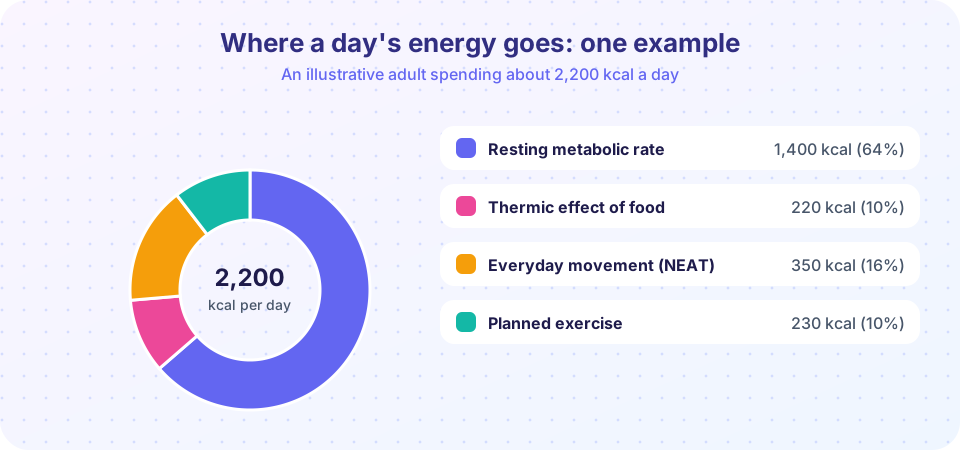
TDEE = BMR (or RMR) + TEF + NEAT + exercise
For a typical adult, resting metabolism is about 60 to 70 percent of TDEE, the thermic effect of food is about 10 percent, and activity (NEAT plus exercise) makes up the rest. The split changes a lot with lifestyle: a farm worker or a delivery cyclist gets far more of the day from activity, and a person at a desk gets far less.
1. Resting metabolism: who burns what
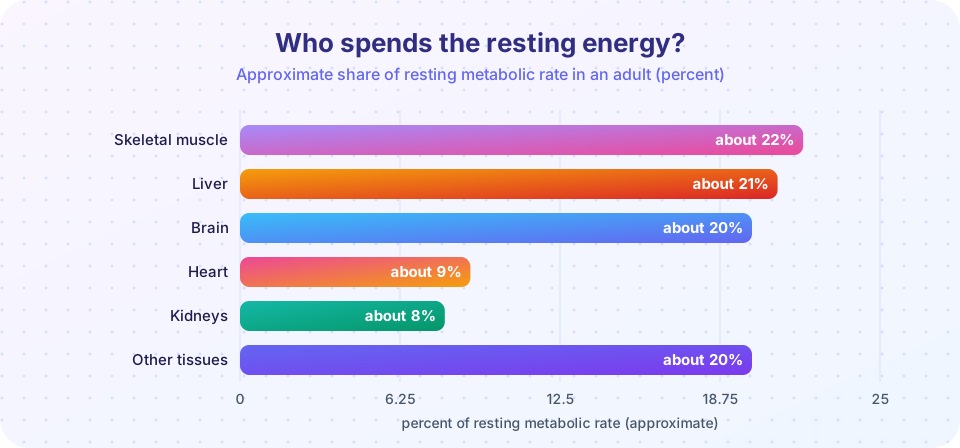
Metabolic rate depends mainly on fat-free mass, the body's lean tissue (muscle, organs, bone, water). That is the active tissue. Two people of the same weight can differ in resting metabolic rate because one has more muscle and organ mass and less fat.
But muscle is not the whole story. At rest, skeletal muscle burns only about 13 kcal per kilogram per day, and fat tissue about 4.5. The brain, liver, heart and kidneys burn much more per kilogram, in the hundreds of kcal per kilogram per day (estimates from Elia, 1992), even though they are a small share of body mass. As a result, these organs together account for well over half of resting expenditure.
Other factors that shift the rate:
- Age: declines slowly in adulthood, mostly because lean mass falls.
- Sex: men have on average more fat-free mass, so a higher rate at the same weight.
- Body temperature and hormones: fever raises metabolic rate by several percent per degree; thyroid hormones raise it strongly.
- Pregnancy, lactation, growth: all increase it (see the lifespan chapter).
- Genes: account for a modest part of the person-to-person variation.
2. The thermic effect of food
Digestion, absorption and the conversion of nutrients into storage forms all cost energy. The cost depends on the nutrient, as a percentage of the energy ingested:
| Nutrient | Thermic effect |
|---|---|
| Protein | about 20-30% |
| Carbohydrate | about 5-10% |
| Fat | about 0-3% |
| Mixed meal | about 10% |
Protein costs the most because making peptide bonds and processing amino acids (including making urea) is expensive. This is one reason higher-protein diets raise expenditure slightly and increase fullness, though the effect is a few tens of kcal per day, not hundreds.
3. NEAT: the hidden variable
NEAT includes every movement that is not formal exercise. It is the most variable part of TDEE between people, ranging by hundreds of kilocalories per day. In a well-known overfeeding experiment, James Levine and colleagues (1999) fed 16 lean volunteers about 1,000 kcal per day above their needs for eight weeks. Fat gain varied roughly tenfold between individuals, and most of the difference was explained by changes in NEAT: some people unconsciously moved more when they ate more. The study was small, but it shows why "calories in, calories out" cannot treat "out" as fixed.
4. Exercise
Planned exercise is the smallest and most controllable component. A 70 kg person who walks briskly for 30 minutes spends a few hundred kcal at most. Exercise is valuable for health regardless of its energy cost, and gets a lot more attention as a weight-loss tool than its energy arithmetic deserves.
Estimating your own: equations
Because direct measurement is difficult, researchers developed prediction equations from measurements of many people. The most widely checked today is Mifflin-St Jeor (1990):
Men:    BMR = 10 x weight(kg) + 6.25 x height(cm) - 5 x age(years) + 5
Women:  BMR = 10 x weight(kg) + 6.25 x height(cm) - 5 x age(years) - 161
Worked example: a 30-year-old man, 70 kg, 175 cm. 10 x 70 = 700; 6.25 x 175 = 1,093.75; 5 x 30 = 150. So 700 + 1,093.75 - 150 + 5 = 1,648.75 kcal/day.
To get TDEE, multiply by a conventional activity factor:
| Lifestyle | Factor |
|---|---|
| Sedentary (desk, little exercise) | 1.2 |
| Lightly active | 1.375 |
| Moderately active | 1.55 |
| Very active | 1.725 |
| Extremely active | 1.9 |
For the example, "moderately active" gives about 1,648.75 x 1.55, roughly 2,556 kcal/day. The older Harris-Benedict equations (revised in 1984) give similar answers for most healthy adults. In validation studies, Mifflin-St Jeor predicts resting rate within about 10 percent for most people, but with a wide spread for individuals: for someone with unusual body composition, the error can be several hundred kcal. Treat the output as a starting point, then watch what happens in practice.
How scientists measure it
- Indirect calorimetry measures oxygen consumption and carbon dioxide production, usually with a hood over the head, and converts them into energy using known equations. The ratio of CO2 produced to O2 consumed (the respiratory quotient) is about 1.0 when burning carbohydrate and about 0.7 for fat, so it also shows which fuel is in use.
- Direct calorimetry measures the heat leaving a person in an insulated chamber (Atwater's approach).
- Doubly labeled water measures free-living expenditure over one to two weeks. The person drinks water enriched with heavy isotopes of hydrogen and oxygen; the hydrogen leaves only as water, the oxygen leaves as water and carbon dioxide, so the difference in their disappearance rates gives CO2 production and thus energy expenditure. It is the standard for real-life TDEE, though costly.
Studies with doubly labeled water have shown, for instance, that adjusted for body size, hunter-gatherers such as the Hadza of Tanzania spend similar daily energy as people in industrial countries, even though they are much more active. That result suggests the body adjusts other spending, and it is one of the many puzzles that make expenditure a live research field.
Common misconceptions
- "Muscle burns a lot of energy at rest." Per kilogram, resting muscle is not very costly (about 13 kcal/kg/day). Gaining 5 kg of muscle raises resting rate by tens of kcal, not hundreds.
- "A slow metabolism explains most weight differences." Heavier people usually have higher, not lower, expenditure because they have more tissue to run.
- "Equations tell you your exact needs." They estimate an average for people like you. Individual error is large.
Try it
The first demonstration compares equations and activity levels. The second is a live calculator: change the numbers to see which component changes most. Both estimate; neither measures.
Press Run (or Ctrl + Enter) to see the result here.
Program input · what you'd type while the program runs
Type the answers before you press Run, one per line. Each time the program reads a line (with input()), it gets the next line from this box.
Check your understanding
Quick check · 5 questions
of 5 answered You scored / 5 · perfect!
-
1. Which component usually accounts for the largest share of daily energy expenditure?
Resting metabolism is typically 60 to 70 percent of the total. -
2. Which macronutrient has the highest thermic effect?
Protein metabolism, including urea formation, costs about 20 to 30 percent of its energy. -
3. Using Mifflin-St Jeor, what is the BMR of a 30-year-old woman, 60 kg, 165 cm?
10 x 60 = 600; 6.25 x 165 = 1,031.25; minus 5 x 30 = 150; minus 161. Total 1,320.25. -
4. What did Levine's 1999 overfeeding study suggest?
People who spontaneously moved more when overfed gained less fat. -
5. What does doubly labeled water measure?
The difference in elimination of the two isotopes gives CO2 production, and from that energy expenditure.
Summary
- TDEE = resting metabolism + thermic effect of food + NEAT + exercise.
- Fat-free mass, especially organs and muscle, drives resting expenditure.
- Protein has the highest thermic effect; NEAT is the most variable component.
- Mifflin-St Jeor times an activity factor gives a reasonable starting estimate with a wide error range.
- Doubly labeled water and indirect calorimetry are the research tools for measurement.
Track your progress
Create a free account to tick off lessons and pick up where you left off on any device.
of Nutrition Science lessons completed