


















Lesson 1 of 47 · Getting Started
Course map: how to study nutrition science
See the whole nutrition science course at a glance: who it is for, what you need first, how to study it, and what each of the nine chapters covers.
Every day you make about a dozen decisions that nutrition scientists study: what to eat, how much, when, and with what. Food supplies the energy for every heartbeat and the raw material for every cell, and it is also tangled up with culture, money, pleasure and plenty of marketing. Nutrition science is the discipline that tries to separate what is known from what is merely claimed.
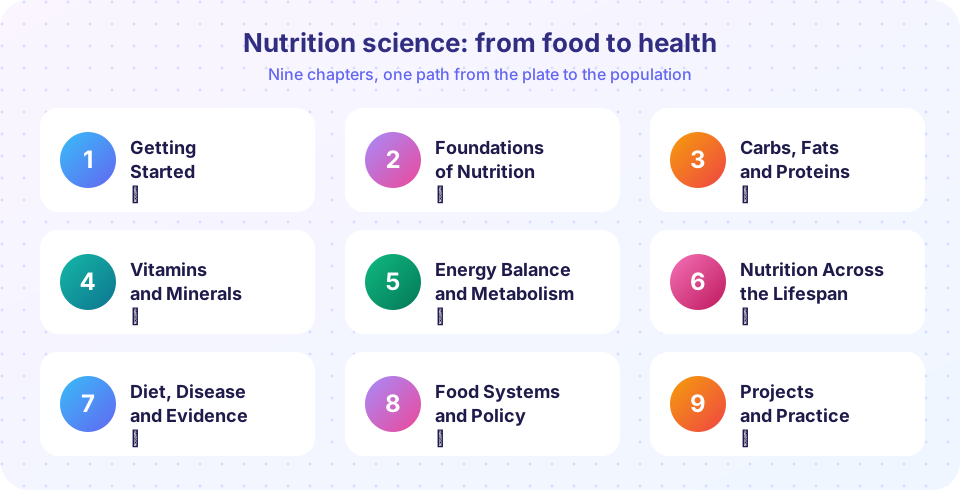
This course takes you from the basic classes of nutrients to energy balance, life stages, the evidence behind diet and disease, and the food systems that decide what reaches your plate. It has nine chapters, pictures, small simulations, and quizzes. It will not tell you what to eat. It will teach you how to think about food questions and how to read the answers people give you.
What you will learn
- Who this course is written for and what you should know first.
- How the nine chapters fit together, from nutrients to food policy.
- A study routine that works for a science that mixes chemistry, biology and statistics.
- Which tools you will meet: diagrams, small Python and browser demonstrations, and quizzes.
Who this course is for
The course is written for learners aged about 14 to 18 and for adults who want to start or refresh the subject. It follows the common core of international school and first-year university courses: the ideas that appear in IGCSE and A Level food and nutrition and biology, in IB Biology and Sports, Exercise and Health Science, and in US AP and introductory college nutrition. All quantities use SI units (grams, milligrams, micrograms, kilojoules) and also give the familiar kilocalorie, because food labels in many countries show both.
You need no nutrition background. You do need to be comfortable with percentages, reading a simple graph, and the idea that matter is made of atoms and molecules. Some lessons use a few lines of Python, but you can run every example with one click and read the results without writing code.
Educational information, not medical advice. This course explains how nutrition works in general. It does not diagnose conditions, prescribe diets or replace a doctor or a registered dietitian. If you have a medical condition, are pregnant, take medicines, or are worried about your eating, talk to a qualified health professional. Reference values quoted here are for healthy adults unless stated.
Key terms
- Nutrient: a substance in food that the body uses for energy, growth, repair or regulation.
- Nutrition science: the study of how food and its components affect the body and health, at scales from molecules to whole populations.
- Diet: everything a person habitually eats and drinks. (It does not mean a weight-loss plan here.)
- Evidence: observations or experiments that can support or contradict a claim.
- Reference intake: an official estimate of how much of a nutrient people of a given age and sex need or can safely eat.
The nine chapters
Start here
- Getting started
- Foundations
The nutrients
- Carbs, fats, proteins
- Vitamins and minerals
The body over time
- Energy and metabolism
- The lifespan
Evidence and the world
- Diet and disease
- Food systems
Practice
- Projects
Think of the course as three layers. Chapters 2 to 4 are what food is made of. Chapters 5 and 6 are what the body does with it, first in a typical adult and then across a lifetime. Chapters 7 and 8 are how we know and what society does about it. Each chapter opens with an overview and ends with a review and a longer quiz.
How the course is organized
Every ordinary lesson follows the same skeleton, so you always know where you are:
- What you will learn: three to five outcomes.
- Key terms: the vocabulary of the lesson.
- The lesson itself: explanations, worked examples with real numbers, and a picture.
- Common misconceptions: wrong ideas that many people hold, and the correction.
- Try it: small demonstrations you can run and change.
- Check your understanding: a short quiz with explanations.
- Summary and a link to the next lesson.
The demonstrations are labelled. A "nutrient calculator" applies a formula; it is not a lab result. A "simulation" is a simplified model; it shows an idea, not a prediction for a real person. Nothing in this course is a diagnostic test.
A study routine that works
Nutrition is a memory-heavy subject, so spread it out. Three sessions of 30 minutes a week beat one long evening. In each session, read one lesson, run the demonstrations, and take the quiz without looking back. A day later, close the lesson and write down three things you remember. That small act of recall, a habit psychologists call retrieval practice, is one of the best-supported study methods there is.
Keep a food diary of questions, not of meals. Whenever you see a food claim (in a headline, an advert, a friend's message), write it down. As you work through the course, come back and judge each claim with the tools you have learned. By Chapter 7 you will have a dozen real examples to test.
Finally, notice units. Nutrition mixes grams, milligrams (one thousandth of a gram), micrograms (one millionth of a gram), kilocalories and kilojoules. A frequent source of error is confusing mg with µg, a factor of 1,000. When a number looks surprising, check its unit first.
Common misconceptions
- "Nutrition science changes its mind every week." Headlines do. The core (energy balance, essential nutrients, the harm of deficiency, the value of mostly plant-based, minimally processed diets) has been stable for decades. What moves is the fine print and the many small, uncertain questions.
- "Natural means safe, and chemical means harmful." Everything you eat, including water and vitamin C, is a chemical. Safety depends on the dose and the substance, not on whether it is "natural".
- "There is one best diet." Populations thrive on very different traditional diets. Good evidence supports shared patterns, not a single plan.
Try it
Your first demonstration is a planner. Enter how many hours a week you can study and see how long the course takes at a steady pace. The second shows a few everyday foods and how their energy splits between carbohydrate, fat and protein, using the energy factors you will meet in Chapter 2.
Press Run (or Ctrl + Enter) to see the result here.
Program input · what you'd type while the program runs
Type the answers before you press Run, one per line. Each time the program reads a line (with input()), it gets the next line from this box.
Check your understanding
Quick check · 4 questions
of 4 answered You scored / 4 · perfect!
-
1. Which scale of nutrition science asks who gets a disease and why?
Population-level studies, such as cohort studies, compare disease rates between groups of people with different diets. -
2. A label says a product contains 250 mg of a mineral. How many micrograms is that?
1 mg = 1,000 µg, so 250 mg = 250,000 µg. Mixing up mg and µg is a common error. -
3. Why does the course label its demonstrations as simulations or calculators?
A demonstration shows an idea with simplified numbers. It never diagnoses anyone. -
4. Which statement about 'natural' foods is best supported?
Many natural substances are harmful in some doses, and many synthetic ones are safe. The dose and the substance matter.
Summary
- The course has nine chapters in three layers: what food is made of, what the body does with it, and how we know and what society does.
- Every lesson follows one skeleton and every demonstration is labelled honestly.
- Study in short, spaced sessions and practice recall.
- Watch the units: grams, milligrams, micrograms, kilocalories and kilojoules.
- This is educational information, never personal medical advice.
Track your progress
Create a free account to tick off lessons and pick up where you left off on any device.
of Nutrition Science lessons completed