


















Lesson 6 of 47 · Foundations of Nutrition
Chapter 2 overview: foundations of nutrition
A map of chapter two: the six classes of nutrients, how energy is counted, how digestion and absorption work, and why water is the most urgent nutrient.
Before studying individual nutrients you need a framework: what counts as a nutrient, how the body gets energy from food, and what happens between the first bite and the moment a molecule enters a cell. Chapter 2 builds that framework. Think of it as the floor plan of a building; Chapters 3 and 4 then furnish each room.
What you will learn
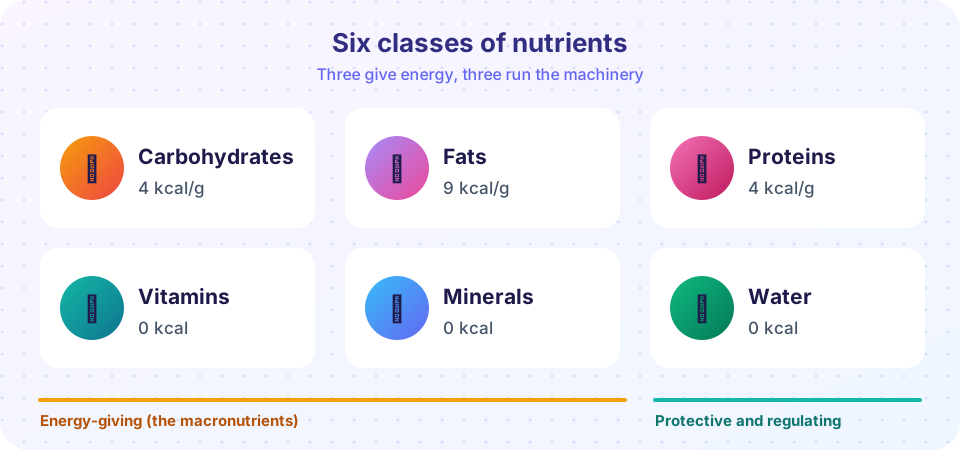
- The six classes of nutrients and which give energy.
- What lessons 2.1 to 2.3 cover and how they connect.
- Why the order of the course goes from classes to digestion to water.
Key terms
- Macronutrient: a nutrient needed in large amounts (grams a day): carbohydrate, fat, protein, and water.
- Micronutrient: a nutrient needed in small amounts (milligrams or micrograms a day): vitamins and minerals.
- Essential nutrient: one the body cannot make, or cannot make enough of, so it must come from food.
- Digestion: breaking food into molecules small enough to absorb.
- Absorption: moving those molecules from the gut into blood or lymph.
The big picture
Six classes of nutrients
The regulators
From food to cell
What each lesson covers
- Nutrient classes and energy defines essential and non-essential nutrients, lists the essential amino acids and fatty acids, and explains the Atwater energy factors that turn grams of macronutrients into kilocalories. You will also see why a calorie on a label is really a kilocalorie.
- Digestion and absorption follows a meal from mouth to colon: enzymes, acid, bile, the surface area of the small intestine, and the role of gut bacteria. It explains why some foods, such as fiber, are not digested but still matter.
- Water and hydration treats water as a nutrient: where it is in the body, how balance is kept, how much people drink in reality, and what dehydration and overhydration do.
- Chapter 2 review ties it together with a ten-question quiz and a one-page summary.
Why this order?
Nutrition courses sometimes start with the plate and work inwards. This course goes the other way, because many food claims fall apart once you ask a simple mechanistic question. "Burn fat with this food" is nonsense if you know that fat is already the densest fuel and that its fate depends on total energy balance. "Detox" is empty if you know what the liver and kidneys do all day. The framework in Chapter 2 gives you the questions to ask.
Common misconceptions
- "Vitamins give you energy." Vitamins help enzymes release energy from macronutrients, but they contain no usable energy themselves. A person who is not deficient will not gain energy by taking more.
- "Fat is bad, carbs are bad, or protein is bad." Each is a class with many members and each is essential in some form.
- "You must drink eight glasses of water a day." Needs vary; Water and hydration shows where the figure comes from and why it is not a rule.
Try it
Warm up with a quick classification exercise, then a short script that sorts a few nutrients by class and energy.
Press Run (or Ctrl + Enter) to see the result here.
Program input · what you'd type while the program runs
Type the answers before you press Run, one per line. Each time the program reads a line (with input()), it gets the next line from this box.
Check your understanding
Quick check · 4 questions
of 4 answered You scored / 4 · perfect!
-
1. Which classes of nutrients provide energy?
Carbohydrates, fats and proteins (and alcohol, which is not a nutrient) supply energy. Vitamins, minerals and water do not. -
2. Which is a micronutrient?
Micronutrients are vitamins and minerals, needed in milligrams or micrograms. -
3. What is the difference between digestion and absorption?
Digestion is breakdown, absorption is uptake across the intestinal lining. -
4. Why does this course study the nutrient classes before the individual foods?
Understanding classes, energy and digestion helps you spot claims that contradict basic physiology.
Summary
- There are six classes of nutrients; three supply energy and three regulate.
- Macronutrients are needed in grams, micronutrients in milligrams or micrograms.
- Chapter 2 covers classes and energy, digestion and absorption, and water.
- Mechanism-based questions make food claims easier to test.
Track your progress
Create a free account to tick off lessons and pick up where you left off on any device.
of Nutrition Science lessons completed