


















Lesson 33 of 47 · Diet, Disease and Evidence
Diet, heart disease, blood pressure and type 2 diabetes
What the best evidence says about fats, sodium, fiber and dietary patterns for cardiovascular disease, hypertension and type 2 diabetes, including DASH, PREDIMED and the DPP.
Cardiovascular disease (heart attacks and strokes) is the leading cause of death worldwide, and type 2 diabetes affects hundreds of millions of people. Both are strongly tied to diet, body weight and physical activity, so they are where nutrition science has done some of its most important work. This lesson walks through the strongest evidence, notes where the picture is still debated and shows how the landmark trials were designed. Remember from the previous lesson that each result comes from a specific design with limits.
Educational information only. This lesson describes research on populations. If you have heart disease, high blood pressure or diabetes, follow the advice of your own clinician, who knows your history and medicines.
What you will learn
- Which dietary factors have the strongest evidence for cardiovascular risk.
- What DASH, PREDIMED and the Diabetes Prevention Program showed.
- How sodium, potassium and fiber affect blood pressure and heart disease.
- Why the best-supported advice is about patterns rather than single nutrients.
Key terms
- LDL cholesterol: low-density lipoprotein, the blood fat particle most strongly linked to artery plaque.
- Hypertension: persistently high blood pressure, usually 130/80 mmHg or more by US guidelines (140/90 by many others).
- Insulin resistance: reduced response of muscle, liver and fat to insulin, a core feature of type 2 diabetes.
- Glycemic index: a ranking of how quickly a carbohydrate food raises blood glucose.
- Dietary pattern: the overall combination of foods someone eats, studied as a whole.
Fats and the heart
For half a century the diet-heart hypothesis has proposed that saturated fat raises LDL cholesterol and thus heart disease risk. The causal role of LDL itself is well established: genetic variants that lower LDL lower heart disease, and across many trials the Cholesterol Treatment Trialists' Collaboration found about a 22 percent lower risk of major vascular events for each 1 millimole per liter reduction of LDL with statins. Where nutrition enters is how much food changes LDL and what replaces the fat.
- Saturated fat (found in butter, cream, fatty meat, coconut and palm oil) raises LDL. A 2020 Cochrane review of trials lasting at least two years found that reducing saturated fat lowered combined cardiovascular events by about 17 percent, with modest certainty. The effect seems tied to what replaces it: swapping saturated fat for polyunsaturated fat (vegetable oils, nuts, fish) is associated with lower risk, while swapping it for refined carbohydrate does not help.
- Industrial trans fats, formed when oils are partially hydrogenated, raise LDL and lower HDL and are clearly harmful. Denmark limited them in 2003, the US phased out partially hydrogenated oils in the 2010s, and the WHO launched a campaign (REPLACE) in 2018 to eliminate them globally. This is one of the cleanest wins for nutrition science.
- Omega-3 fats from oily fish, eaten once or twice a week, are associated with lower heart disease death in cohorts. In large trials of fish oil supplements in generally healthy people, overall cardiovascular events were not reduced, so food and pill results should not be conflated.
- Dietary cholesterol has a modest effect on blood cholesterol for most people; eggs in moderation are not clearly harmful in healthy adults, although the evidence varies.
Blood pressure: sodium, potassium and DASH
High blood pressure is the biggest single risk factor for stroke and a major one for heart attacks and kidney disease. Diet affects it in several ways.
Sodium. Population studies, trials of salt reduction and the INTERSALT study all link higher sodium intake with higher blood pressure. The average global intake is about 4 g of sodium (roughly 10 g of salt) a day; the WHO recommends under 2 g of sodium (5 g of salt), and the US dietary guidelines set 2,300 mg as an upper limit. Most sodium in rich-country diets comes from processed and restaurant foods, not the saltshaker. (Salt in grams is about 2.5 times the sodium in grams.)
Potassium from fruit, vegetables, legumes and dairy lowers blood pressure and tempers the effect of sodium.
The DASH trials. The Dietary Approaches to Stop Hypertension trial (Appel et al., 1997) fed participants all of their meals so that adherence was certain. A diet rich in fruit, vegetables and low-fat dairy lowered systolic blood pressure by about 5.5 mmHg compared with a typical American diet, and by roughly twice as much in people who already had hypertension. A follow-up trial, DASH-Sodium (2001), tested the DASH diet at three sodium levels and showed that cutting sodium on top of DASH lowered pressure further. A reduction of 5 mmHg across a population is large enough to be expected to prevent many strokes and heart attacks.
Fiber, whole grains and plants
Meta-analyses of cohort studies and trials, including one in The Lancet in 2019 that pooled 185 prospective studies and 58 trials, find that people eating more fiber (about 25 to 29 g a day compared with lower intakes) have roughly 15 to 30 percent lower rates of cardiovascular disease, type 2 diabetes, colorectal cancer and total death, with a dose-response pattern. Whole grains, legumes, vegetables, fruits and nuts all contribute. This consistency across designs makes "eat more fiber-rich plant foods" one of the best-supported statements in nutrition.
Dietary patterns: Mediterranean, DASH, plant-based and others
Nutrition researchers increasingly study whole patterns, because people eat foods, not nutrients, and foods interact.
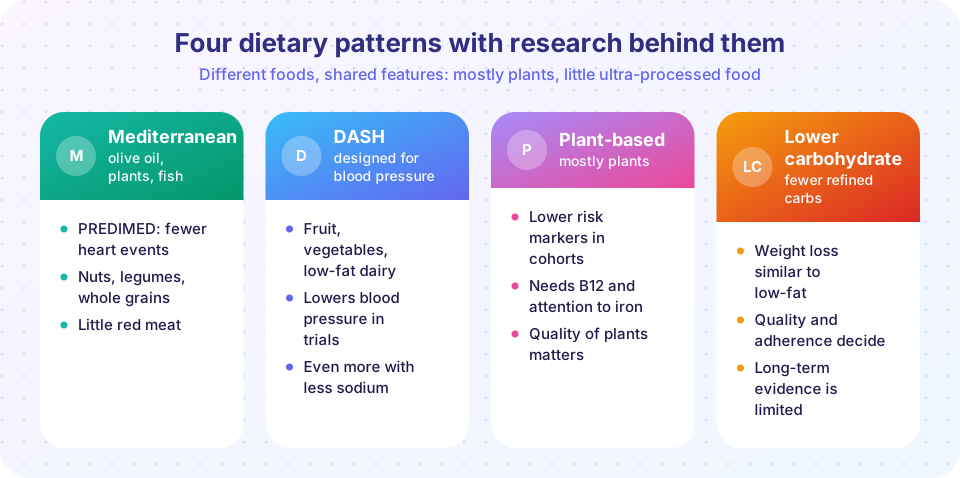
- Mediterranean. Olive oil, vegetables, fruit, legumes, nuts, whole grains and fish, with little red meat. PREDIMED, described in the last lesson, showed about 30 percent fewer major cardiovascular events in high-risk adults who followed it with extra olive oil or nuts, compared with advice to cut fat.
- DASH. Designed for blood pressure, with strong trial evidence.
- Plant-based diets. Cohort studies link healthy plant-based diets (whole grains, legumes, nuts, vegetables) with lower cardiovascular and diabetes risk; "plant-based" made of refined grains, sugary drinks and potato chips does not carry the same benefit, which is why quality matters. Vegan diets need a reliable vitamin B12 source.
- Lower-carbohydrate diets. The DIETFITS trial (Gardner et al., 2018) randomized 609 adults to a healthy low-fat or healthy low-carbohydrate diet for a year. Both lost weight (about 5.3 and 6.0 kg, a difference that was not statistically significant). The lesson: for weight, the best diet is the one a person can follow, and food quality mattered in both arms.
- Ultra-processed foods. Observational studies link high intake with obesity and chronic disease, and a small, tightly controlled NIH trial (Hall et al., 2019) found people ate about 500 kcal a day more on an ultra-processed diet than on an unprocessed diet matched for presented nutrients. The causal mechanism is still being studied.
Type 2 diabetes
Type 2 diabetes develops when the body can no longer make enough insulin to overcome insulin resistance, and excess body fat, especially around the abdomen, is the main driver. Prevention evidence is among the strongest in all of nutrition research.
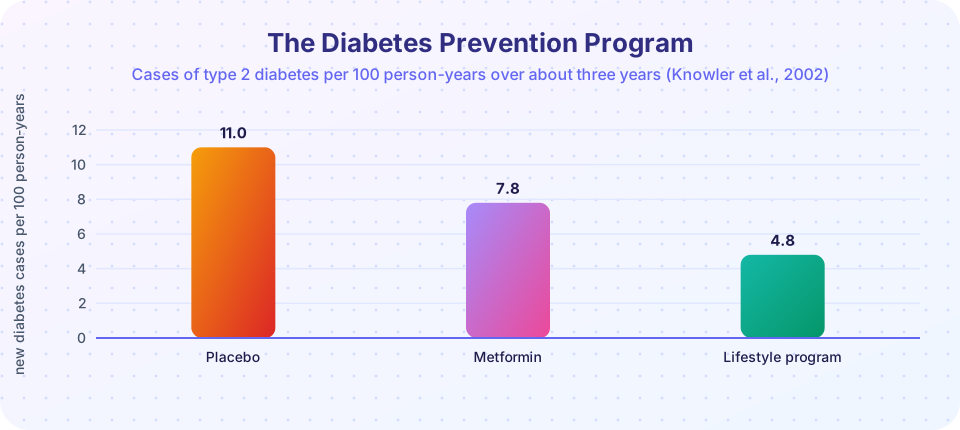
The Diabetes Prevention Program (Knowler et al., 2002) enrolled more than 3,000 US adults with prediabetes and overweight. They were assigned randomly to placebo, metformin (a diabetes medicine), or an intensive lifestyle program with a goal of 7 percent weight loss and 150 minutes of physical activity a week. After about 3 years, the diabetes rate per 100 person-years was 11.0 on placebo, 7.8 with metformin and 4.8 with lifestyle, a reduction of about 58 percent for lifestyle and 31 percent for metformin compared with placebo. Follow-up studies found that a substantial benefit persisted for more than a decade.
Other relevant findings:
- Sugar-sweetened beverages are associated with a higher risk of type 2 diabetes, roughly 10 to 20 percent more per daily serving in meta-analyses, partly through weight gain.
- Whole grains, nuts, legumes and coffee are associated with lower risk; red and processed meat with higher risk, although effect sizes are modest.
- Glycemic index and load may help some people manage blood sugar after meals, but their role in prevention beyond overall diet quality is smaller than once hoped.
Press Run (or Ctrl + Enter) to see the result here.
Program input · what you'd type while the program runs
Type the answers before you press Run, one per line. Each time the program reads a line (with input()), it gets the next line from this box.
Common misconceptions
- "Fat makes you fat and clogs arteries, so all fat is bad." The type of fat matters: unsaturated fats from plants and fish are linked with benefits; industrial trans fats are harmful.
- "Salt only matters if you have high blood pressure." Population-wide sodium reduction lowers blood pressure and risk, though people differ in salt sensitivity.
- "One superfood will protect my heart." The evidence favors overall patterns rich in plants and fiber, not single foods.
Check your understanding
Quick check · 6 questions
of 6 answered You scored / 6 · perfect!
-
1. Which fat has the clearest evidence of harm?
Trans fats raise LDL, lower HDL and have been regulated or banned in many countries. -
2. In the DASH trial, what was special about the way participants ate?
Controlled feeding means differences in blood pressure can be attributed to the diet. -
3. What did PREDIMED find?
High-risk adults had about 30 percent fewer events, based on the published analyses. -
4. In the DPP, which intervention gave the lowest diabetes incidence?
The rates were 11.0, 7.8 and 4.8 per 100 person-years respectively. -
5. What did the DIETFITS trial suggest about low-fat versus low-carbohydrate diets for weight loss over a year?
Average loss was similar in both arms. -
6. Approximately how many grams of salt contain 2 g of sodium?
Salt is about 40 percent sodium by weight, so 2 g sodium is about 5 g salt.
Summary
- Replacing saturated fat with unsaturated fat, eliminating trans fat, cutting sodium and eating more fiber all have good evidence for cardiovascular health.
- DASH lowered blood pressure in a controlled-feeding trial; PREDIMED suggested Mediterranean patterns reduce events.
- The Diabetes Prevention Program showed lifestyle change can cut diabetes onset in prediabetes by more than half.
- Patterns and food quality matter more than any single nutrient.
Track your progress
Create a free account to tick off lessons and pick up where you left off on any device.
of Nutrition Science lessons completed