


















Lesson 24 of 47 · Energy Balance and Metabolism
Energy balance and body weight: why weight is regulated
Why the 3,500-calorie rule overpredicts weight loss, how leptin, ghrelin and the hypothalamus regulate appetite, and why metabolism adapts when body weight falls.
Take the energy balance equation and a rule of thumb that a kilogram of body fat holds about 7,700 kilocalories. Cut 500 kcal a day and you should lose a kilogram every 15 days, 24 kilograms in a year, with no end in sight. Nobody loses 24 kilograms in a year on a 500 kcal deficit, and most people who lose weight find the loss slowing down long before they expected. The reason is not that thermodynamics fails. It is that the body is a regulated system: intake and expenditure both respond to weight change, and they respond in ways that resist it. This lesson shows the evidence and the mechanisms.
What you will learn
- Where the "3,500 kcal per pound" rule comes from and why it overshoots over long periods.
- How the hypothalamus integrates hormone signals to control hunger.
- What adaptive thermogenesis is, with the landmark evidence.
- Why keeping weight off is harder than losing it, and what helps.
Key terms
- Energy density of tissue: the energy stored per kilogram of tissue; fat tissue is about 7,700 kcal/kg because it is mostly triglyceride with a little water and protein.
- Set point / settling point: ideas about the weight a body tends to defend. A settling point depends on the environment as well as biology.
- Adaptive thermogenesis: a fall in energy expenditure beyond what the loss of body mass explains.
- Hypothalamus: the part of the brain that reads energy status and controls feeding.
- Leptin: a hormone made by fat cells, proportional to stored fat.
The rule of thumb and its limits
In 1958, Max Wishnofsky estimated that a pound of body fat tissue holds about 3,500 kcal, which is where 7,700 kcal per kilogram comes from. The number itself is about right for fat tissue; the error comes from treating it as a constant exchange rate over time. The simple rule assumes expenditure stays the same as you lose weight. In practice:
- A smaller body needs less energy, since there is less tissue to maintain and move. A 10 kg loss typically lowers TDEE by something like 200 to 300 kcal per day, which shrinks the deficit.
- Not all weight lost is fat. Early weight loss includes glycogen and water, and some lean mass is lost too, so the energy content of lost weight varies.
- The body adapts, as described below.
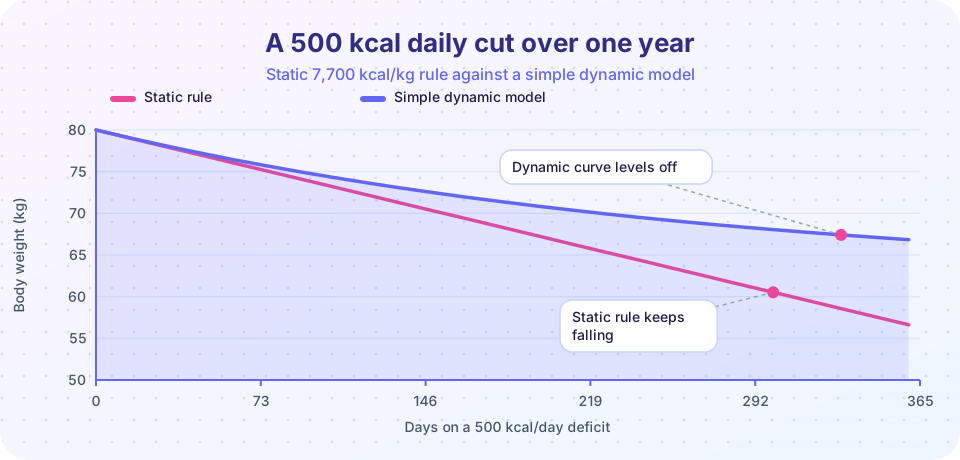
Kevin Hall and colleagues at the US National Institutes of Health built dynamic models that account for these changes. Their central result: weight change follows a curve that levels off, approaching a new steady weight over about one to three years, instead of continuing in a straight line.
A very simple version shows the shape. Suppose expenditure is proportional to body weight, E = k x W, and weight changes by dW/dt = (I - k x W) / 7700 per day, where I is intake. Weight approaches W = I / k exponentially, with a time constant of 7700 / k days. For an 80 kg person whose intake of 2,200 kcal exactly matches expenditure (so k is 27.5 kcal per kg per day), a cut of 500 kcal per day ends at about 62 kg in the long run, not by losing 24 kg a year forever: the model predicts about 13 kg lost in the first year. Real people vary, but the curve shape is right.
How the brain keeps score
The hypothalamus, a small structure at the base of the brain, sits at the center of appetite control. In its arcuate nucleus, two groups of neurons act like a brake and an accelerator:
- AgRP/NPY neurons promote hunger. They are turned on by ghrelin and by low leptin and insulin.
- POMC neurons reduce hunger. They are turned on by leptin, insulin and gut peptides.
Hormones report to these neurons:
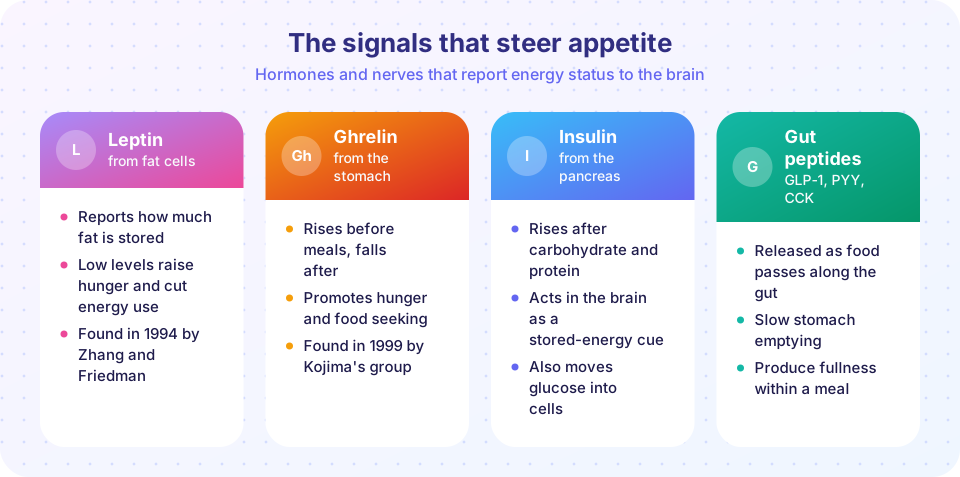
- Leptin, discovered in 1994 by Jeffrey Friedman's group (Zhang and colleagues) in the ob/ob mouse, is released by fat cells in proportion to fat mass. It tells the brain how large the reserves are. Mice and a few rare human families that cannot make leptin eat without limit and become extremely obese; giving leptin to the people with that deficiency works dramatically. For most people with obesity, leptin is already high, and extra leptin has little effect, a state called leptin resistance.
- Ghrelin, found by Masayasu Kojima's group in 1999, comes from the stomach, rises before habitual meal times and falls after eating.
- Insulin rises after meals and also signals sufficiency to the brain.
- Gut peptides (GLP-1, PYY, CCK) are released as nutrients move along the gut and cause fullness. Modern medicines that mimic GLP-1 are among the most effective anti-obesity treatments; their use belongs with a clinician and is outside the scope of this lesson.
Fullness is also affected by the volume and structure of food, protein content, fiber, and by learned cues, stress, sleep and the sight and smell of food. Brain pathways for pleasure and reward can drive eating beyond need: this is why the same person may be satisfied after a meal and still eat dessert.
When weight falls, the system pushes back
Evidence for the body's defense of weight is substantial:
- The Minnesota Starvation Experiment (Ancel Keys, 1944-45). Thirty-six healthy young men ate roughly half their usual energy for six months. They lost about a quarter of their body weight, their metabolic rate dropped by a large amount (more than the loss of tissue alone would explain), and they became preoccupied with food, collecting recipes and dreaming of meals. During refeeding, many overshot their original body weight in fat before eventually returning to it.
- Leibel, Rosenbaum and Hirsch (1995) studied people whose weight had been changed by 10 percent in either direction and found that expenditure per unit of lean mass shifted in the direction that opposes the change: lower after weight loss, higher after gain.
- Follow-up of contestants of a televised weight-loss competition (Fothergill and colleagues, 2016) found that six years later, most had regained much of the weight and had resting metabolic rates several hundred kcal per day below what their body size predicted, a persistent adaptation. It was a small, unusual group, so the exact size of the effect is debated, but the direction is consistent with other studies.
Several changes combine after weight loss: leptin falls, ghrelin rises, fullness signals after a meal weaken and the drive to eat increases. NEAT and the efficiency of muscle work change too. These signals persist for at least a year in studies that have tracked them.
This is a biology of resistance to change, not a moral failing. It shows why prevention is easier than cure, and why long-term maintenance needs strategies that work with the system: adequate protein and fiber, regular physical activity (which is especially linked to successful maintenance), sleep and a food environment that does not constantly challenge hunger.
Settling points and the environment
The simplest "set point" idea says the body holds a fixed weight. The evidence is better described by a settling point: weight settles where biology and environment balance. Average body weights in many countries have risen across a few decades, too fast for genes to change, which points to the food environment, activity patterns and other social changes as the drivers. Genes still matter: twin and adoption studies attribute a large share of the differences between people in body weight to heredity, which is why a population in the same environment still varies widely.
Common misconceptions
- "If a 500 kcal deficit loses a pound a week, I will lose 52 pounds in a year." The rate slows as weight falls and the body adapts.
- "People who regain weight lack willpower." Hormonal and metabolic changes after weight loss increase hunger and reduce expenditure; willpower works against biology.
- "Metabolism is permanently damaged by dieting." The evidence points to a persistent but modest adaptation, not permanent damage.
Try it
The Python demonstration compares the static rule with the simple dynamic model above. The JavaScript demonstration asks how long a given goal takes under each model. Both are simplified models, not predictions for a person.
Press Run (or Ctrl + Enter) to see the result here.
Program input · what you'd type while the program runs
Type the answers before you press Run, one per line. Each time the program reads a line (with input()), it gets the next line from this box.
Press Run (or Ctrl + Enter) to see the console output here.
No output.
Check your understanding
Quick check · 6 questions
of 6 answered You scored / 6 · perfect!
-
1. Why does the 7,700 kcal per kg rule overpredict long-term weight loss?
A smaller, adapted body spends less, which narrows the original deficit. -
2. Which hormone is made by fat cells and signals long-term energy stores?
Leptin rises with fat mass and acts on the hypothalamus to reduce appetite. -
3. What did the Minnesota Starvation Experiment show after prolonged restriction?
Men lost about a quarter of body weight, metabolic rate fell and they became preoccupied with food. -
4. Adaptive thermogenesis refers to...
It is the extra reduction in expenditure after weight loss. -
5. Which hormone rises before meals and stimulates hunger?
Ghrelin comes from the stomach, rises before habitual mealtimes and increases hunger. -
6. Which description best fits the idea of a settling point?
Environment and biology interact, so weight can settle at different levels in different surroundings.
Summary
- The 7,700 kcal/kg rule is right for fat tissue but wrong as a fixed exchange rate over time.
- The hypothalamus integrates leptin, ghrelin, insulin and gut peptides to regulate hunger.
- After weight loss, hunger rises and expenditure falls beyond what body size predicts.
- Body weight settles where biology and environment balance; prevention is easier than reversal.
Next: Chapter review
Track your progress
Create a free account to tick off lessons and pick up where you left off on any device.
of Nutrition Science lessons completed