


















Lesson 15 of 47 · Carbohydrates, Fats and Proteins
Chapter 3 review: carbohydrates, fats and proteins
Review sugars, starch and fiber, the types of fat and cholesterol, protein quality and needs, and test yourself with a ten-question quiz.
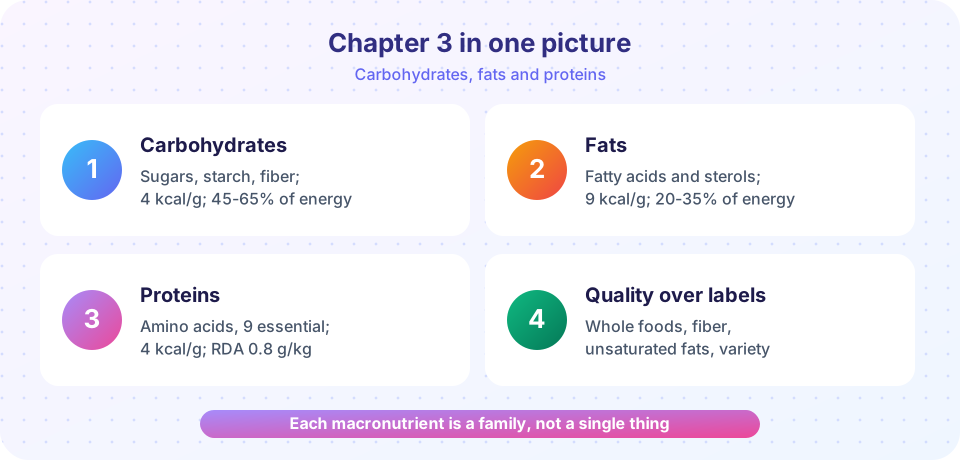
Chapter 3 covered the three energy nutrients. You met carbohydrates from single sugars to fiber, fats from saturated to trans, and proteins from single amino acids to folded molecules, and you learned that the quality inside each class matters as much as the percentage of energy it supplies. This review gathers the key numbers and ideas and tests them.
What you will learn
- The numbers to remember for each macronutrient.
- How to compare diets by quality, not only by percentages.
- Where you may need to revisit a lesson.
Key terms
- AMDR: carbohydrate 45 to 65 percent, fat 20 to 35 percent, protein 10 to 35 percent of energy.
- Free sugars: keep below 10 percent of energy.
- Fiber: about 14 g per 1,000 kcal, 25 to 38 g a day.
- Saturated fat: keep below about 10 percent of energy; replace with unsaturated fat.
- Protein RDA: 0.8 g per kg per day for adults.
The chapter in a table
| Macronutrient | Energy | Essential member | Key guideline | Quality question |
|---|---|---|---|---|
| Carbohydrate | 4 kcal/g | None strictly, but about 130 g/day glucose need | 45 to 65% of energy; fiber 25 to 38 g; free sugars under 10% | Whole or refined? |
| Fat | 9 kcal/g | Linoleic and alpha-linolenic acids | 20 to 35% of energy; saturated under 10%; trans fat as low as possible | Which fatty acids? |
| Protein | 4 kcal/g | Nine amino acids | 0.8 g/kg RDA; 10 to 35% of energy | Complete? From which foods? |
Lessons: carbohydrates, fats, proteins.
Comparing diets by quality
Imagine two diets, each with 2,000 kcal and 55 percent carbohydrate, 30 percent fat and 15 percent protein. On percentages they are identical. Diet A gets its carbohydrate from whole grains, beans, vegetables and fruit, and its fat mostly from olive oil, nuts and fish; its protein is half from legumes and fish. Diet B gets its carbohydrate from white bread, sugary drinks and pastries, and its fat mostly from butter, fried foods and processed meat. A nutrition scientist would predict very different outcomes, even though a calculator would call the two diets equal. This is the reason the review of evidence in Chapter 7 looks at dietary patterns and food substitutions and not only at nutrient percentages.
Common misconceptions
- "A low-carb or low-fat label tells me how healthy a food is." Both ignore the type of carbohydrate or fat, and the other nutrients present.
- "Fiber, sugar and starch are all just carbs, so they behave the same." Digestion, blood glucose and gut effects differ.
- "If protein is good, protein bars and shakes are always needed." Most people meet the RDA from ordinary food.
Try it
First, compare two diets by energy shares and by a simple quality score, to see why percentages alone are not enough. Then use flashcards to rehearse the numbers.
Press Run (or Ctrl + Enter) to see the result here.
Program input · what you'd type while the program runs
Type the answers before you press Run, one per line. Each time the program reads a line (with input()), it gets the next line from this box.
Check your understanding
Quick check · 10 questions
of 10 answered You scored / 10 · perfect!
-
1. Which disaccharide is found in milk?
Lactose, glucose plus galactose, is the sugar of milk. -
2. A food has GI 50 and 30 g of available carbohydrate per serving. Its glycemic load is
GL = 50 x 30 / 100 = 15. -
3. Which advice is best supported for fat?
Replacing saturated with polyunsaturated fat lowers LDL and cardiovascular risk; replacing it with refined carbohydrate does not. -
4. What is the main function of LDL particles?
LDL delivers cholesterol to tissues; excess LDL can deposit in artery walls. -
5. Which food is a source of complete protein?
Eggs supply all nine essential amino acids in good proportions. -
6. A 70 kg adult's protein RDA is about
0.8 x 70 = 56 g. -
7. Which is a free sugar?
Free sugars include added sugars and sugars in honey, syrups and fruit juices. -
8. How do fats reach the blood after absorption?
Chylomicrons enter lymph vessels and join the blood near the heart. -
9. Which substitution is associated with lower disease risk?
Choosing whole grains over refined grains is the beneficial direction; the reverse is not. -
10. Why can a vegetarian diet meet protein needs?
A varied intake of legumes, grains, nuts and seeds supplies all essential amino acids over the day.
Summary
- Carbohydrates, fats and proteins each include members of very different quality.
- Key numbers: AMDR 45-65, 20-35, 10-35 percent; free sugars under 10 percent; fiber 25 to 38 g; saturated fat under about 10 percent; protein 0.8 g/kg.
- Replacement matters: whole for refined, unsaturated for saturated, plant and fish for processed meat.
- Chapter 4 turns to the micronutrients: vitamins and minerals.
Track your progress
Create a free account to tick off lessons and pick up where you left off on any device.
of Nutrition Science lessons completed