


















Lesson 34 of 47 · Diet, Disease and Evidence
Judging nutrition claims, fad diets and supplements
A practical guide to appraising nutrition headlines, spotting red flags in fad diets and supplement marketing, and understanding what large supplement trials found.
Nutrition claims arrive from every direction: news articles, social media influencers, product labels, friends and relatives. Some are well founded, many are exaggerated and a few are simply false. The job of a nutrition-literate person is not to memorize which is which but to have a method. With a handful of questions, a basic grasp of statistics and some awareness of how supplements and fads are sold, you can sort most claims into "worth taking seriously", "interesting but unproven" and "ignore".
Educational information only. This lesson teaches evaluation skills. It does not tell you what to take or avoid for your own health; discuss supplements and diet changes with a clinician, especially if you are pregnant, ill or on medicines.
What you will learn
- A checklist for appraising a headline or a health claim.
- Why fads spread, and what the evidence says about several popular ones.
- What the big supplement trials found, including cases of harm.
- How testing many foods against many outcomes produces false alarms.
Key terms
- Anecdote: a single story or testimonial, which cannot show cause.
- Multiple comparisons: testing many hypotheses at once, which raises the chance of false positives.
- P-hacking: analyzing data in many ways until something looks significant.
- Conflict of interest: a financial or other tie that could bias research or advice.
- Placebo effect: improvement caused by expectation rather than the treatment itself.
A checklist for any claim
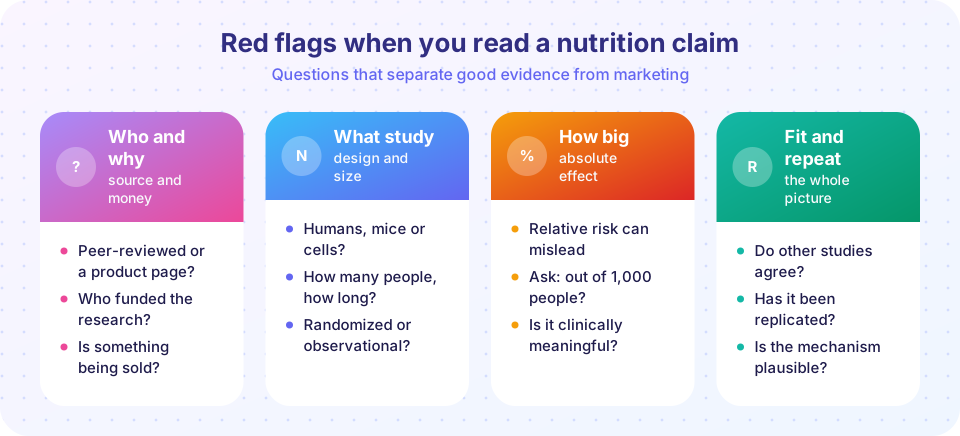
- Who is making it, and what do they gain? A peer-reviewed article in a reputable journal, a university press release, a product page and an influencer's video carry different weight. Industry funding does not automatically invalidate research, but studies funded by food and supplement companies are more likely to report favorable conclusions, so read the funding statement.
- What kind of evidence is it? Cells in a dish and mice are a starting point, not an answer: most compounds that work in mice never work in people. In humans, ask whether it was a randomized trial, a cohort or a survey (see study designs), how many people took part and how long they were followed.
- How big is the effect, in absolute terms? "Reduces risk by 30 percent" can mean from 0.2 to 0.14 percent. Ask what it means out of 1,000 people.
- Is the outcome one that matters? Changing a blood marker is not the same as preventing a heart attack. A study showing a drop in a biomarker is weaker than one showing fewer events.
- Does it fit with other evidence, and has it been repeated? A single surprising study is usually followed by regression to normal. One that matches multiple lines of evidence is more credible.
- Is the language a red flag? "Miracle", "detox", "toxins", "cures", "doctors hate this", "secret", "boosts immunity" without specifics, personal testimonials as proof, and conspiracy explanations for why experts disagree are all warning signs.
Why false alarms are common
A study that tests whether each of 20 foods is linked to a disease will, by chance alone, find about one "significant" association at the usual 5 percent threshold, even if no food does anything. A flexible analysis (different subgroups, different outcomes, different cut-points) multiplies the opportunities. This is the problem of multiple comparisons, and it explains why headlines about single foods flip-flop. Honest studies pre-register their hypotheses, adjust for the number of tests, and ask whether the result replicates. The simulation below shows how big the problem is.
Press Run (or Ctrl + Enter) to see the result here.
Program input · what you'd type while the program runs
Type the answers before you press Run, one per line. Each time the program reads a line (with input()), it gets the next line from this box.
Fad diets: why they appeal and what the evidence says
Fad diets succeed because they offer simple rules, dramatic stories and a sense of control. Many produce short-term weight loss because they cut calories or remove whole food groups, then fail because people cannot stay on them. Here are a few common ones.
- Detox and cleanse diets. The liver, kidneys, lungs, gut and skin already remove waste products. No juice, tea or foot pad has been shown to remove "toxins" beyond that; products rarely name the toxin they target or measure it.
- Alkaline diets. The pH of the blood is tightly regulated by the lungs and kidneys, and food cannot change it appreciably. Urine pH does change, which is why test strips look convincing.
- Gluten-free diets. Essential for people with celiac disease (about 1 percent of people) and helpful for some with wheat allergy or non-celiac gluten sensitivity. There is no evidence of benefit for the general population, and gluten-free versions of processed foods are not healthier.
- Intermittent fasting and time-restricted eating. Trials show weight loss similar to ordinary calorie restriction in many studies, with the main difference being how easy people find it. Some small studies show metabolic benefits, others show none, and long-term data are limited. It is not appropriate for everyone.
- Very low-carbohydrate (ketogenic) diets. Effective for short-term weight loss and glucose control in some people, but not better than other diets over a year in several trials, and hard to maintain; they also raise LDL cholesterol in some.
- "Clean eating". A vague term. Rigid rules about purity can drift into orthorexia, an unhealthy fixation on food quality, which is not an official diagnosis but is widely discussed by clinicians.
A few popular food beliefs are also tested. Sugar does not make children hyperactive: a 1995 meta-analysis of 23 double-blind trials (Wolraich et al.) found no effect on behavior or thinking, although parents who believe their child had sugar rate behavior as worse. And for most healthy people, moderate egg intake has no clear effect on heart disease, in contrast to the strong evidence for trans fat.
Supplements: what trials found
Dietary supplements are sold as everything from vitamins and minerals to herbs and protein powders. In many countries, including the United States (under the 1994 Dietary Supplement Health and Education Act), they do not need approval for safety or effectiveness before sale, and the manufacturer is responsible for the claims. Independent testing by bodies such as USP and NSF is voluntary.
The most important lesson comes from large randomized trials of antioxidants, which seemed promising based on observational studies of people who ate many fruit and vegetables:
- ATBC (Finland, 1994) gave beta-carotene supplements to male smokers and found about 18 percent more lung cancers, not fewer.
- CARET (US, 1996) gave beta-carotene plus retinol to smokers and asbestos-exposed workers and found a relative risk of lung cancer near 1.3; it was stopped early.
- SELECT (2011) tested vitamin E and selenium for prostate cancer prevention and found that vitamin E users had about 17 percent more prostate cancers.
- VITAL (2018) tested vitamin D (2,000 IU a day) and fish oil in about 25,000 generally healthy adults and found no reduction in total cancer or cardiovascular events.
- Meta-analyses of antioxidant supplements have found no mortality benefit and possible increases for some.
The pattern: nutrients from foods can be associated with benefit, but isolating one compound into a pill at high dose does not necessarily reproduce it, and can cause harm. That is not a reason to avoid all supplements. They do help specific groups: folic acid before pregnancy, vitamin B12 for vegans and older adults, vitamin D for people with deficiency, iron for iron-deficiency anemia, and iodine in iodine-poor regions. The test is whether there is evidence for a particular person and a particular nutrient.
Reading the news
Press releases and headlines often compress findings. Look for the original study, check the sample size and design, notice whether "linked to" has become "causes", and whether mouse results are presented as human results. Finally, one study is rarely the end of the story: look for a systematic review or the opinion of respected bodies (national dietary guideline committees, WHO, Cochrane) that weigh the whole literature.
Common misconceptions
- "If it's natural, it's safe." Many natural compounds are toxic, and high-dose supplements can cause harm.
- "Science keeps changing its mind, so nobody knows anything." Core findings (trans fats, fiber, sodium, folate and neural tube defects) have been stable for decades; the debates are at the edges.
- "A product with a doctor's endorsement must be proven." Credentials are not evidence; look for trials.
Check your understanding
Quick check · 6 questions
of 6 answered You scored / 6 · perfect!
-
1. Why are headlines about single foods often contradicted later?
Multiple comparisons and flexible analysis produce false positives. -
2. What did the ATBC trial find about beta-carotene supplements in smokers?
The trial, like CARET, showed harm rather than benefit. -
3. Which is the best description of 'detox' products?
The liver and kidneys do the detoxification, and products rarely identify what they remove. -
4. A claim reports a 40 percent lower risk of a disease. What should you ask first?
Relative changes in a rare outcome may be tiny in absolute terms. -
5. For which group is a vitamin B12 supplement well supported?
Plant foods have no B12 and absorption falls with age. -
6. What did the 1995 meta-analysis of sugar and children's behavior conclude?
Parents' expectations, not sugar itself, seemed to explain the belief.
Summary
- Use a checklist: source, study type, absolute effect, outcome relevance, replication and plausibility.
- Multiple comparisons make chance findings common; pre-registration and replication protect against them.
- Fad diets rely on simplicity and anecdote; many have little evidence of benefit beyond calorie reduction.
- High-dose antioxidant supplements have caused harm in trials, while targeted supplementation helps specific groups.
Next: Chapter review
Track your progress
Create a free account to tick off lessons and pick up where you left off on any device.
of Nutrition Science lessons completed