


















Lesson 25 of 47 · Energy Balance and Metabolism
Chapter 5 review: energy balance and metabolism
Review food energy, Atwater factors, resting metabolism, the thermic effect of food, TDEE, appetite hormones and adaptation, with a ten-question quiz.
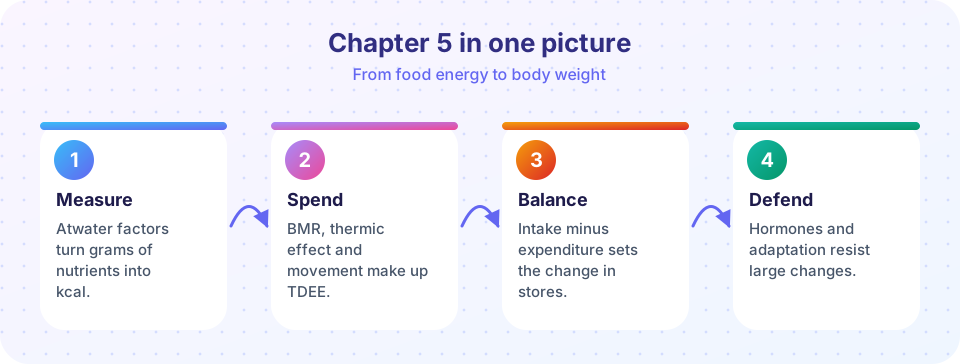
You have followed energy from a bomb calorimeter to a body that actively defends its weight. This review collects the main ideas in one picture and one table, then tests you with ten questions that mix all three lessons.
What you will learn
- Which facts and numbers from the chapter are worth memorizing.
- How the ideas connect: measurement, expenditure, balance and regulation.
- Which mistakes to avoid when you reason about calories.
Recap table
| Topic | Key facts |
|---|---|
| Units and measurement | 1 kcal = 4.184 kJ; Atwater factors 4 (protein), 4 (carbohydrate), 9 (fat), 7 (alcohol), about 2 (fiber) |
| Gross vs metabolizable | Bomb calorimeter measures gross energy; feces and urea losses make metabolizable energy lower, most for protein |
| Expenditure | TDEE = resting metabolism (about 60-70%) + TEF (about 10%) + NEAT + exercise |
| Prediction | Mifflin-St Jeor: 10W + 6.25H - 5A + 5 (men) or - 161 (women); times an activity factor of 1.2 to 1.9 |
| Thermic effect | Protein about 20-30%, carbohydrate 5-10%, fat 0-3% |
| Balance and weight | Fat tissue about 7,700 kcal/kg; real weight loss levels off; expenditure and appetite adapt |
| Hormones | Leptin (fat cells, long-term), ghrelin (stomach, hunger), insulin, GLP-1, PYY, CCK (fullness) |
Connecting the ideas
- Measurement sets the input side. The same Atwater factors that make labels possible hide errors of several percent and larger ones for single whole foods.
- Expenditure sets the output side. You can estimate it with equations, but individuals differ by hundreds of kcal and can only be measured with calorimetry or doubly labeled water.
- Balance is dynamic. Intake and expenditure respond to each other, so the neat straight line from the energy balance equation bends into a curve.
- Regulation explains persistence. The brain reads leptin, ghrelin, insulin and gut peptides, and defends weight more strongly against loss than against gain.
Key terms to know: kilocalorie, kilojoule, gross and metabolizable energy, Atwater factors, BMR, RMR, TEF, NEAT, TDEE, respiratory quotient, doubly labeled water, adaptive thermogenesis, leptin, ghrelin, hypothalamus.
Common mistakes to avoid
- Treating a label value as exact: it is an average, rounded estimate.
- Treating an equation's output as a measurement of an individual.
- Assuming a deficit works the same way for months as it does for days.
- Explaining weight regain by weak willpower alone, when hormones and expenditure have shifted.
How to study this chapter
Work through the chapter in the order it was written, but test yourself in reverse. Start from the question "why is body weight hard to change?" and trace the answer back: appetite hormones and adaptation explain the defense of weight; expenditure components explain what is being defended; and Atwater factors explain how the input side is counted. If you can tell that story without looking at the notes, you have the chapter.
A worked check helps. A woman of 40 weighs 65 kg and is 168 cm tall. Mifflin-St Jeor gives 10 x 65 + 6.25 x 168 - 5 x 40 - 161 = 1,339 kcal for her BMR. With light activity (factor 1.375) her TDEE is about 1,841 kcal, and about a tenth of it, around 180 kcal, goes on digesting food. If she eats 1,527 kcal, the gap is about 314 kcal a day, and the static rule predicts roughly 0.29 kg per week at first, a number that shrinks as her body adapts.
Try it
Check your chapter knowledge with a quick estimator that chains the ideas: it computes a person's BMR, TDEE and the energy of a day's menu, then shows the daily gap and a first-week prediction. It is a worked example, not a diagnosis.
Press Run (or Ctrl + Enter) to see the console output here.
No output.
Check your understanding
Quick check · 10 questions
of 10 answered You scored / 10 · perfect!
-
1. How many kcal are in 25 g of fat, by Atwater general factors?
25 x 9 = 225 kcal. -
2. 2,092 kJ is closest to how many kcal?
2,092 / 4.184 = 500. -
3. Which loss explains why protein's metabolizable energy is well below its gross energy?
Nitrogen leaves as urea, carrying chemical energy out of the body. -
4. Which component of TDEE varies most between individuals living similar lives?
Everyday movement and fidgeting range by hundreds of kcal per day. -
5. What is the respiratory quotient when mostly fat is burned?
Fat oxidation yields about 0.7 molecules of CO2 per molecule of O2. -
6. Which pair is correct?
Leptin is made by fat tissue and ghrelin mainly by the stomach. -
7. Why does a 500 kcal/day deficit lose less than 24 kg in a year?
As weight falls and the body adapts, the daily deficit narrows. -
8. Using Mifflin-St Jeor, which has the higher BMR at the same age, height and weight?
The sex constants are +5 and -161, a difference of 166 kcal per day. -
9. Which finding supports the existence of adaptive thermogenesis?
The extra drop beyond what lost tissue explains is the definition of the adaptation. -
10. Which method measures free-living energy expenditure over one to two weeks?
The two isotopes' elimination rates reveal CO2 production and thus energy use.
Summary
- Energy in, energy out is an identity; the interesting science is in how each side is measured and regulated.
- Atwater factors, TDEE components and prediction equations are tools with known error bars.
- Body weight is defended by hormones and adaptive changes, which explains why loss levels off and regain is common.
Track your progress
Create a free account to tick off lessons and pick up where you left off on any device.
of Nutrition Science lessons completed