


















Lesson 40 of 47 · Food Systems and Policy
Chapter 8 review: food systems and policy
Review food safety, labels, food security, malnutrition, sustainability, dietary guidelines and food policy with a recap table and a ten-question quiz.
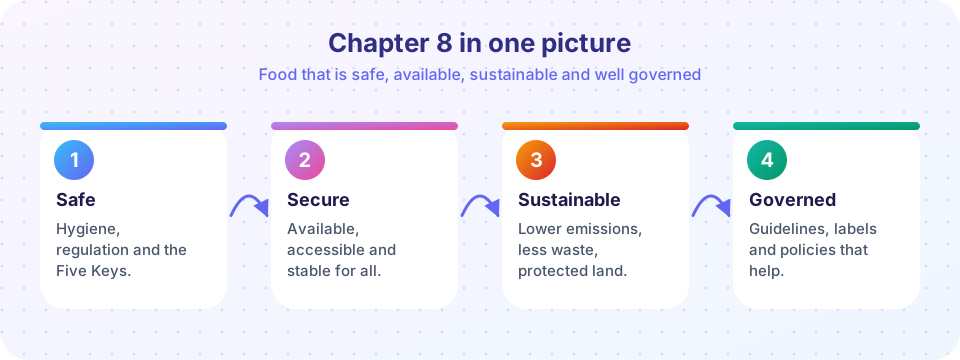
This chapter moved from the individual plate to the system that fills it. It has four main messages. Food must be safe. It must be available and accessible to everyone. It must be produced in a way that is sustainable. And the environment in which people choose, shaped by guidelines, labels, prices and programs, is a powerful lever for health. Use this page to consolidate the main ideas and test yourself.
What you will learn
- The key facts and figures from each lesson of the chapter.
- How safety, security, sustainability and policy connect.
- Common mistakes in thinking about food systems.
Recap table
| Topic | Key ideas |
|---|---|
| Food safety | Foodborne illness: about 600 million cases a year (WHO); danger zone 5-60 degrees C; Five Keys; HACCP; Codex |
| Labels | Nutrition facts (check serving size), ingredients by weight, claims, front-of-pack systems; "use by" vs "best before" |
| Food security | Four pillars: availability, access, utilization, stability; hunger is mainly about poverty and conflict |
| Triple burden | Undernutrition, micronutrient deficiency, overweight and obesity often coexist |
| Waste and footprint | About a third of food lost or wasted; ruminant meat and cheese have the highest emissions per kg; plants the lowest |
| Guidelines and policy | FBDGs; fortification, taxes, regulation, labels, school meals; population-level policies reach more people |
Key terms to know: food system, food environment, food security, triple burden, stunting, wasting, hidden hunger, CO2e, HACCP, Codex, ADI, front-of-pack labeling, fortification, reformulation, price elasticity, equity.
How the pieces connect
- Safety and security. Unsafe food and poor sanitation waste nutrients and sicken children, which links utilization (a pillar of food security) to hygiene.
- Waste and sustainability. Preventing waste feeds people and cuts emissions at the same time.
- Policy and equity. The same tax or label can help or harm depending on who it reaches, so equity belongs in the design.
- Evidence and policy. The evidence chapter's skills apply directly: policy evaluations are often natural experiments with biases to weigh.
Common mistakes to avoid
- Treating hunger as a shortage of food rather than of access.
- Assuming local always means low-carbon.
- Believing education alone changes diets at population scale.
- Reading "natural" or "low fat" as a guarantee of healthiness or safety.
A worked example: reading a policy claim
A report says that a tax of 20 percent on sugary drinks "cut purchases by 17 percent and saved lives". Apply the chapter's tools. The first number is consistent with an elasticity of about -1, since 1.2 to the power of -1 is 0.833. The second claim needs more scrutiny: a drop in purchases is not a drop in disease, and the study design matters. Was there a comparison group? Did people switch to other sugary products? Who paid the tax, and who benefited? A balanced reading concludes that the tax probably reduces consumption, that health effects follow only if the reduction persists and is not offset by substitution, and that its effect on equity depends on how the revenue is used.
Try it
The calculator below turns a simple menu into a rough emissions estimate and a label check, bringing together sustainability and labeling. The numbers are the same global averages used in the lesson.
Press Run (or Ctrl + Enter) to see the console output here.
No output.
Check your understanding
Quick check · 10 questions
of 10 answered You scored / 10 · perfect!
-
1. What is the temperature danger zone for food?
Bacteria multiply rapidly in this range. -
2. Which is the first ingredient on a label?
Ingredients are listed in descending order of weight. -
3. Which pillar of food security is weakened by repeated diarrhea from unsafe water?
Infection and poor sanitation prevent the body from using food. -
4. Which pair shows the triple burden of malnutrition?
Undernutrition and overweight often coexist. -
5. Which food has the highest average emissions per kilogram?
Around 99 kg CO2e per kg for beef from beef herds. -
6. Why does fortification have such reach?
Adding nutrients to staples protects everyone who eats them. -
7. A sugar tax raises prices by 20 percent and elasticity is -1. By roughly how much will purchases fall?
(1.2)^-1 = 0.833, a 16.7 percent fall. -
8. What does the WHO Five Keys advise about cooked and raw food?
Separating prevents cross-contamination. -
9. What is a key lesson of the health impact pyramid?
Structural changes reach whole populations with less individual effort. -
10. Which statement about food waste is correct?
Wasted food carries wasted land, water and energy.
Summary
- Safe, secure, sustainable and well-governed food are the four goals of a good food system.
- Temperature control, hygiene and regulation keep food safe; labels inform choices.
- Hunger and obesity share causes; waste and footprint link nutrition to the climate.
- Population-level policies reach the most people; judge them for effectiveness, equity and side effects.
Track your progress
Create a free account to tick off lessons and pick up where you left off on any device.
of Nutrition Science lessons completed