


















Lesson 7 of 47 · Foundations of Nutrition
Nutrient classes and energy
Learn which nutrients are essential, the nine essential amino acids and two essential fatty acids, and how grams of food become kilocalories.
A food label lists calories, grams of fat, milligrams of sodium and micrograms of vitamin D. Behind every one of those numbers is a decision about what counts as a nutrient and how to measure its energy. This lesson explains both.
You will learn which nutrients you must eat because your body cannot make them, how scientists measure the energy in food, and how to calculate a food's energy from its macronutrients yourself, which is how most nutrition databases and label programs actually do it.
What you will learn
- The difference between essential, conditionally essential and non-essential nutrients.
- The nine essential amino acids and the two essential fatty acids.
- What a kilocalorie is and how it relates to a kilojoule.
- How to compute the energy of a food or meal using the Atwater factors.
Key terms
- Essential nutrient: one the body cannot synthesize at all, or in sufficient amounts, so it must be supplied by food.
- Conditionally essential: normally made by the body but needed from food in special conditions, such as prematurity or illness.
- Kilocalorie (kcal): the energy needed to raise 1 kg of water by 1 degree Celsius; about 4.184 kJ. A "Calorie" on a label is a kilocalorie.
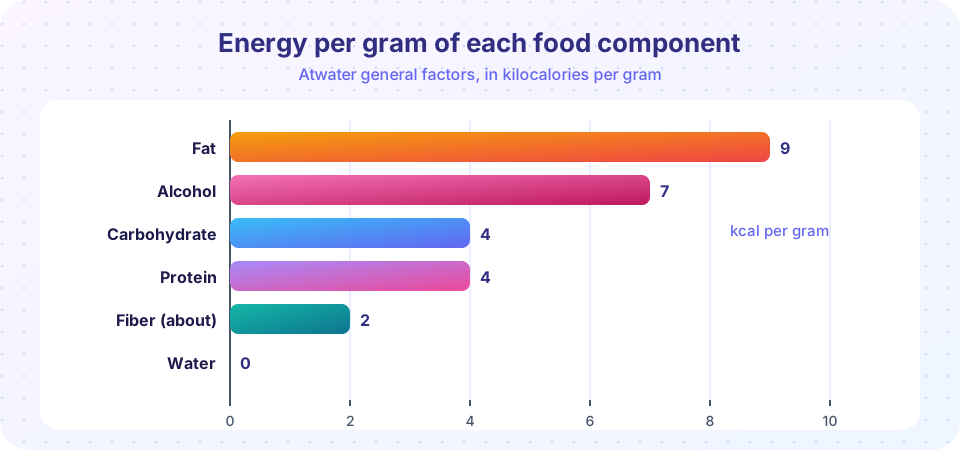
- Atwater factors: average energy values per gram: 4 kcal for carbohydrate and protein, 9 for fat, 7 for alcohol.
- Energy density: energy per gram of food, which is high in oils and nuts and low in vegetables.
Essential and non-essential nutrients
Of the thousands of compounds in food, about 40 are classed as essential nutrients for humans. They fall into the six classes from the overview, and the logic is the same each time: if the body cannot make a molecule fast enough to meet its needs, a lack of it in the diet causes a deficiency disease.
Essential amino acids. Proteins are built from 20 amino acids. Nine are essential for adults: histidine, isoleucine, leucine, lysine, methionine, phenylalanine, threonine, tryptophan and valine. The others can be made from other molecules. Some are conditionally essential: arginine, cysteine, glutamine and tyrosine become critical for premature infants or in severe illness. Proteins and amino acids returns to protein quality.
Essential fatty acids. Humans cannot insert double bonds at certain positions of a fatty acid, so two fats must come from food: linoleic acid (an omega-6 fat) and alpha-linolenic acid (an omega-3 fat). From these the body can make longer-chain fats such as EPA and DHA, but only slowly, so fish and algae are valuable sources.
Vitamins and minerals. By definition a vitamin is an organic compound needed in small amounts that the body cannot make enough of. There are 13. Minerals are chemical elements; those with recommended intakes include calcium, phosphorus, magnesium, sodium, potassium, chloride, iron, zinc, copper, iodine, selenium, manganese, chromium, molybdenum and fluoride. Chapter 4 describes them.
Water is essential and needed in the largest amount of all, though it is often forgotten.
Some compounds are not essential yet beneficial. Dietary fiber has no essential role in survival but benefits gut and heart health. Phytochemicals such as flavonoids and carotenoids are subjects of active research. Calling something "essential" is a technical label, not a compliment.
Measuring energy: from fire to physiology
A calorie (small c) is the energy needed to heat 1 g of water by 1 degree Celsius, about 4.184 joules. Food energy is expressed in kilocalories (kcal) or kilojoules (kJ). On US labels "Calories" with a capital C means kilocalories; in much of the world labels give both kJ and kcal, and the conversion is 1 kcal = 4.184 kJ.
The first measurements used a bomb calorimeter: burn a dried food in a sealed chamber surrounded by water and see how much the water warms. That gives gross energy: roughly 4.1 kcal/g for starch, 9.4 for fat and 5.65 for protein. But the body is not a bomb. Some food is not digested, and the body cannot burn protein's nitrogen: it excretes it as urea, losing energy. After allowing for these, Wilbur Atwater's team in the 1890s derived the general factors still used today:
| Component | kcal per gram | kJ per gram |
|---|---|---|
| Carbohydrate (available) | 4 | 17 |
| Protein | 4 | 17 |
| Fat | 9 | 37 |
| Alcohol (ethanol) | 7 | 29 |
| Dietary fiber (EU label value) | about 2 | about 8 |
Fiber's value differs between regulators because it depends on how much is fermented by gut bacteria. Alcohol is not a nutrient (it is not needed for health), but it does supply energy, which is why it appears here.
Worked example. A snack bar contains 20 g carbohydrate, 8 g fat and 5 g protein. Energy = 20 x 4 + 5 x 4 + 8 x 9 = 80 + 20 + 72 = 172 kcal, which is 172 x 4.184 = about 720 kJ. Fat supplies 72/172 = 42 percent of the energy, even though it is only 8 of the 33 grams (24 percent of the mass). This shows why high-fat foods are energy dense.
Energy density and satiety
Energy density is energy per gram of food. Water-rich foods such as soup, fruit and cooked vegetables have 0.2 to 1 kcal/g. Bread is about 2.5, chocolate about 5, and oils close to 9. Because stomach stretching and the weight of food influence fullness, low-density foods tend to fill you up on fewer calories, an idea revisited in Chapter 5.
Comparing foods by energy sources
The calculation above lets you break a food's energy into the percentage supplied by each macronutrient, which is a more useful picture than the grams. Chicken breast gets roughly 75 percent of its energy from protein and the rest from fat; rice gets about 90 percent from carbohydrate; olive oil is 100 percent fat. A diet's overall mix should lie in the AMDR ranges you saw in Reference intakes and labels.
Common misconceptions
- "A calorie is a calorie, so food quality does not matter." The energy value is the same, but foods differ in how much you absorb, how full they leave you, and what other nutrients they carry. Energy balance controls weight, but food quality affects health.
- "Essential means important and non-essential means unimportant." Non-essential amino acids are vital; they are simply made by your body from other sources.
- "Labels are exact." Label energy is calculated from averages and is allowed a tolerance, so real values may differ by 10 to 20 percent.
Try it
First a calculator that estimates energy from macronutrients and compares it with a label value. Then a styled chart of where the energy comes from in nine common foods, using the Atwater factors on rounded composition values. The values are typical, not exact.
Press Run (or Ctrl + Enter) to see the result here.
Program input · what you'd type while the program runs
Type the answers before you press Run, one per line. Each time the program reads a line (with input()), it gets the next line from this box.
Press Run (or Ctrl + Enter) to see the result here.
Program input · what you'd type while the program runs
Type the answers before you press Run, one per line. Each time the program reads a line (with input()), it gets the next line from this box.
Check your understanding
Quick check · 5 questions
of 5 answered You scored / 5 · perfect!
-
1. Which of these is an essential fatty acid?
Linoleic acid (omega-6) and alpha-linolenic acid (omega-3) cannot be made by the human body. -
2. A food has 10 g carbohydrate, 10 g protein and 10 g fat. Estimated energy?
10 x 4 + 10 x 4 + 10 x 9 = 40 + 40 + 90 = 170 kcal. -
3. How many kilojoules are in 100 kcal?
100 x 4.184 = 418.4 kJ. -
4. Why is protein's usable energy about 4 kcal/g, below its roughly 5.65 kcal/g in a bomb calorimeter?
Nitrogen cannot be fully oxidized by humans, and some protein is not absorbed. -
5. Which statement about 'essential' is correct?
Essential describes a nutrient's supply, not its importance relative to other nutrients.
Summary
- Essential nutrients are those the body cannot make in sufficient amounts: nine amino acids, two fatty acids, vitamins, minerals and water.
- 1 kcal = 4.184 kJ; Atwater general factors give 4 kcal/g for carbohydrate and protein, 9 for fat, and 7 for alcohol.
- Calculate a food's energy by multiplying grams by factors; fat supplies a large share of energy even in small amounts.
- Energy density and quality both matter; labels are close but not exact.
Next: Digestion and absorption
Track your progress
Create a free account to tick off lessons and pick up where you left off on any device.
of Nutrition Science lessons completed