


















Lesson 10 of 47 · Foundations of Nutrition
Chapter 2 review: foundations of nutrition
Review the six classes of nutrients, Atwater energy factors, the stages of digestion and absorption, and water balance, then take a ten-question quiz.
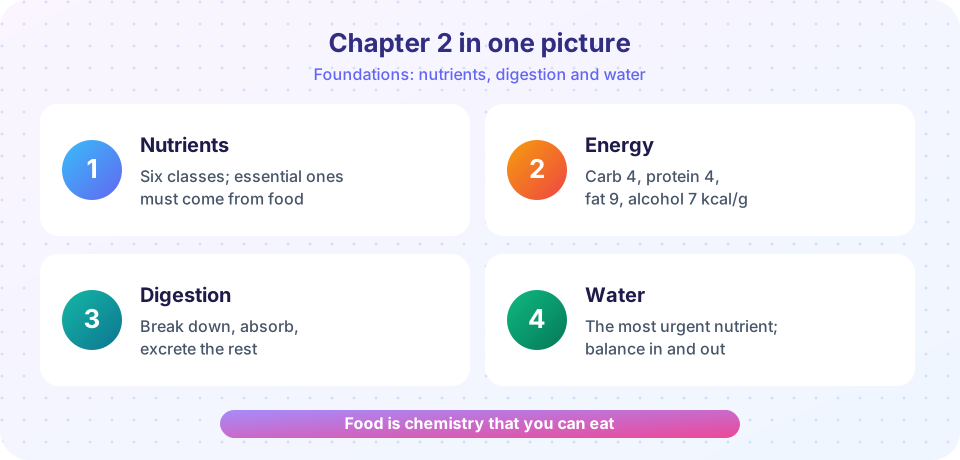
Chapter 2 gave you the framework that the rest of the course hangs on. You can now name the six classes of nutrients, calculate the energy in a food, trace a meal from mouth to colon, and explain how the body keeps its water in balance. This review checks that these pieces fit together.
What you will learn
- How to connect nutrient classes, energy, digestion and water into one story.
- Which facts and numbers from the chapter to remember.
- Where your own gaps are, using a ten-question quiz.
Key terms
- Essential nutrient: must come from food because the body cannot make enough.
- Atwater factors: 4, 4, 9 and 7 kcal per gram for carbohydrate, protein, fat and alcohol.
- Hydrolysis: splitting a bond by adding water; the basic chemistry of digestion.
- Chylomicron: a lipoprotein particle that carries absorbed fat through lymph.
- ADH: the hormone that makes the kidneys conserve water.
The chapter in a table
| Topic | Key facts | Where to revisit |
|---|---|---|
| Nutrient classes | Six classes; carbohydrate, fat, protein give energy; 9 essential amino acids; 2 essential fatty acids | Nutrient classes and energy |
| Energy | 1 kcal = 4.184 kJ; 4/4/9/7 kcal per gram; label energy is calculated | Nutrient classes and energy |
| Digestion | Mouth starts starch; stomach starts protein; small intestine finishes and absorbs; colon recovers water | Digestion and absorption |
| Absorption routes | Sugars and amino acids go to the liver through the portal vein; fats go through lymph | Digestion and absorption |
| Water | 50 to 60 percent of body weight; AI about 2.0 to 3.7 L total per day; ADH and thirst regulate | Water and hydration |
One meal, whole chapter
Take a cheese sandwich and a glass of water. Classify it: bread supplies starch (carbohydrate), cheese supplies protein and fat, and both bring minerals such as calcium and sodium and a little vitamin B12. Estimate the energy: a 60 g slice-pair of bread (about 28 g carbohydrate and 5 g protein) plus 30 g of cheddar (about 7 g protein and 10 g fat) gives roughly 4 x 28 + 4 x 12 + 9 x 10 = 112 + 48 + 90 = 250 kcal.
Follow it through the body: amylase begins on the bread in the mouth, pepsin starts on the cheese protein in the stomach, bile emulsifies the cheese fat in the duodenum, and pancreatic enzymes and brush-border enzymes finish the job. Glucose and amino acids go to the liver through the portal vein, while the fat is carried away by chylomicrons in lymph. A little fiber in the bread reaches the colon and is fermented. The water you drink, along with the 35 percent that was in the bread, joins the body's pool and leaves in time through urine, sweat and breath.
If you can narrate that sequence, you have the chapter.
Common misconceptions
- "All calories are absorbed." Atwater factors account for average losses, but absorption depends on the food and the person; fiber and some nut fats are only partly absorbed.
- "Digestion happens mostly in the stomach." It starts there for protein but most of it takes place in the small intestine.
- "Water has no role in nutrition." It is an essential nutrient with a reference intake.
Try it
Use the first demonstration to audit the energy in a meal you describe. The second is a set of flashcards for chapter 2.
Press Run (or Ctrl + Enter) to see the result here.
Program input · what you'd type while the program runs
Type the answers before you press Run, one per line. Each time the program reads a line (with input()), it gets the next line from this box.
Check your understanding
Quick check · 10 questions
of 10 answered You scored / 10 · perfect!
-
1. Which nutrients provide energy?
Only carbohydrates, fats and proteins (and alcohol) supply energy. -
2. A food has 5 g protein, 5 g fat and 20 g carbohydrate. Energy?
5 x 4 + 5 x 9 + 20 x 4 = 20 + 45 + 80 = 145 kcal. -
3. Which enzyme starts protein digestion in the stomach?
Pepsin is activated by stomach acid and cuts proteins into peptides. -
4. Where does vitamin B12 absorption happen, with the help of intrinsic factor?
Intrinsic factor, made by the stomach, binds B12 so that it can be absorbed in the ileum. -
5. How do absorbed fats first travel to the blood?
Chylomicrons enter lymphatic vessels first, then join the blood near the heart. -
6. Which is one of the nine essential amino acids?
Lysine is essential; glutamine and alanine can be made by the body. -
7. What does ADH do?
ADH increases water reabsorption in the kidneys, so urine becomes concentrated. -
8. Which condition arises from low lactase activity?
Lactose intolerance is low lactase; milk allergy is an immune reaction to milk proteins; celiac disease concerns gluten. -
9. About how much of a typical adult's daily water comes from food?
On average, food supplies about one fifth of total water intake. -
10. Which statement about the 'eight glasses a day' rule is best?
Total needs depend on the person and environment, and food and other drinks contribute.
Summary
- Six nutrient classes; three give energy with Atwater factors 4, 4 and 9 kcal per gram.
- Digestion breaks food into small molecules; absorption mostly occurs in the small intestine, with sugars and amino acids going to the liver and fats through lymph.
- Water is an essential nutrient, regulated by thirst and ADH; both too little and too much cause harm.
- Chapter 3 now examines the three energy nutrients in detail.
Track your progress
Create a free account to tick off lessons and pick up where you left off on any device.
of Nutrition Science lessons completed