


















Lesson 16 of 47 · Vitamins and Minerals
Chapter 4 overview: vitamins and minerals
A map of chapter four: what vitamins and minerals are, how they are grouped, why tiny amounts matter, and how deficiency, toxicity and fortification fit in.
Vitamins and minerals contain no energy and are needed in tiny amounts: milligrams or even micrograms a day. Yet without them nothing works. Vitamins help enzymes release energy, build blood and bone, protect cells and control genes. Minerals build bones, carry nerve signals, move oxygen and run hundreds of enzymes. A shortage of just one can be dramatic: a missing 150 micrograms of iodine causes goiter and, in pregnancy, damages the baby's brain.
This chapter surveys the micronutrients. This overview gives the map; the following lessons go through the fat-soluble vitamins, the water-soluble vitamins and the minerals.
What you will learn
- What distinguishes vitamins from minerals and how each group is divided.
- Why deficiency and excess both matter.
- How fortification and supplements fit into the picture.
- What each lesson of the chapter covers.
Key terms
- Vitamin: an organic compound needed in small amounts that the body cannot make in sufficient quantity.
- Mineral: an inorganic element that the body needs; divided into major minerals (needed above 100 mg/day) and trace minerals.
- Bioavailability: the fraction of a nutrient that is absorbed and used.
- Fortification: adding nutrients to foods, as in iodized salt or folic acid in flour.
- Hidden hunger: micronutrient deficiency in people who may get enough energy.
Vitamins versus minerals
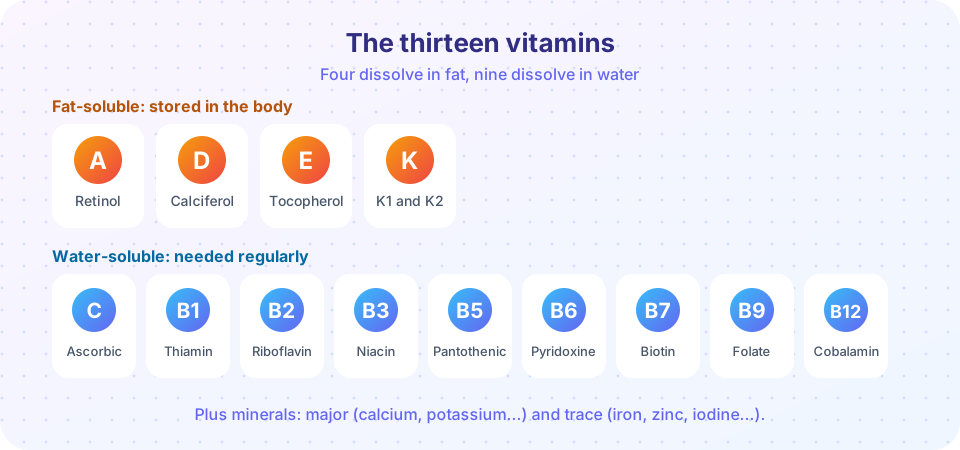
Vitamins are organic (they contain carbon and are made by living things) and fragile: heat, light, air and acid can destroy them. Thirteen are recognized. Minerals are inorganic elements that cannot be destroyed by cooking, though they can leach into the cooking water. They are divided by amount: major minerals (calcium, phosphorus, magnesium, sodium, potassium, chloride, sulfur) are needed in hundreds of milligrams a day, and trace minerals (iron, zinc, iodine, selenium, copper, manganese, fluoride, chromium, molybdenum) in milligrams or micrograms.
Two families of vitamins
The most useful grouping is by solubility.
- Fat-soluble vitamins (A, D, E and K) dissolve in fat, are absorbed with dietary fat and travel in lymph, and can be stored in the liver and fat tissue. Storage means deficiency develops slowly, but excess can accumulate to toxic levels.
- Water-soluble vitamins (C and the eight B vitamins) dissolve in water, are absorbed straight into the blood, and mostly are not stored (apart from B12). Excess is largely excreted in urine, so toxicity from foods is rare, although high-dose supplements of some (such as B6 or niacin) cause problems.
Heat and boiling water destroy some water-soluble vitamins, which is why steaming vegetables or using the cooking water in soup retains more.
Why tiny amounts matter
Most B vitamins act as coenzymes: small helper molecules that fit into enzymes and allow them to work. A tiny amount can serve billions of reactions because it is recycled. That explains both the small requirement and the disproportionate damage of a lack. Minerals serve as structural material (calcium in bone), electrolytes (sodium, potassium) or parts of enzymes and proteins (iron in hemoglobin, zinc in many enzymes).
Deficiency, excess and the U-curve
Every micronutrient follows the U-shaped dose-response curve from Chapter 1: too little causes deficiency, and too much, especially from supplements, can cause toxicity. Deficiencies still affect billions of people: iron deficiency (the most common worldwide, a leading cause of anemia), vitamin A deficiency (a leading cause of childhood blindness), iodine and zinc deficiency, and vitamin D deficiency in many regions. In wealthy countries, subgroups have low intakes of nutrients such as vitamin D, calcium, potassium and magnesium. At the other extreme, toxicity is now more often reported from high-dose supplements and fortified foods than from ordinary diets, so reference bodies publish upper limits (UL) for many nutrients.
Fortification and supplements
Fortification is one of public health's quiet successes. Iodized salt has nearly eliminated goiter in many countries. Folic acid in flour has cut neural tube defects. Vitamin A in fats or sugar, vitamin D in milk and iron in flour address regional gaps. Supplements have a smaller role in healthy people eating a varied diet. They are valuable for specific groups: vitamin B12 for vegans, folic acid for those planning pregnancy, vitamin D for infants or people with little sun, iron for diagnosed deficiency. Large trials have mostly failed to show that multivitamins prevent heart disease or cancer in healthy adults, and some high-dose supplements (beta-carotene in smokers, for example) increased risk. Supplements are not a substitute for a good diet.
What each lesson covers
Chapter 4 roadmap
Three ideas to carry
- Fat-soluble vitamins: vision, bones, antioxidant defense and blood clotting.
- Water-soluble vitamins: energy metabolism, blood formation, collagen and the classic deficiency diseases.
- Minerals in the body: calcium and bone, iron and oxygen, sodium and potassium and blood pressure, iodine, zinc and others.
- Chapter 4 review.
Common misconceptions
- "Vitamins are harmless because they are natural." Fat-soluble vitamins accumulate, and high doses of some water-soluble ones are harmful.
- "A multivitamin makes up for a poor diet." It supplies some nutrients but not fiber, protein, healthy fats or the many other compounds in whole foods.
- "You only get vitamins from fresh food." Frozen vegetables are often as nutritious as fresh; canned and frozen foods can retain nutrients well.
Try it
First a plot of how widely vitamin requirements vary, then a classification game.
Press Run (or Ctrl + Enter) to see the result here.
Program input · what you'd type while the program runs
Type the answers before you press Run, one per line. Each time the program reads a line (with input()), it gets the next line from this box.
Check your understanding
Quick check · 4 questions
of 4 answered You scored / 4 · perfect!
-
1. Which vitamins are fat-soluble?
Vitamins A, D, E and K dissolve in fat and can be stored. -
2. Why are minerals not destroyed by cooking in the way vitamins can be?
Minerals are elements, so heat cannot destroy them, although they may leach into cooking water. -
3. Which approach has been a major public health success against micronutrient deficiency?
Iodized salt has nearly eliminated goiter in many countries. -
4. Why can excess of fat-soluble vitamins be a problem?
Storage in liver and fat tissue means high doses can build up to toxic levels.
Summary
- Vitamins are organic and fragile; minerals are inorganic elements; both are needed in small amounts with no energy.
- Fat-soluble vitamins (A, D, E, K) are stored; water-soluble ones (C, B) are mostly excreted; B12 is stored.
- Both deficiency and excess matter, and the UL protects against excess.
- Fortification is powerful; supplements are for specific needs, not a general substitute for food.
Next: Fat-soluble vitamins
Track your progress
Create a free account to tick off lessons and pick up where you left off on any device.
of Nutrition Science lessons completed