


















Lesson 20 of 47 · Vitamins and Minerals
Chapter 4 review: vitamins and minerals
Review the fat-soluble and water-soluble vitamins and the main minerals, their deficiency diseases and upper limits, then test yourself with a ten-question quiz.
Chapter 4 introduced thirteen vitamins and a dozen minerals, and every one has a function, food sources, a reference intake and a failure mode. You do not need to memorize every number. You do need the pattern: what a nutrient is for, what its deficiency disease is called, where to find it, and when excess is a problem. This review organizes the chapter into that pattern.
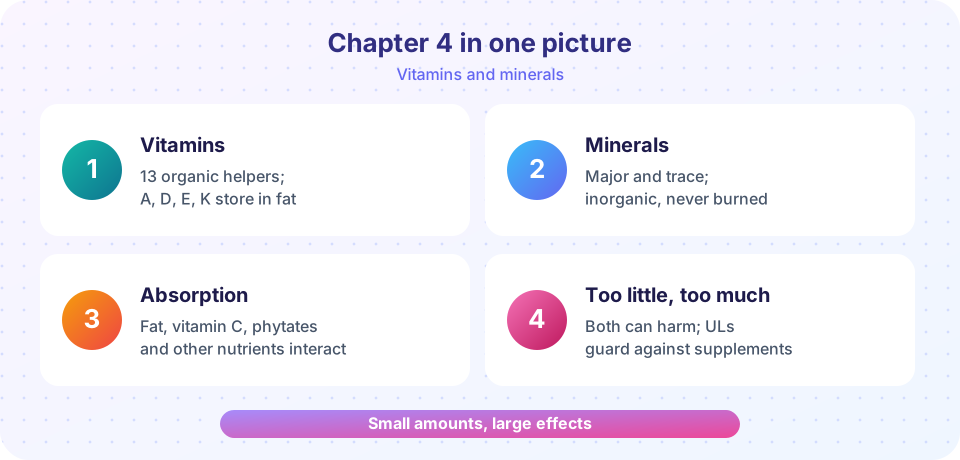
What you will learn
- A table linking each key micronutrient with its main job and deficiency.
- The interactions that change absorption.
- Where your knowledge needs more practice.
Key terms
- Bioavailability: the share of a nutrient that is absorbed and used.
- UL: the highest daily intake unlikely to harm almost everyone.
- Fortification: adding nutrients to foods, such as iodine to salt.
- Coenzyme: a vitamin-derived helper molecule for an enzyme.
- Deficiency disease: a condition caused by lack of a specific nutrient.
The chapter in a table
| Nutrient | Main job | Deficiency | Remember |
|---|---|---|---|
| Vitamin A | Vision, epithelia, immunity | Night blindness | Excess preformed A is toxic, especially in pregnancy |
| Vitamin D | Calcium absorption, bone | Rickets, osteomalacia | Made in skin; supplements for at-risk groups |
| Vitamin E | Membrane antioxidant | Rare | High-dose supplements show no benefit |
| Vitamin K | Clotting, bone proteins | Bleeding | Steady intake with warfarin |
| Thiamin (B1) | Carbohydrate metabolism | Beriberi | Whole grains; polished rice story |
| Niacin (B3) | NAD coenzymes | Pellagra | Maize and nixtamalization |
| Folate (B9) | DNA synthesis | Megaloblastic anemia, neural tube defects | 400 µg folic acid before pregnancy |
| Vitamin B12 | DNA, nerves | Pernicious anemia, neuropathy | Only animal foods; vegans need supplements |
| Vitamin C | Collagen, antioxidant, iron absorption | Scurvy | Destroyed by heat |
| Calcium | Bone, nerves, muscle | Osteoporosis (long term) | 1,000 mg; needs vitamin D |
| Iron | Hemoglobin | Anemia | Heme vs non-heme; vitamin C helps |
| Iodine | Thyroid hormones | Goiter, impaired brain development | Iodized salt |
| Sodium / potassium | Fluid balance, nerves | Excess sodium raises blood pressure | Salt = sodium x 2.5 |
Revisit the lessons: fat-soluble vitamins, water-soluble vitamins, minerals.
Interactions and food first
A single food often delivers several micronutrients that help each other: a lentil and pepper stew gives non-heme iron with vitamin C; fortified milk gives calcium with vitamin D; a salad with olive oil gives carotenoids with the fat to absorb them. By contrast, a supplement delivers one or a few compounds without the food context, and at doses that can exceed what any food supplies. This is why dietary guidance puts food first, and supplements for specific needs (B12 for vegans, folic acid before pregnancy, vitamin D for infants and people with little sun, iron for diagnosed deficiency).
A second theme is the U-shaped curve: too little causes deficiency diseases, and too much from supplements and fortified foods can cause toxicity, which is why the UL exists. Before taking a high-dose supplement, ask: What deficiency am I trying to fix? Do I have evidence of it? What is the UL?
Common misconceptions
- "If I eat a healthy diet I need no supplements, ever." Mostly true, with exceptions: infants (vitamin D, sometimes iron), pregnancy (folic acid), vegans (B12), older adults (B12, vitamin D) and some medical conditions.
- "More of a vitamin is always safer than too little." Fat-soluble vitamins accumulate; B6, niacin, folic acid, zinc, iron and iodine have limits too.
- "All minerals in food are absorbed." Phytate, oxalate and competing minerals reduce absorption.
Try it
The first demonstration checks a day's intake of five nutrients against the RDA and UL. The second provides flashcards.
Press Run (or Ctrl + Enter) to see the result here.
Program input · what you'd type while the program runs
Type the answers before you press Run, one per line. Each time the program reads a line (with input()), it gets the next line from this box.
Check your understanding
Quick check · 10 questions
of 10 answered You scored / 10 · perfect!
-
1. Which vitamin is needed to make collagen?
Vitamin C is a cofactor for the enzymes that stabilize collagen; its lack causes scurvy. -
2. Which condition is linked with polished white rice diets?
Polishing removes the thiamin-rich bran, leading to beriberi where rice is the staple. -
3. Why are vegans advised to supplement vitamin B12?
B12 is produced by microbes and found naturally in animal foods; vegans need fortified foods or supplements. -
4. What is the main reason for the UL?
The UL is the highest daily intake unlikely to cause harm. -
5. Which pairing increases absorption of non-heme iron?
Vitamin C converts iron to an absorbable form and counters inhibitors. -
6. Which vitamin is made in the skin under UVB light?
UVB converts a cholesterol derivative in the skin into vitamin D3. -
7. How many grams of salt contain about 2 g of sodium?
Salt = sodium x 2.5, so 2 g sodium is about 5 g salt. -
8. Which mineral is essential for thyroid hormones?
Thyroid hormones contain iodine; deficiency causes goiter. -
9. Which statement about fat-soluble vitamins is correct?
Vitamins A, D, E and K are stored in liver and fat tissue. -
10. Which food pattern best supports micronutrient intake?
A varied whole-food diet supplies many nutrients together, with supplements reserved for specific needs.
Summary
- Each micronutrient has a job, sources, a deficiency disease and an upper limit.
- Fat-soluble vitamins are stored; water-soluble ones mostly are not, except B12.
- Absorption depends on interactions: vitamin D with calcium, vitamin C with iron, phytate and oxalate binding.
- Food first; supplements for identified needs.
- Chapter 5 turns to energy balance and metabolism, the second half of the course.
Track your progress
Create a free account to tick off lessons and pick up where you left off on any device.
of Nutrition Science lessons completed