


















Lesson 14 of 47 · Carbohydrates, Fats and Proteins
Proteins and amino acids
Learn how proteins are built from amino acids, what makes a protein complete, how much you need, and how plant and animal protein sources compare.
The word protein comes from the Greek for "of first importance", and it earns the name. Almost every task in a cell is carried out by a protein: enzymes catalyze reactions, hemoglobin carries oxygen, antibodies fight infection, collagen holds skin and bones together, and muscle proteins contract. Yet the protein you eat is not used as protein directly. It is broken down into amino acids, which the body reassembles into its own proteins.
Understanding this explains the idea of "complete" and "incomplete" proteins, why a vegetarian diet can meet protein needs, and why much of the protein hype, such as extreme intake targets and "anabolic windows", is stronger than the evidence.
What you will learn
- How amino acids link into proteins and why the sequence matters.
- Which amino acids are essential and what "protein quality" means.
- How much protein different people need and where it comes from.
- What happens to extra protein, and what protein deficiency looks like.
Key terms
- Amino acid: a molecule with an amino group, an acid group and a side chain; 20 are used to build human proteins.
- Peptide bond: the covalent link between two amino acids.
- Essential amino acid: one that the body cannot make in adequate amounts; nine for adults.
- Nitrogen balance: the difference between nitrogen eaten and nitrogen excreted; a way to measure protein status.
- PDCAAS / DIAAS: scores of protein quality that combine amino acid pattern and digestibility.
Building blocks
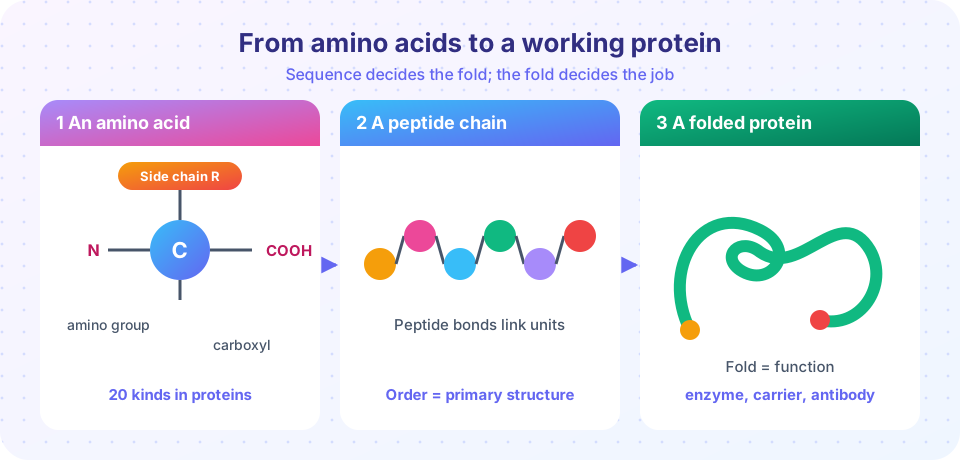
Every amino acid has the same backbone: a central carbon bound to an amino group (nitrogen), a carboxyl (acid) group, a hydrogen and a distinctive side chain (R). The side chain makes the amino acid small and water-loving, or large and oily, or charged, and so shapes how the chain folds. Amino acids link through peptide bonds, formed by removing a molecule of water, so the reverse step in digestion is hydrolysis. A short chain is a peptide; a long one, usually from 50 to several thousand amino acids, is a protein.
The sequence is coded by genes, and the sequence determines the way the chain folds into a precise three-dimensional shape. Change one amino acid and the effect can be dramatic: sickle-cell disease results from a single amino acid substitution in hemoglobin.
Because protein contains nitrogen (about 16 percent by weight), a food's protein content is estimated from its nitrogen content by multiplying by 6.25.
Essential amino acids
Nine amino acids must come from food in adults: histidine, isoleucine, leucine, lysine, methionine, phenylalanine, threonine, tryptophan and valine. The other eleven can be made, though in illness or infancy some become conditionally essential. The body keeps a pool of free amino acids, constantly drawn from food and from the breakdown of its own proteins, which are replaced all the time: an adult recycles on the order of 300 g of protein a day, far more than the 50 to 100 g eaten.
Protein quality
A complete protein supplies all nine essential amino acids in proportions close to human needs. Animal proteins (meat, fish, eggs, milk) are complete, as are soy and quinoa. Many plant proteins are limited in one amino acid: cereals are low in lysine, and legumes are low in the sulfur amino acids (methionine and cysteine). Scientists score quality with the PDCAAS (protein digestibility-corrected amino acid score), capped at 1.0, and the newer DIAAS, which uses digestibility at the end of the small intestine. Egg, milk and soy proteins score near the top; many beans around 0.6 to 0.75; wheat much lower, about 0.4 because of lysine.
Quality matters less than people think in mixed diets. Different plant proteins complement each other: rice and beans, or hummus and bread, together provide a balanced profile. There is no need to eat them in the same meal; a varied diet over the day does the job. Vegetarian and vegan diets can meet protein needs if they include enough legumes, soy, nuts, seeds and grains, with extra attention to total intake when energy is low.
How much do you need?
The adult RDA is 0.8 g of protein per kilogram of body weight per day, about 56 g for a 70 kg person. This covers the needs of nearly everyone, since it was set from nitrogen balance studies plus a safety margin. Average intakes in many countries are higher, at 80 to 100 g. The AMDR is 10 to 35 percent of energy.
Higher intakes are appropriate in some situations: children and adolescents need more per kilogram because they grow (roughly 0.85 to 1.05 g/kg), pregnancy and breastfeeding raise needs, and many experts suggest 1.0 to 1.2 g/kg for older adults to counter loss of muscle with age. Athletes doing resistance or endurance training are often advised 1.2 to 2.0 g/kg, spread across meals. Beyond about 2 g/kg, there is little extra gain for most people. People with kidney disease may need to limit protein and should follow medical advice.
Spreading protein through the day, with roughly 20 to 30 g at a meal, seems to stimulate muscle protein synthesis efficiently, though total daily protein matters more than precise timing. The "anabolic window" of 30 minutes after a workout is largely a myth: the benefits of protein extend over many hours.
What happens to extra protein?
Unlike fat and carbohydrate, protein cannot be stored as a reserve. Amino acids not needed for building are deaminated: the nitrogen part is made into urea and excreted in urine, and the carbon skeleton is burned for energy or converted to glucose or fat. This is why very high-protein diets increase the need for water to carry away urea, and why surplus protein, like any surplus energy, can contribute to weight gain.
Plant and animal sources
Protein-rich foods differ in what they bring along. Fish, poultry, eggs, dairy, legumes, soy, nuts and seeds supply protein with other nutrients: iron, zinc, B12 (animal foods only), omega-3 fats (fish), fiber (plants). Observational studies link diets rich in processed and red meat with higher risks of colorectal cancer and heart disease, while those rich in legumes, nuts and fish are linked with lower risk, particularly when they replace red and processed meat. The WHO's cancer agency classes processed meat as carcinogenic to humans and red meat as probably carcinogenic, for intakes that are high and long-term. This does not mean that a little meat is dangerous; it means that the pattern is important.
Protein deficiency
In poor regions, protein-energy malnutrition takes two classic forms: marasmus, severe wasting from overall lack of food, and kwashiorkor, with swollen abdomen and edema in children whose diet is low in protein relative to energy. Protein deficiency is rare in well-fed populations, but low appetite, illness and restrictive diets can make intake inadequate in older adults.
Common misconceptions
- "Plant proteins are incomplete, so vegetarians cannot get enough protein." A varied plant diet provides all the essential amino acids; complementing across the day is sufficient.
- "Eat protein within 30 minutes of training or the workout is wasted." The anabolic window is wide, and total daily protein matters more.
- "More protein builds more muscle without limit." Muscle gain needs resistance training and enough energy; benefits level off around 1.6 to 2 g/kg.
- "High protein harms healthy kidneys." There is no good evidence of this in healthy people; people with existing kidney disease should seek advice.
Try it
The first demonstration estimates your protein needs from body weight under different situations and compares them with a sample day. The second shows the idea of limiting amino acids with invented numbers.
Press Run (or Ctrl + Enter) to see the result here.
Program input · what you'd type while the program runs
Type the answers before you press Run, one per line. Each time the program reads a line (with input()), it gets the next line from this box.
Press Run (or Ctrl + Enter) to see the result here.
Program input · what you'd type while the program runs
Type the answers before you press Run, one per line. Each time the program reads a line (with input()), it gets the next line from this box.
Check your understanding
Quick check · 5 questions
of 5 answered You scored / 5 · perfect!
-
1. What is the adult RDA for protein?
The RDA is 0.8 g/kg/day, which is about 56 g for a 70 kg adult. -
2. How many amino acids are essential for adults?
Nine of the 20 amino acids must come from food; the body makes the rest. -
3. Why can beans and rice complement each other?
Cereals are low in lysine while legumes are low in sulfur amino acids, so together they cover the profile. -
4. What happens to amino acids not needed for building proteins?
There is no protein store; excess amino acids are converted to urea plus fuel. -
5. A food contains 2.4 g nitrogen per 100 g. Estimate its protein content using the factor 6.25.
2.4 x 6.25 = 15 g of protein per 100 g.
Summary
- Proteins are chains of amino acids joined by peptide bonds; sequence determines fold and function.
- Nine amino acids are essential; protein quality depends on amino acid pattern and digestibility.
- Adults need 0.8 g/kg/day; children, older adults and athletes may need more, with diminishing returns beyond about 2 g/kg.
- Surplus protein is not stored; nitrogen is excreted as urea.
- A varied diet, with plants and animal foods, supplies enough protein; processed and red meat are best limited.
Next: Chapter 3 review
Track your progress
Create a free account to tick off lessons and pick up where you left off on any device.
of Nutrition Science lessons completed