


















Lesson 8 of 47 · Foundations of Nutrition
Digestion and absorption
Follow a meal through the digestive tract: enzymes, stomach acid, bile, the small intestine's huge surface, absorption routes and the role of gut bacteria.
When you eat a slice of bread with cheese, none of the starch, protein or fat in it can enter your blood as it is. Those molecules are far too big. The digestive tract is a long, carefully controlled disassembly line that cuts food into units small enough to cross the lining of the gut, and then moves those units to where the body needs them.
Knowing how this works explains many everyday facts: why chewing matters, why fiber does not provide the usual energy yet feeds gut bacteria, why fat needs bile, why some people cannot drink milk, and why a vitamin may be wasted if it is not absorbed.
What you will learn
- The four stages: ingestion, digestion, absorption and elimination.
- Which enzymes and fluids work in the mouth, stomach and small intestine.
- How the small intestine achieves its enormous absorptive surface.
- How carbohydrates, proteins and fats take different routes into the body.
- What the large intestine and gut microbiota do.
Key terms
- Enzyme: a protein that speeds up a chemical reaction; digestive enzymes cut large molecules into small ones.
- Peristalsis: waves of muscle contraction that push food along the tract.
- Villi and microvilli: finger-like projections of the intestinal lining that multiply its surface area.
- Bile: a fluid made by the liver and stored in the gallbladder that emulsifies fat.
- Microbiota: the community of microorganisms living in the gut.
Two kinds of digestion
Mechanical digestion physically breaks food into smaller pieces: chewing, the churning of the stomach, and the mixing movements of the intestine. More surface area helps enzymes. Chemical digestion uses enzymes, acid and bile to break chemical bonds. The reactions are hydrolysis: water is used to split a bond, as in the splitting of a starch chain into glucose.
The journey, step by step
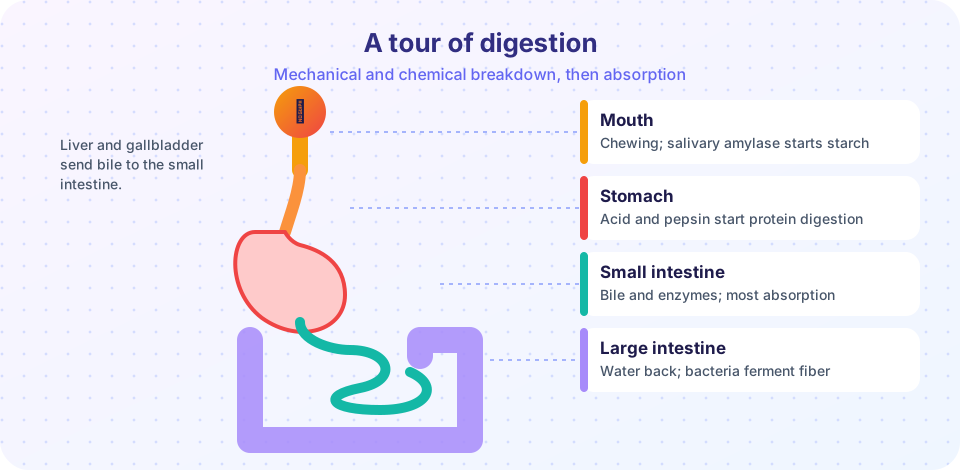
Mouth. Chewing cuts food into pieces and mixes it with saliva. Salivary amylase begins to break starch into shorter chains (hold bread in your mouth for a minute and it begins to taste slightly sweet). A little lipase is also present. Swallowing pushes the mouthful into the esophagus, where peristalsis carries it to the stomach in seconds, even if you stand on your head.
Stomach. The stomach is a muscular bag that stores a meal and releases it slowly, over about two to four hours. It secretes hydrochloric acid, which lowers the pH to roughly 1.5 to 3.5 after a meal, killing many microbes and unfolding proteins. The enzyme pepsin, released in an inactive form and activated by acid, starts to cut proteins into peptides. Mucus protects the stomach wall from its own acid. Cells in the stomach also make intrinsic factor, a protein needed to absorb vitamin B12 later in the small intestine, which is why a failure of stomach cells can cause B12 deficiency. Little absorption occurs here, other than some alcohol, water and a few drugs.
Small intestine. Food leaves the stomach as a thick liquid called chyme and enters the duodenum, the first part of the small intestine. Here the real work happens. The pancreas pours in bicarbonate, which neutralizes the acid, and a mixture of enzymes: pancreatic amylase (starch), proteases such as trypsin (proteins) and lipase (fats). The liver makes bile, stored in the gallbladder and released into the duodenum. Bile salts do not digest fat; they break large fat globules into tiny droplets (emulsification), giving lipase a large surface to work on. Finally the cells of the intestinal lining carry brush-border enzymes, such as lactase, sucrase and maltase, which split disaccharides, and peptidases, which split small peptides.
The small intestine is about 3 to 5 meters long in a living person (about 6 m after death when muscle tone is lost), but its inner surface is folded, then covered with villi, and each of those cells with microvilli. Together these folds multiply the surface so that estimates for the absorbing area are in the region of tens of square meters. Nearly all nutrients are absorbed in the jejunum, the middle part; the ileum, the last part, absorbs vitamin B12 and recycles bile salts.
Large intestine. What cannot be digested or absorbed, mostly fiber, moves into the colon. It absorbs water and some minerals. Billions of bacteria ferment fiber and produce short-chain fatty acids such as butyrate, which feed the colon's cells, plus gases. The remaining waste is formed into feces, and total transit time from mouth to exit is about one to three days.
Routes of absorption
Different nutrients enter by different doors.
- Glucose and galactose are carried across the lining by an active transporter (SGLT1) that moves them together with sodium ions, which is why a little salt helps the absorption of sugar in oral rehydration solutions. Fructose enters by facilitated diffusion through a transporter called GLUT5.
- Amino acids and small peptides use specific transporters, and then enter capillaries.
- Water-soluble nutrients (sugars, amino acids, water-soluble vitamins, most minerals) enter the blood capillaries of the villi and travel in the portal vein to the liver, which sorts, stores and processes them before they reach the rest of the body.
- Fats are different. Bile salts and the products of fat digestion form tiny clusters called micelles, which carry fatty acids and monoglycerides to the cell surface. Inside the cell they are reassembled into triglycerides and packed with proteins into chylomicrons, particles too large for capillaries. Chylomicrons enter the lymph vessels (lacteals) in each villus, travel through the lymphatic system and join the blood near the heart. Fat-soluble vitamins (A, D, E, K) ride along with them, which explains why a salad with a little oil absorbs carotenoids better than one without.
When digestion goes wrong
Lactose intolerance is the loss of lactase activity after childhood in most of the world's adults. Undigested lactose reaches the colon, where bacteria ferment it, causing gas and discomfort. In some populations with a history of dairy farming, lactase persists into adulthood. Lactose intolerance is not an allergy: milk allergy is an immune reaction to milk proteins. Celiac disease is an autoimmune reaction to gluten that damages villi and reduces absorption. Gastric acid problems, pancreatic insufficiency and bile duct blockage each impair particular steps. If you suspect a problem, see a doctor; diagnosis is not a job for guesswork.
The gut microbiota
The colon hosts a vast community of bacteria, with estimates of the same order as the number of human cells in the body. They ferment fiber, make some vitamin K and B vitamins (the amount absorbed is modest compared with the diet), train the immune system and compete with harmful microbes. Diet shapes the community: more diverse plant fibers support a more varied microbiota. How much this affects health in healthy adults is a lively and unsettled research area, so be skeptical of strong claims about "fixing" the microbiome with a single product.
Common misconceptions
- "Food stays in your stomach for days." Most food leaves the stomach within about four hours. Total transit through the whole tract takes a day or two.
- "Digestive enzymes do all the work in the stomach." Most digestion and nearly all absorption happen in the small intestine.
- "You digest fiber." Humans lack the enzymes to digest most fiber; gut bacteria ferment part of it.
- "Detox diets clean out the gut." The liver, kidneys and gut already handle waste continuously; there is no evidence that special products improve this in healthy people.
Try it
The first demonstration walks a meal through the tract with typical times. The second draws a chart of typical pH values along the tract, showing why enzymes of the stomach and the intestine are so different. Both are simplified, and individual values vary.
Press Run (or Ctrl + Enter) to see the result here.
Program input · what you'd type while the program runs
Type the answers before you press Run, one per line. Each time the program reads a line (with input()), it gets the next line from this box.
Check your understanding
Quick check · 5 questions
of 5 answered You scored / 5 · perfect!
-
1. Where does most chemical digestion and nutrient absorption take place?
Pancreatic and brush-border enzymes finish digestion in the small intestine, whose villi absorb nearly all nutrients. -
2. What is the main job of bile salts?
Bile emulsifies fat. The pancreas, not bile, supplies the bicarbonate that neutralizes acid. -
3. How do digested fats reach the bloodstream?
Chylomicrons are too big for capillaries and travel through the lymphatic system before joining the blood. -
4. Lactose intolerance is caused by
Without enough lactase, lactose is fermented by colon bacteria, producing gas and discomfort. Milk allergy is a different, immune condition. -
5. What do gut bacteria produce when they ferment fiber?
Short-chain fatty acids such as butyrate feed colon cells and may have wider health effects.
Summary
- Digestion is mechanical and chemical; chemical digestion is hydrolysis driven by enzymes, acid and bile.
- The mouth starts starch, the stomach starts protein, and the small intestine, with pancreatic and brush-border enzymes, completes digestion.
- Villi and microvilli give the small intestine a huge surface; most nutrients are absorbed there.
- Water-soluble nutrients go to the liver by the portal vein; fats and fat-soluble vitamins travel via lymph.
- The colon reabsorbs water and houses bacteria that ferment fiber.
Next: Water and hydration
Track your progress
Create a free account to tick off lessons and pick up where you left off on any device.
of Nutrition Science lessons completed