


















Lesson 43 of 47 · Projects and Practice
Project 3: three case studies in applied nutrition
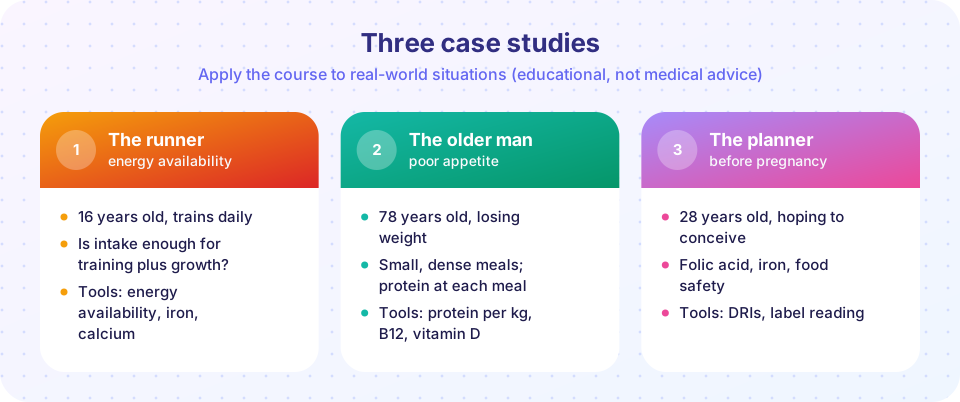
Practice applying the course to three realistic cases: energy availability in a teenage runner, poor appetite in an older man and folate planning before pregnancy.
Textbook facts become useful when you can apply them to a person. This project gives you three short cases drawn from different parts of the course. For each, you will identify the relevant concepts, do the calculations and decide what to refer on rather than solve alone, which is as important as any number. The people here are fictional composites; the numbers are worked examples. The goal is to practice reasoning, not to produce advice.
Educational exercise only. Nutrition professionals work with medical teams, and the right answer in a real case often includes a referral. Nothing here is medical advice or a diagnosis.
What you will learn
- How to calculate energy availability for an athlete.
- How to estimate protein and energy targets for an older adult and decide when to refer.
- How to convert folic acid to dietary folate equivalents and plan pre-pregnancy nutrition.
- How to separate what a nutrition calculation can say from what needs a clinician.
Key terms
- Energy availability (EA): the energy left for body functions after exercise, per kilogram of fat-free mass.
- RED-S: relative energy deficiency in sport, a syndrome of health and performance problems caused by low energy availability.
- Unintentional weight loss: weight lost without trying; a loss of 5 percent or more over 3 to 6 months is a trigger for medical assessment.
- DFE: dietary folate equivalent, a unit that accounts for the better absorption of folic acid than food folate.
- Referral: passing a patient to a doctor or specialist when a problem is outside nutrition advice.
Case 1: the teenage runner
Situation. Maya is 16 and trains six days a week for middle-distance running. She weighs 52 kg and has about 20 percent body fat (an assumption for this exercise), so her fat-free mass is about 41.6 kg. She says she eats "healthily" and records an average intake of 2,100 kcal a day. On training days she estimates that exercise uses about 700 kcal.
Concepts. Energy availability is calculated as:
EA = (energy intake - exercise energy expenditure) / fat-free mass
Research by Anne Loucks and colleagues suggested that EA below about 30 kcal per kg of fat-free mass per day disrupts reproductive hormones in women, while about 45 kcal per kg or more supports normal function in healthy athletes. Chronically low EA is the central problem in RED-S, with consequences including missed periods, bone stress injuries (a particular risk during the adolescent bone-building window described in the childhood lesson), iron deficiency, frequent illness and poorer performance.
Calculation. The first program computes EA for Maya and shows how much extra food it would take to reach 45.
Interpretation. Compare the result with the thresholds. An EA in the "reduced" zone, even if not below 30, is a signal. Ask about periods, injuries, tiredness and mood. Check calcium (1,300 mg), iron (15 mg) and vitamin D. And note the limits: the 700 kcal figure is an estimate, body fat is assumed, and one record is not a diagnosis.
Referral. If menstrual periods have stopped or become irregular, if there have been stress fractures, or if there is any sign of disordered eating, Maya should see a doctor and a sports dietitian, with parental involvement because she is a minor.
Case 2: the older man with a poor appetite
Situation. Tom is 78, lives alone and weighs 68 kg. Three months ago he weighed 72 kg. He says he is "not hungry", eats toast and tea for most meals and his dentures are loose.
Concepts. A loss of 4 kg from 72 kg is about 5.6 percent in three months, which meets the usual trigger for assessment of unintentional weight loss. Possible causes include dental problems, depression, loneliness, medicines, swallowing difficulty, cancer, thyroid and gut disease, so a medical review comes first. Nutrition support runs in parallel: ESPEN guidance suggests roughly 27-30 kcal per kg per day as a starting estimate for older people, and protein of at least 1.0 g per kg (often 1.2 g), as in the older adults lesson.
Calculation. The same program estimates energy and protein ranges for Tom and an example of how to divide protein across meals.
Practical steps. Small, frequent, energy- and protein-dense meals; fortifying everyday foods (milk powder in porridge, olive oil on vegetables, cheese in soups); snacks he enjoys; company at meals; help with shopping or meal delivery; attention to dentures and swallowing; B12 and vitamin D checked; and oral nutritional supplements only as advised by a clinician.
Referral. Because the weight loss is unexplained, Tom needs a doctor's assessment and probably a dental review. A dietitian can then build a plan.
Case 3: planning before pregnancy
Situation. Priya is 28 and hopes to conceive in the next few months. She eats a mostly vegetarian diet with fortified breakfast cereal, rarely eats fish and drinks two cups of coffee a day. Her food folate intake is estimated at about 250 micrograms a day.
Concepts. The neural tube closes within about four weeks of conception (pregnancy lesson), so the standard advice is 400 micrograms of folic acid a day from a supplement, before conception and in early pregnancy, in addition to a varied diet. Folic acid taken with food counts as about 1.7 micrograms of DFE per microgram, while food folate counts as 1. The pregnancy RDA is 600 micrograms of DFE. Other issues: iron (27 mg RDA in pregnancy; vegetarians absorb non-heme iron less efficiently, so ferritin may be checked), iodine (220 micrograms; iodized salt or a supplement), vitamin B12 if the diet excludes animal products, caffeine below 200 mg a day, no alcohol, and food safety.
Calculation. The program converts Priya's folate sources to DFE, and shows the caffeine total.
Referral. A pre-conception visit with her doctor or midwife is the right place to review medicines, vaccinations, iron status and any condition (such as diabetes or epilepsy treatment) that changes the folic acid dose.
Press Run (or Ctrl + Enter) to see the result here.
Program input · what you'd type while the program runs
Type the answers before you press Run, one per line. Each time the program reads a line (with input()), it gets the next line from this box.
Reflection
For each case, write down: what the numbers tell you, what they do not tell you, and who should be involved. In Maya's case the numbers cannot tell you whether her periods are regular; in Tom's case they cannot say why he lost weight; in Priya's case they cannot show her iron stores. Recognizing the limits of a calculation is part of professional judgment. The widget below prompts you with questions for each case.
Check your understanding
Quick check · 5 questions
of 5 answered You scored / 5 · perfect!
-
1. What is energy availability?
It measures the energy left for body functions after exercise, per kilogram of fat-free mass. -
2. Roughly what EA threshold has been linked to hormonal disruption in women?
Below about 30 kcal/kg FFM/day suppresses reproductive hormones in studies. -
3. Tom lost 4 kg from 72 kg in three months. What is the next step?
Unexplained loss of 5 percent or more in 3-6 months should be assessed. -
4. How many micrograms of DFE is 400 micrograms of folic acid taken with food?
400 x 1.7 = 680 micrograms DFE. -
5. Why does a nutrition calculation not replace a clinical assessment?
Numbers describe intake; they cannot show why someone is ill or diagnose deficiency.
Summary
- Energy availability links training, intake and body composition; low EA harms health in young athletes.
- Unintentional weight loss in older adults needs medical review as well as nutrition support.
- Folic acid before conception counts at 1.7 DFE per microgram; pre-pregnancy planning includes iron, iodine and food safety.
- Know when to refer: the best nutrition advice sometimes is a referral.
Track your progress
Create a free account to tick off lessons and pick up where you left off on any device.
of Nutrition Science lessons completed