


















Lesson 28 of 47 · Nutrition Across the Lifespan
Nutrition in childhood and adolescence
Understand growth and appetite from toddlers to teenagers, why iron and calcium matter, how to handle picky eating, and how growth charts are used to track health.
Between age two and eighteen, a person grows from roughly 12 kilograms to an adult body, builds most of their skeleton and learns food habits that often last for life. Growth is uneven: toddlers slow down after the rapid first year, and appetite becomes unpredictable. Then the adolescent growth spurt arrives, with intake that can look enormous. Parents, teachers and health workers need to know what is normal, which nutrients are most at risk and how to support healthy eating without turning meals into battles. This lesson explains the science behind those questions.
Educational information only. Children's growth, feeding difficulties, allergies and eating disorders need personal attention from a pediatrician, nurse or dietitian. Nothing here is a diagnosis or treatment advice.
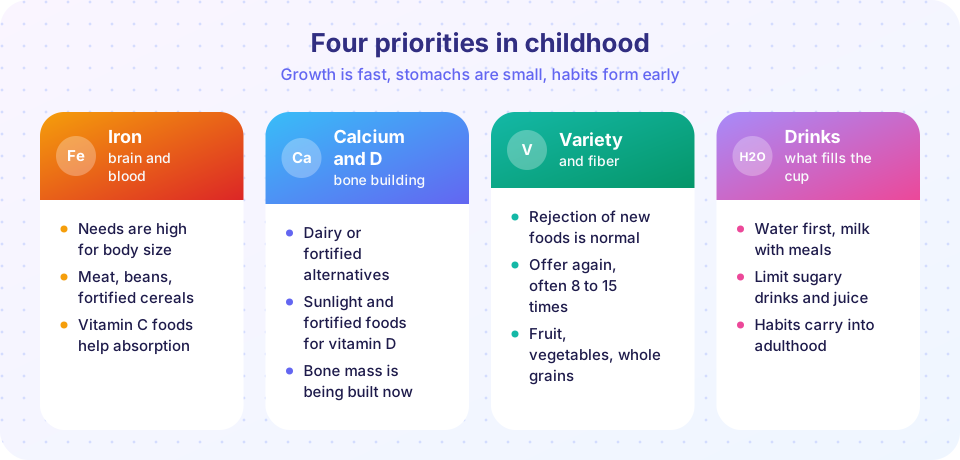
What you will learn
- How growth rate, appetite and energy needs change from toddlerhood to adolescence.
- Why iron, calcium and vitamin D need particular attention.
- How food preferences form and what research says about picky eating.
- How growth charts are read, and why the adolescent years are a key window for bone health.
Key terms
- Growth velocity: how fast a child grows, in cm or kg per year.
- Peak height velocity: the time of the fastest growth during the adolescent growth spurt.
- Food neophobia: fear or reluctance to try new foods, common between ages two and six.
- Percentile: the share of children of the same age and sex who are smaller or lighter than your child.
- Peak bone mass: the maximum bone mineral content reached, usually by the late twenties.
Growth and appetite
Weight and length rise fast in infancy, as the previous lesson showed, then slow down. A toddler may gain only about 2 to 3 kg per year, and parents often worry because the child eats less than expected. A child's appetite follows the growth rate, so a small appetite at age 3 is normal. Another change appears in the early school years: children usually gain a little more weight per year than they did as toddlers and grow steadily, about 5 to 6 cm per year, until puberty.
At puberty, growth speeds up again. Girls usually reach the fastest growth around ages 11 to 12 and boys around 13 to 14, with typical gains of roughly 8 to 10 cm a year at the peak. Energy and nutrient needs rise accordingly: teenage boys often need more energy than any other age group, which explains the large appetites.
Growth charts: how health is tracked
Growth charts compare a child to a reference population. The WHO Child Growth Standards (2006) describe how healthy, breastfed infants and young children grow in six countries and are used for children under five. For older children many countries use references such as the US CDC charts or national charts, which show weight, height and body mass index (BMI) for age and sex.
A percentile says where the child stands. The 50th percentile is the median: half of children weigh more, half less. What matters more than one measurement is the trajectory: a child who has tracked along the 25th percentile and moves to the 5th deserves attention even though both are "normal" numbers. In the CDC system for ages 2 to 19, BMI-for-age at or above the 85th percentile is classed as overweight and at or above the 95th as obesity, and under the 5th percentile as underweight. Percentile cut-offs are screening tools, not diagnoses, and a clinician considers growth history, build and family patterns.
Iron
Iron deficiency is the most common nutrient deficiency worldwide. Toddlers are at risk because they are growing fast and often drink a lot of cow's milk (low in iron) while accepting little meat. Teenage girls are at risk after menstruation begins. Teenage boys need it for the growth of muscle and blood volume. The RDAs show these peaks:
| Group | Iron RDA (mg/day) |
|---|---|
| 1-3 years | 7 |
| 4-8 years | 10 |
| 9-13 years | 8 |
| Boys 14-18 | 11 |
| Girls 14-18 | 15 |
Iron deficiency in early childhood can impair brain development, with effects on attention and learning that may not be fully reversible, which is why prevention is emphasized. Heme iron in meat, poultry and fish is absorbed well; non-heme iron in beans, lentils, fortified cereals and leafy greens is absorbed less well, but eating it with a vitamin C food (such as citrus, tomato or peppers) roughly improves absorption, while tea and coffee at the same meal reduce it.
Press Run (or Ctrl + Enter) to see the result here.
Program input · what you'd type while the program runs
Type the answers before you press Run, one per line. Each time the program reads a line (with input()), it gets the next line from this box.
Calcium, vitamin D and the bone bank
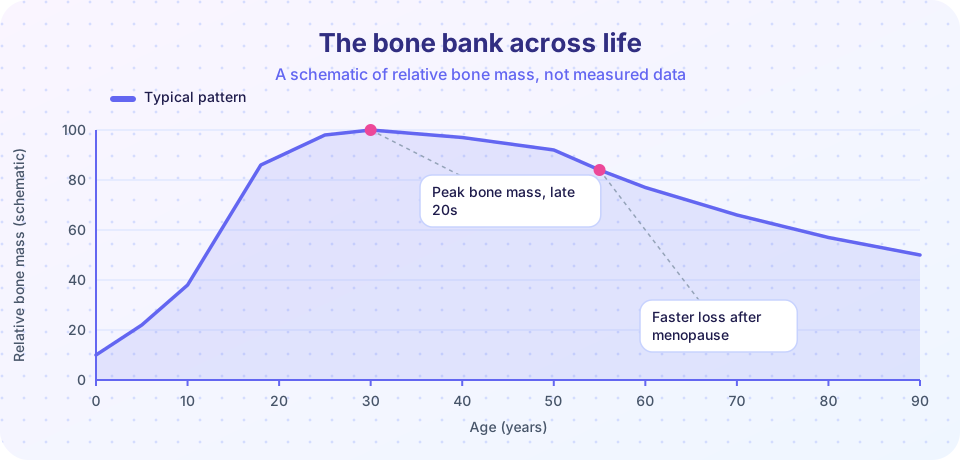
Bones are not inert. Throughout childhood they are built (modeling) and remodeled. About a quarter of adult bone mass is laid down in the roughly two years around peak height velocity, and peak bone mass is reached in the late twenties. After that, bone is gradually lost. A higher peak is like a bigger bank balance for later life: modeling studies suggest that raising peak bone mass by even a small amount could shift the age at which osteoporosis becomes a risk.
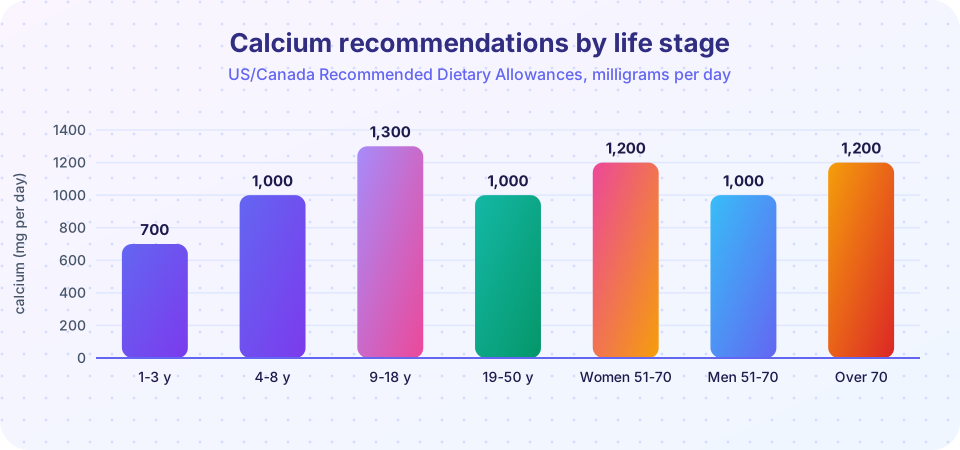
The calcium RDA is 1,300 mg a day for ages 9 to 18, the highest of any life stage, and 1,000 mg for 4 to 8 year olds. Vitamin D (15 micrograms, or 600 IU, from age 1) helps absorb calcium. Weight-bearing physical activity (running, jumping, sports) also builds bone and works together with the diet. The chart below shows how calcium recommendations change over the lifespan; the next lesson returns to it for adults.
Where does the calcium come from? Dairy foods are the main source in many countries (milk, yogurt, cheese). Alternatives include calcium-fortified plant milks and juices, tofu set with calcium salts, canned fish eaten with the bones, and some green vegetables such as broccoli and kale (but spinach's oxalate binds its calcium so little is absorbed). The tool below adds up a day's choices.
Variety, picky eating and habits
Many young children refuse new foods, especially bitter vegetables. This neophobia peaks between about 2 and 6 and probably had a protective role when children began to wander and might eat something poisonous. Studies of repeated exposure show that tastes are learned: children often need ten or more tastes of a new food before accepting it, so a refusal on day one does not mean dislike. Helpful practices that research supports include offering the food again without pressure, eating together and showing enjoyment yourself, serving small portions with a food the child already likes, and involving children in shopping and cooking. Pressure to eat tends to backfire and increase dislike.
A useful framework is Ellyn Satter's division of responsibility: adults decide what food is offered, when and where; the child decides whether to eat and how much. It keeps the adult in charge of the menu and the child in charge of hunger. For genuine concerns, such as weight falling across percentiles, gagging, a very limited diet or distress, seek professional advice; severe selectivity can indicate a feeding disorder.
Drinks and sugar
Sugar-sweetened beverages are the largest single source of added sugar for many teenagers, and observational studies and trials link them to weight gain and dental caries. The WHO suggests that free sugars should be under 10 percent of daily energy, and under 5 percent for additional benefit. Water and milk are the best everyday drinks. Fruit juice contributes sugar and little fiber and is usually limited in children's guidelines.
Adolescence: independence and risk
Teenagers choose more of their own food, skip breakfast more often and eat out more, so diets often drift toward lower calcium, fiber and fruit and vegetables. Vegetarian and vegan teenagers can eat well, but need a reliable source of vitamin B12, iron, calcium, iodine, zinc and omega-3 fats. This is also the period when eating disorders (such as anorexia nervosa, bulimia and binge eating disorder) most often begin. Warning signs include intense preoccupation with weight, rigid food rules, secretive eating and rapid weight change. They are serious illnesses, not lifestyle choices, and early treatment improves outcomes; a doctor should be involved.
Common misconceptions
- "My toddler eats almost nothing, so something is wrong." Appetite follows the slower toddler growth rate; look at the growth chart, not a single meal.
- "Children will starve themselves if I let them." Healthy children regulate intake well over days; the problem is when pressure or constant snacking disrupts this.
- "Calcium only matters for the elderly." Peak bone mass is built in youth, so the teenage years are the best time to invest.
Check your understanding
Quick check · 6 questions
of 6 answered You scored / 6 · perfect!
-
1. Why does a toddler's appetite often fall compared with infancy?
Growth velocity drops after infancy, so food intake falls with it. -
2. Which group has the highest calcium RDA?
At 1,300 mg a day, teens build most of their peak bone mass. -
3. How is a percentile best used?
A change of trajectory is often more informative than a single measurement. -
4. Which best matches research on food neophobia?
Repeated tasting without pressure helps preferences develop. -
5. Why do teenage girls have a higher iron RDA than boys of the same age (15 vs 11 mg)?
Menstruation adds to iron needs. -
6. What is peak bone mass?
After peak bone mass, bone is slowly lost, so building a higher peak early is protective.
Summary
- Growth slows after infancy, then surges in adolescence, and appetite follows.
- Iron and calcium with vitamin D are the nutrients to watch; teens build much of their bone mass.
- Growth charts show trajectories; repeated, pressure-free exposure widens food acceptance.
- Sugary drinks and eating disorders are important adolescent issues.
Next: Adulthood and older age
Track your progress
Create a free account to tick off lessons and pick up where you left off on any device.
of Nutrition Science lessons completed