


















Lesson 38 of 47 · Food Systems and Policy
Food security, the triple burden and sustainable diets
Understand the four pillars of food security, the triple burden of malnutrition, food loss and waste, the climate footprint of foods and what sustainable healthy diets look like.
Enough food is grown on Earth to feed everyone in terms of calories, yet hundreds of millions of people go hungry, many more lack key vitamins and minerals, and a still larger number live with overweight or obesity. At the same time, producing food is one of humanity's largest impacts on the planet. Two questions follow: how do we make sure everyone can eat well, and how do we do it without wrecking the land, water and climate that food depends on? This lesson sets out the concepts and the numbers, with the caveat that statistics in this field are estimates that change from year to year.
What you will learn
- The four pillars of food security and how food insecurity is measured.
- The triple burden of malnutrition and its main causes.
- How much food is lost or wasted, and why.
- The environmental footprint of different foods and what "sustainable diets" mean.
Key terms
- Food insecurity: lacking reliable access to enough safe, nutritious food.
- Stunting, wasting: low height for age (stunting) and low weight for height (wasting) in children, signs of chronic and acute undernutrition.
- Micronutrient deficiency ("hidden hunger"): too little of vitamins and minerals, such as iron, vitamin A, zinc or iodine, even when energy intake is adequate.
- Food loss and waste: food lost between farm and retail (loss) or discarded by shops, restaurants and households (waste).
- CO2-equivalent (CO2e): a unit that expresses the warming effect of different greenhouse gases as the amount of carbon dioxide that would have the same effect.
What food security means
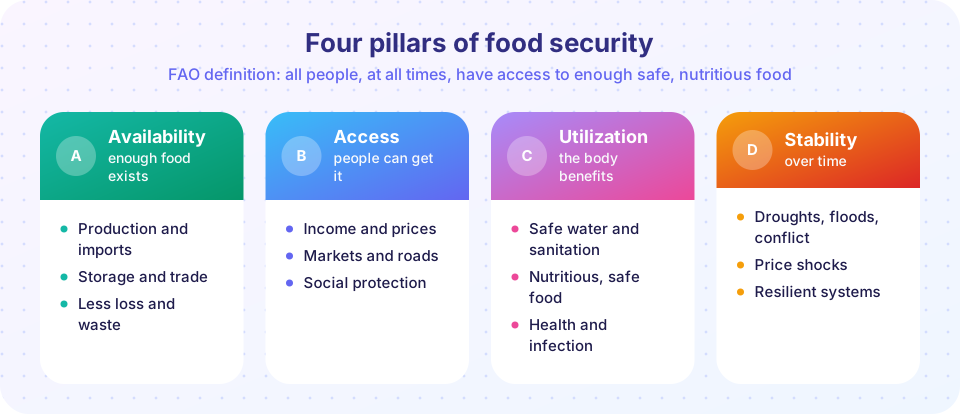
The FAO's definition says that food security exists when all people, at all times, have physical, social and economic access to sufficient, safe and nutritious food that meets their dietary needs and food preferences for an active and healthy life. From this follow four pillars:
- Availability: enough food is produced, stored and traded.
- Access: people can afford and reach it. Poverty, not absolute shortage, is the commonest cause of hunger today.
- Utilization: the body can use the food: it must be safe and nutritious, and people must be free of repeated infections. Poor water and sanitation cause diarrhea, which wastes nutrients.
- Stability: the first three hold over time, despite droughts, floods, conflict and price spikes.
Hunger is tracked by FAO's Prevalence of Undernourishment and by survey-based scales of experience, such as the Food Insecurity Experience Scale. According to FAO's State of Food Security and Nutrition reports, roughly 730 million people, about one in eleven people worldwide, faced hunger in 2023, and billions could not afford a healthy diet. Progress stalled in the late 2010s and was set back by conflict, climate shocks and the COVID-19 pandemic. Because definitions and data vary, check the latest report for current figures.
The triple burden of malnutrition
Malnutrition has three faces that often coexist in the same country, community or even household:
- Undernutrition. In 2022, roughly 148 million children under five were stunted and about 45 million were wasted (UN/WHO/World Bank estimates). Stunting reflects the early-life period discussed in the lifespan chapter, with lasting effects on health and learning.
- Micronutrient deficiencies. Iron-deficiency anemia, vitamin A deficiency (a leading cause of preventable childhood blindness), zinc and iodine deficiency affect billions, mainly in low-income settings, but iron and vitamin D deficiencies occur in rich countries too.
- Overweight and obesity. The WHO estimated that in 2022 about 890 million adults lived with obesity and that overweight and obesity were also rising among children, including in low- and middle-income countries. Cheap, energy-dense, ultra-processed foods and inactive lifestyles are the main drivers, set against the biology of weight regulation described in chapter 5.
Solutions that address only one face can worsen another. A program that adds calories without nutrients can raise obesity; a campaign against obesity must not push families into undernutrition. Strategies that improve the quality of diets (access to fruit, vegetables, legumes, animal-source foods in small amounts, and fortified staples) tackle all three at once.
Press Run (or Ctrl + Enter) to see the console output here.
No output.
Food loss and waste
The FAO has estimated that about a third of food produced for people is lost or wasted. More recent work by the UN Environment Programme estimated that in 2019 households, restaurants and retailers wasted around 931 million tonnes of food, about 17 percent of the food available to consumers, with households responsible for well over half. Food is lost on the farm and in storage because of pests, mold, poor roads and lack of cold chains in lower-income countries, and wasted at the consumer end in richer ones, through over-buying, confusion about date labels and large portions.
Wasted food carries wasted land, water, fertilizer and fuel, and food rotting in landfill releases methane. Preventing waste is therefore among the most efficient ways to improve food security and reduce emissions at once. Practical measures include better storage and cold chains, clear date marking, portion control, planning, composting and redistributing surplus food.
The environmental footprint of food
The global food system produces roughly a third of human-caused greenhouse gas emissions (estimates are about 30 to 35 percent), uses around 70 percent of freshwater withdrawals, takes up about half of habitable land, and is a leading driver of biodiversity loss and of the pollution of waterways by fertilizer. Impacts vary widely between foods:
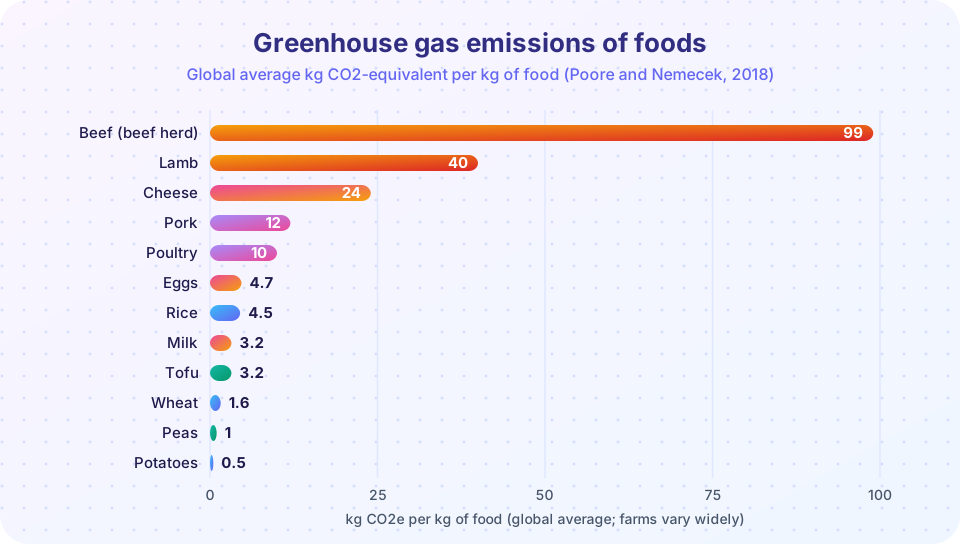
The figures come from a widely cited analysis of about 38,000 farms in 119 countries (Poore and Nemecek, 2018), and they show consistent patterns:
- Ruminant meat (beef, lamb) and cheese have the highest footprints per kilogram, because cattle and sheep need land and feed and produce methane.
- Pork, poultry and eggs are lower; fish varies with fishing and farming methods.
- Legumes, grains, vegetables, fruit and nuts have much lower footprints. Transport matters less than many people expect: for most foods it accounts for only a small share of emissions, with land use and farming dominating.
- Variation within a food can be bigger than the gap between foods: well-run low-impact beef can have a smaller footprint than poorly produced high-impact alternatives, though not below plant proteins.
Press Run (or Ctrl + Enter) to see the result here.
Program input · what you'd type while the program runs
Type the answers before you press Run, one per line. Each time the program reads a line (with input()), it gets the next line from this box.
Sustainable healthy diets
FAO and WHO define sustainable healthy diets as patterns that promote health and wellbeing, have low environmental impact, are accessible, affordable, safe and equitable, and are culturally acceptable. The 2019 EAT-Lancet Commission proposed a "planetary health diet" of mostly vegetables, fruits, whole grains, legumes, nuts and unsaturated oils, with small amounts of fish and poultry and little red meat, refined grains and added sugar, and estimated that wide adoption could prevent a large number of premature deaths while keeping food production within planetary boundaries. It has been criticized for the cost of the diet in low-income countries and for assumptions about nutrient adequacy, which illustrates a general point: no single recipe fits every region. In places where undernutrition is common, small amounts of animal-source foods can be valuable, while in high-consumption countries moving toward plant-rich diets benefits both health and environment.
Other levers are on the production side (more efficient farming, better manure and fertilizer management, restoring soils), the supply side (cutting loss and waste, storage and processing) and the demand side (changing diets). No single lever suffices.
Common misconceptions
- "The world cannot feed everyone." Global calorie supply exceeds need; hunger is mainly about poverty, access, conflict and waste.
- "Eating local is always greener." Transport is a small part of the footprint for most foods; what you eat usually matters more than where it came from.
- "A vegan diet is the only sustainable one." Plant-rich diets reduce impact, but sustainability is a spectrum; nutritional adequacy and context matter.
- "Obesity and hunger are opposites." They often coexist, sometimes in the same family.
Check your understanding
Quick check · 6 questions
of 6 answered You scored / 6 · perfect!
-
1. Which is NOT one of the four pillars of food security?
The pillars are availability, access, utilization and stability. -
2. What is the 'triple burden of malnutrition'?
All three can exist in the same population. -
3. Roughly what share of food produced is lost or wasted, by the FAO's widely cited estimate?
Later estimates for retail and consumer waste alone are about 17 percent of food available. -
4. Which food has the highest average emissions per kilogram in the Poore and Nemecek data?
Beef from beef herds is near 100 kg CO2e per kg; potatoes are around 0.5. -
5. Why can transport be a small part of a food's footprint?
Production usually outweighs transport, though air freight is an exception. -
6. What is stunting?
Wasting is low weight for height; stunting is low height for age.
Summary
- Food security needs availability, access, utilization and stability; poverty and conflict drive most hunger.
- The triple burden of malnutrition means undernutrition, hidden hunger and obesity often coexist.
- About a third of food is lost or wasted; cutting waste helps people and the climate.
- Foods differ greatly in footprint: ruminant meat and cheese highest, plants lowest.
Track your progress
Create a free account to tick off lessons and pick up where you left off on any device.
of Nutrition Science lessons completed