


















Lesson 46 of 47 · Projects and Practice
Cheat sheet: the numbers and rules to remember
A two-page visual cheat sheet of key formulas, reference values, study designs and food system rules from energy balance to food policy, plus a quick converter.
This page is a revision sheet for the second half of the course. It condenses the main formulas, numbers and rules into two illustrated pages and a handful of conversions you will use repeatedly. Print it, screenshot it or keep it open while you work through the projects. It is a memory aid, not a substitute for understanding: each item links back to the lesson where the reasoning lives.
What you will learn
- The formulas and reference values most worth memorizing.
- Which rules of thumb have limits you should remember.
- How to convert between common units quickly.
Page 1: energy and life stages
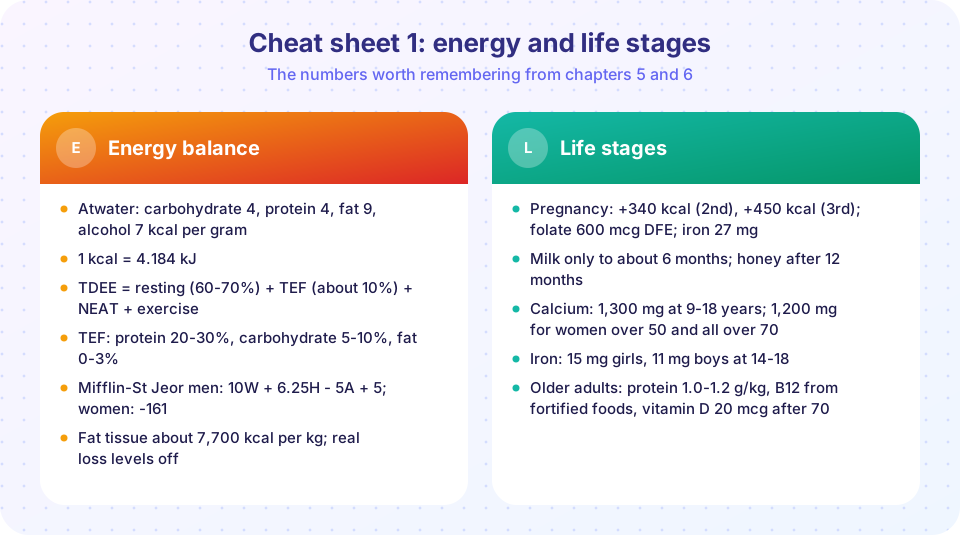
Where to review: units and Atwater factors, expenditure, weight regulation, pregnancy and infancy, childhood and teens and older age.
Page 2: evidence and food systems
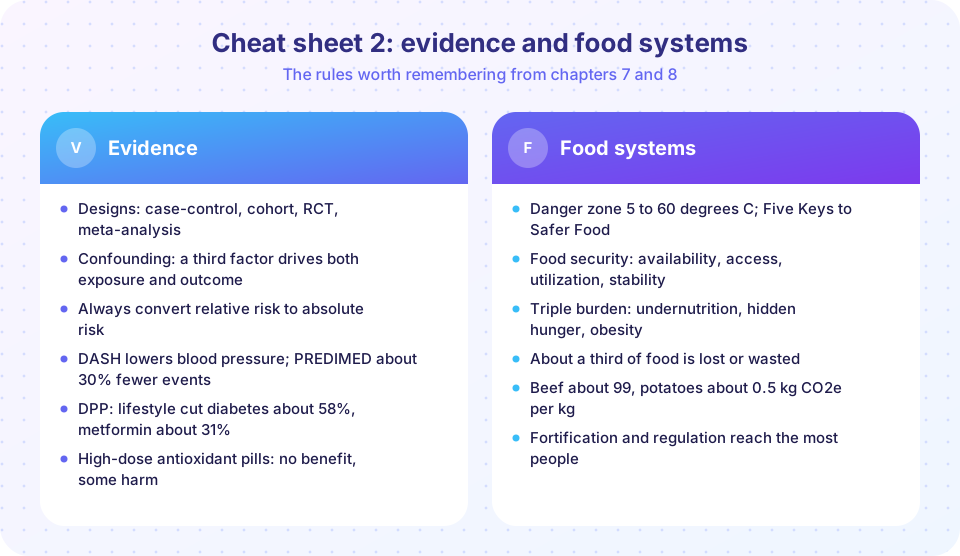
Where to review: study designs, heart disease and diabetes, claims and fads, food safety and labels, security and sustainability and guidelines and policy.
Formulas on one screen
Energy from food:     kcal = 4 x carbohydrate g + 4 x protein g + 9 x fat g + 7 x alcohol g
Units:                kJ = kcal x 4.184
Mifflin-St Jeor:      men 10W + 6.25H - 5A + 5; women 10W + 6.25H - 5A - 161
TDEE:                 BMR x activity factor (1.2 / 1.375 / 1.55 / 1.725 / 1.9)
Energy availability:  (intake - exercise energy) / fat-free mass; below 30 kcal per kg FFM is low
Macronutrient grams:  carbohydrate or protein = kcal x share / 4; fat = kcal x share / 9
Fiber target:         14 g per 1,000 kcal
Salt and sodium:      salt g = sodium g x 2.5
Relative risk:        risk exposed / risk unexposed
Absolute risk diff.:  risk exposed - risk unexposed; NNT = 1 / difference
Elasticity:           quantity change % = price change % x elasticity
Bacterial growth:     cells = 2 ^ (time / doubling time)
Rules of thumb with their limits
- 7,700 kcal per kg of fat. Right for tissue, wrong as a fixed exchange rate over months: expenditure and appetite adapt.
- Activity factors. Conventions with big individual errors.
- DRIs. Targets for groups of healthy people, judged over time, not tests for one day or one person.
- Relative risk. Meaningless without the baseline risk.
- Danger zone 5 to 60 degrees C. A simple guide; growth speeds depend on the organism and food.
- Averages for emissions. Farms and methods vary widely.
Worked problems using the cheat sheet
Try these before running the code, then compare with the recall drill.
Problem 1: label energy. A snack bar has 6 g of protein, 12 g of fat and 30 g of carbohydrate. Energy is 6 x 4 + 12 x 9 + 30 x 4 = 24 + 108 + 120 = 252 kcal, or about 1,054 kJ. Fat supplies 108 of the 252 kcal, about 43 percent, more than its gram share suggests, because fat is energy dense.
Problem 2: expenditure. A 28-year-old man weighs 80 kg and is 180 cm tall. His BMR is 10 x 80 + 6.25 x 180 - 5 x 28 + 5 = 800 + 1,125 - 140 + 5 = 1,790 kcal. With a moderate activity factor of 1.55, TDEE is about 2,775 kcal. A 15 percent deficit would be about 2,360 kcal, and with protein at 1.6 g per kg his target is 128 g, or 512 kcal, which is about 22 percent of the plan.
Problem 3: risk. A study reports that a food is linked to a relative risk of 1.30 for a disease with a baseline risk of 2 percent. The risk in the exposed group is 2.6 percent, an absolute increase of 0.6 percentage points, and about 167 people would have to be exposed for one extra case if the link were causal.
Problem 4: safety. A pot of soup was left at room temperature for four hours. With a 20-minute doubling time, bacteria could in theory multiply 2 to the power of 12, about 4,000 times. Real growth is slower, but this is why the two-hour rule exists.
Problem 5: policy. A tax raises the price of a drink by 15 percent, and elasticity is -1.2. Purchases change by 1.15 to the power of -1.2 minus 1, which is about -15.4 percent.
Try it
A quick converter for the units and conversions you will use most. Change the numbers and read the results.
Press Run (or Ctrl + Enter) to see the console output here.
No output.
Check your understanding
Quick check · 5 questions
of 5 answered You scored / 5 · perfect!
-
1. How many kcal are in 40 g of carbohydrate and 10 g of fat?
40 x 4 = 160 plus 10 x 9 = 90, total 250 kcal. -
2. Which is the Mifflin-St Jeor sex constant for women?
Men add 5; women subtract 161. -
3. How many grams of salt contain 2,000 mg of sodium?
2 g sodium x 2.5 = 5 g salt. -
4. NNT is calculated as...
An absolute difference of 0.02 gives an NNT of 50. -
5. Which is the correct pairing?
Bacteria multiply quickly between refrigerator and hot-holding temperatures.
Summary
- Memorize the 4-4-9-7 energy factors, the BMR equation, the DRIs for key life stages, the study designs and the Five Keys.
- Remember each rule's limits: estimates, group targets and averages are not individual answers.
- Use the converter and drills to build fluency.
Next: Further study
Track your progress
Create a free account to tick off lessons and pick up where you left off on any device.
of Nutrition Science lessons completed